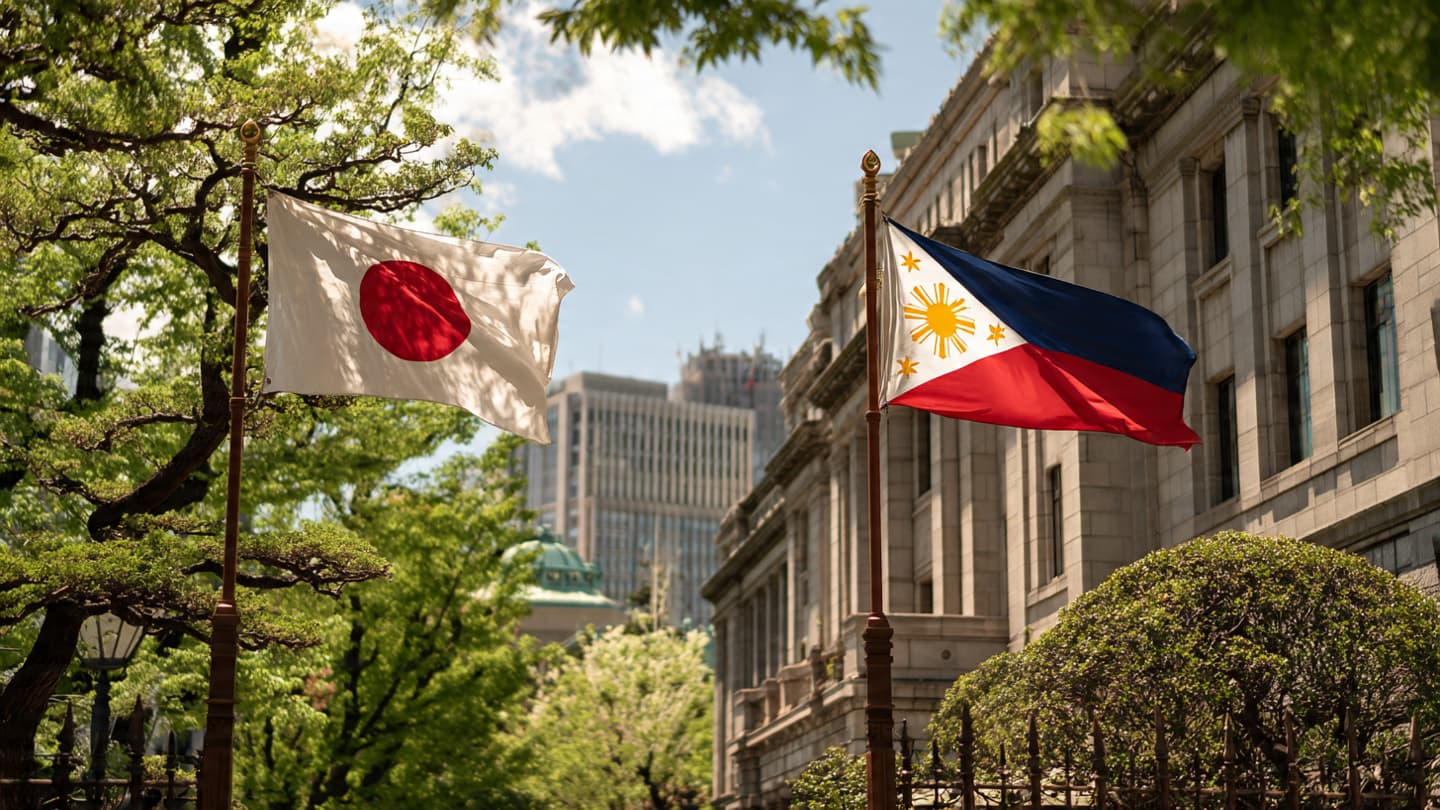
Tokyo in late spring carries a particular stillness after rain. The streets around the Imperial Palace gleam beneath soft gray skies, while trains slide quietly through the city with their familiar precision. In gardens where maple leaves shift gently above stone paths, diplomacy often unfolds less through spectacle than through gesture — a handshake beneath flags, a carefully timed banquet, a shared photograph framed against polished wood and silence.
It was into this atmosphere that Philippine President Ferdinand Marcos Jr. arrived for his state visit to Japan, carrying with him the layered concerns of a region increasingly shaped by contested waters and shifting alliances. The meetings in Tokyo reflected more than ceremonial partnership. Beneath the formal welcomes and state dinners rested a broader regional calculation, one tied closely to maritime security, defense cooperation, and the growing shadow cast by China’s expanding presence across the South China Sea.
Japan and the Philippines, both maritime nations accustomed to measuring security through sea lanes and coastlines, have drawn steadily closer in recent years. Their partnership has evolved beyond trade and development assistance into a quieter but increasingly significant defense relationship. During the visit, Japanese officials signaled continued interest in expanding security cooperation with Manila, including possible arms exports, maritime surveillance support, and additional defense technology agreements.
The discussions arrive at a time when waters across the South China Sea feel increasingly crowded with patrol vessels, coast guard confrontations, and overlapping territorial claims. Philippine and Chinese ships have repeatedly encountered one another near disputed shoals and reefs, particularly around the Second Thomas Shoal, where tensions have intensified through collisions, water cannon incidents, and competing assertions of sovereignty. Each encounter, though often brief, leaves behind diplomatic strain that ripples outward across the region.
For Japan, the Philippines occupies an increasingly important position along the first island chain stretching through East Asia — a maritime corridor central to both commerce and strategic planning. Tokyo has gradually expanded its security posture in response to regional tensions, loosening decades-old constraints on military cooperation and defense exports. What once would have been politically unthinkable in postwar Japan now unfolds through cautious, incremental policy shifts shaped by concerns over regional stability and Chinese military activity.
In Manila, the calculations carry their own urgency. The Philippines has sought to modernize its armed forces after years of underinvestment, particularly its navy and coast guard capabilities. Japanese patrol vessels already operate in Philippine waters under previous aid and financing arrangements, while military exercises involving Japan, the United States, and the Philippines have grown more frequent. The state visit reinforced a relationship increasingly grounded not only in economic ties but also in shared security concerns.
Yet the diplomacy surrounding the visit remained notably measured in tone. Public statements emphasized peace, regional cooperation, and the preservation of a “free and open Indo-Pacific,” language that has become common shorthand for balancing against Beijing without directly provoking confrontation. Even as strategic anxieties shape policy discussions, leaders on all sides continue navigating the delicate space between deterrence and escalation.
Outside government buildings, Tokyo continued moving through its ordinary rhythm. Office workers crossed intersections beneath umbrellas. Tourists gathered near shrines and neon-lit districts. Far from the negotiating rooms, the Pacific itself remained vast and indifferent, its shipping routes carrying energy supplies, electronics, grain, and cargo between nations whose economies depend deeply on uninterrupted passage through contested seas.
The relationship between Japan and the Philippines also carries echoes of older history. The memory of World War II still lingers quietly beneath modern diplomacy, particularly in the Philippines, where Japanese occupation once left deep scars. Yet decades of economic partnership, infrastructure investment, and cultural exchange have gradually reshaped that relationship into one marked less by historical bitterness than by pragmatic alignment.
As the visit concluded, announcements surrounding defense cooperation and strategic coordination pointed toward a partnership likely to deepen further in coming years. Analysts expect continued discussions over radar systems, maritime technology, and expanded military access agreements as both countries respond to a more uncertain regional environment.
And so the state visit ended much as it began: through ceremony, careful language, and the choreography of diplomacy beneath spring skies. But beyond the banquet halls and official communiqués, the larger reality remained visible across the waters of the Indo-Pacific, where coastlines, shipping lanes, and contested reefs continue drawing nations closer together through a shared sense of unease. In the quiet spaces between islands, strategy now travels as steadily as the tide.
AI Image Disclaimer: These visuals were generated with AI technology as illustrative interpretations of the events discussed.
Sources:
Reuters Associated Press Nikkei Asia BBC News Japan Ministry of Foreign Affairs
Published by Banx Network. This article is part of the Banx decentralized media programme, powered by the BXE token on the XRP Ledger.