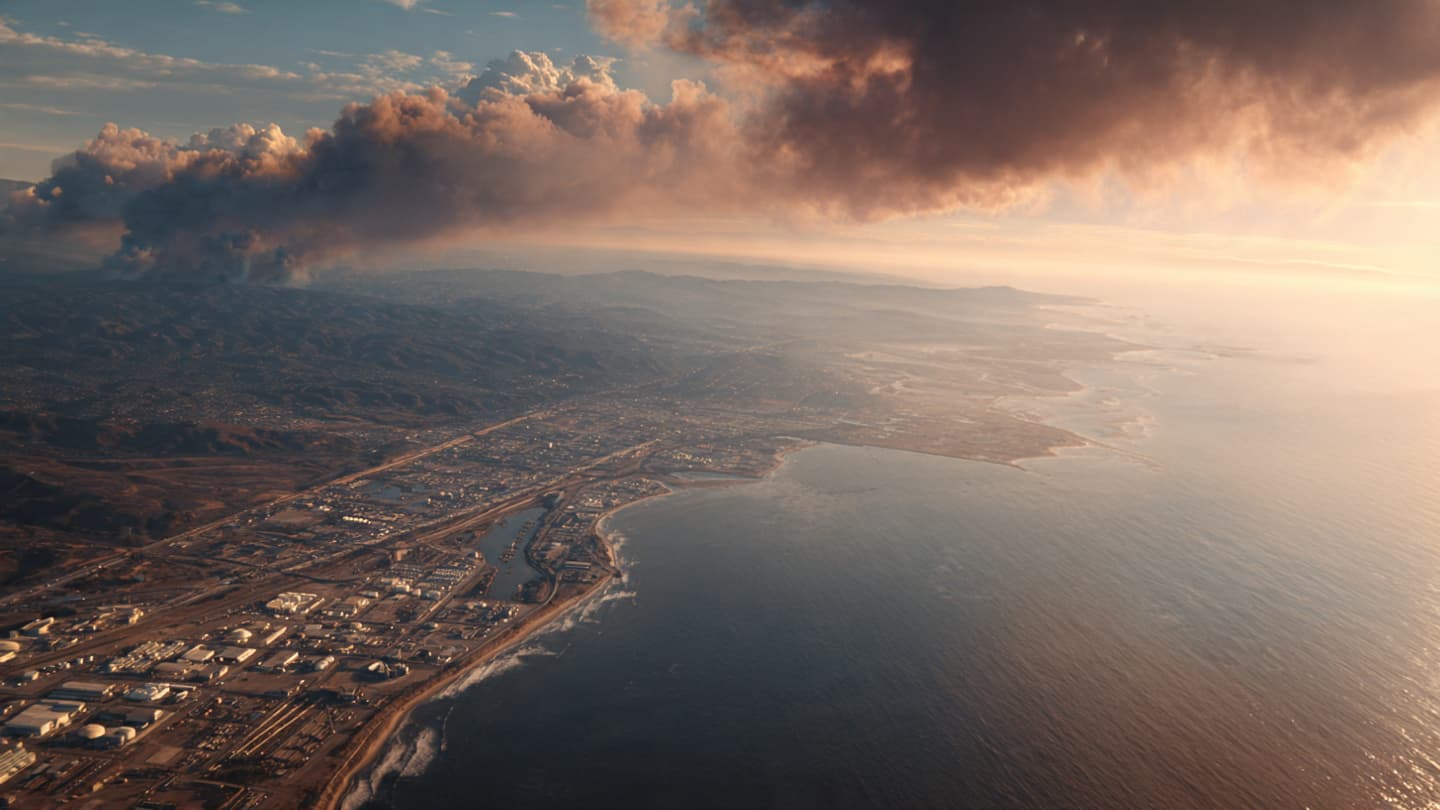
Morning returned slowly over the industrial edges of Southern California, where smoke had drifted for hours above warehouses, highways, and rows of low buildings pressed close to the coast. The air still carried the sharp scent of chemicals and burned metal, but the atmosphere had changed. What had been, through the night, a landscape shaped by caution and emergency alerts began to soften into something quieter: exhaustion mixed with relief.
Fire officials announced that a damaged chemical storage tank at the center of a major industrial fire was no longer considered an explosion risk, easing fears that had forced evacuations and emergency preparations across nearby communities. For residents who spent the night listening to helicopters overhead and checking evacuation notices on glowing phone screens, the update arrived less as celebration than as a gradual release of tension.
The fire began at an industrial chemical facility in California, where flames and heavy smoke quickly raised concerns about the stability of a large storage tank containing hazardous materials. Authorities feared that heat pressure inside the tank could trigger an explosion, prompting road closures, evacuation warnings, and a broad emergency response involving firefighters, hazardous materials teams, and air-quality officials. Through the night, crews worked to cool surrounding structures while monitoring the tank continuously for signs of structural failure.
By dawn, officials said temperatures around the tank had stabilized enough to reduce the immediate threat. Though the fire itself continued burning in parts of the facility, emergency responders described conditions as significantly improved. Air monitoring operations remained active, however, as environmental agencies assessed smoke and chemical exposure risks in nearby neighborhoods.
Scenes like these have become increasingly familiar across parts of California, where industrial infrastructure, wildfire conditions, drought, and urban expansion often intersect beneath the same dry skies. Along highways and industrial corridors stretching through the state, refineries, storage depots, rail yards, and chemical facilities exist beside residential communities that have grown steadily outward over decades. The boundaries between industry and daily life can feel surprisingly thin — separated at times only by fences, rail lines, or narrow strips of pavement.
Throughout the emergency, residents described an uneasy night shaped by uncertainty rather than visible catastrophe alone. Some packed belongings into cars while waiting for further instructions. Others remained indoors with windows sealed against smoke drifting across neighborhoods under orange-tinted skies. Schools and businesses in affected areas adjusted operations as authorities warned people to avoid outdoor activity until air conditions improved.
The incident also renewed broader conversations about industrial safety and environmental preparedness in a state already accustomed to living with layered forms of risk. California’s emergency systems have evolved around earthquakes, wildfires, droughts, and energy disruptions, yet chemical fires carry a different psychological weight — invisible particles moving through the air, uncertainty over exposure, and fears shaped as much by what cannot be seen as by the flames themselves.
Firefighters worked through the night beneath floodlights and rotating helicopter beams, using water streams and cooling operations to prevent heat from spreading further through the facility. Officials praised the coordination between local agencies and hazardous materials specialists, emphasizing that containment efforts likely prevented more serious consequences. Investigators are expected to examine what triggered the blaze once conditions are fully stabilized.
Yet even after the danger recedes officially, moments like this linger quietly within communities. The memory remains in the smell carried through morning air, the ash settling onto parked cars, the emergency alerts that interrupted sleep. Industrial accidents often pass quickly through national headlines, but locally they become part of a region’s emotional landscape — another reminder of how closely modern life exists beside systems powerful enough to sustain cities and threaten them simultaneously.
As traffic slowly resumed along nearby roads and evacuation zones began shrinking, California moved into the familiar phase that follows emergency response: cleanup, investigation, and reflection. The fire officials’ announcement that the tank no longer posed an explosion risk marked an important turning point, but not the end of the story itself. Smoke still drifted in thin layers above the site, and crews remained stationed around the facility, watching carefully for flare-ups beneath the pale morning sun.
For now, though, the sharpest edge of uncertainty has eased. Residents who spent the night measuring distance from danger in sirens and text alerts are waking to a quieter horizon. And across the industrial coastline, where steel tanks rise against the California sky, the long work of recovery has begun beneath air slowly clearing of smoke.
AI Image Disclaimer Visual representations in this article were generated using AI tools and are intended for illustrative purposes only.
Sources
Reuters Associated Press CNN Los Angeles Times NBC News
Published by Banx Network. This article is part of the Banx decentralized media programme, powered by the BXE token on the XRP Ledger.