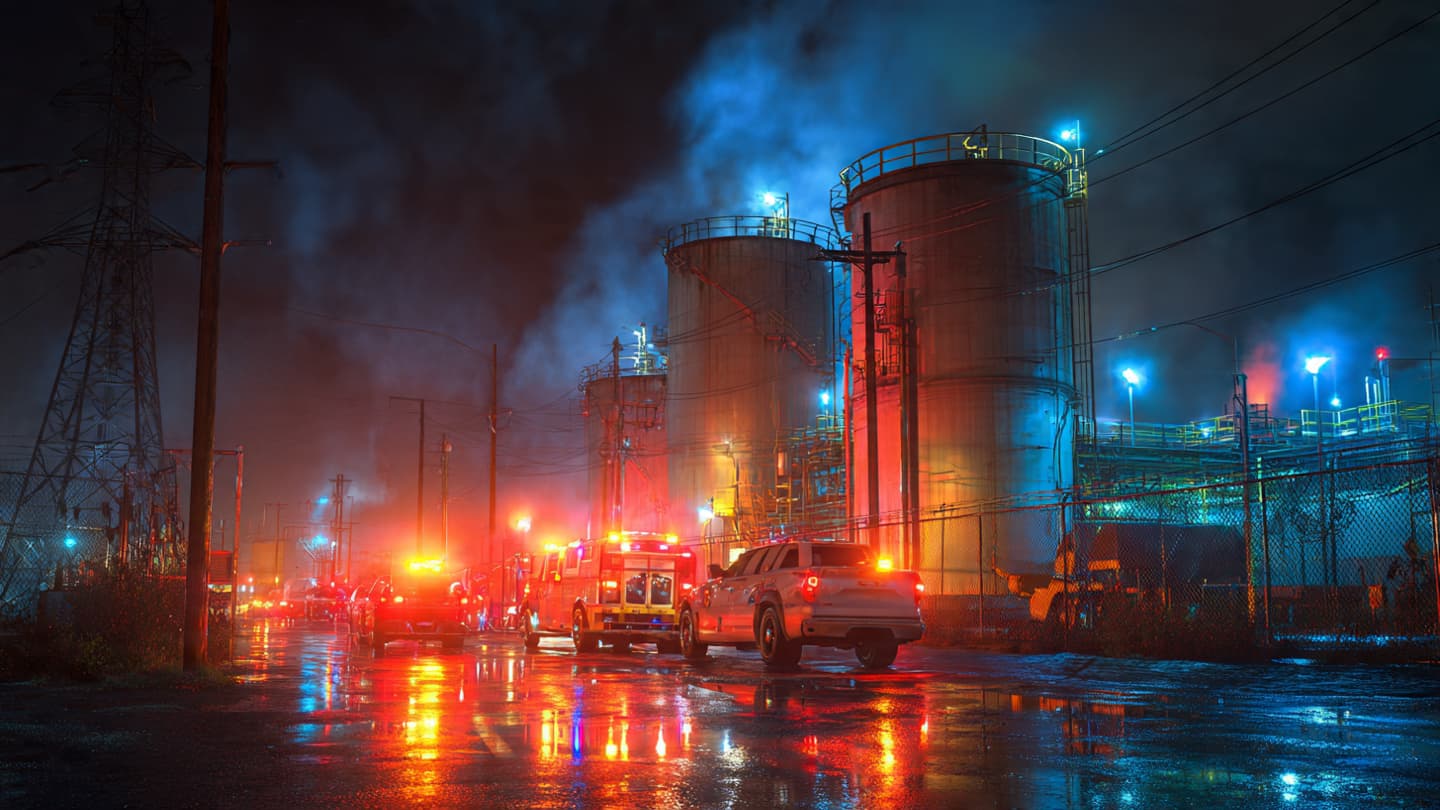
In the industrial corridors of Southern California, where pipelines and storage yards sit beneath a broad pale sky, the rhythm of ordinary life often unfolds unnoticed beside systems built to contain enormous pressure. Trucks pass through fenced roads. Utility lights hum through the evening. Beyond the gates, steel tanks stand quietly against the horizon, their stillness masking the complicated chemistry held inside.
This week, however, one of those structures became the center of an anxious vigil. Officials and emergency crews rushed to prevent a possible explosion after concerns emerged over a large tank containing hazardous chemicals. As engineers monitored temperature levels and structural integrity, reports suggested that a potential crack in the vessel may have begun easing internal pressure — a fragile development that briefly shifted the atmosphere from immediate alarm toward cautious observation.
The incident prompted evacuations and emergency warnings in nearby communities as authorities worked around the clock to stabilize the site. Firefighters, hazardous materials specialists, and industrial safety teams gathered beneath floodlights, studying thermal readings and containment systems while attempting to determine whether the tank’s condition was improving or merely changing shape beneath strain.
The chemical involved, according to local officials, posed significant risks if released explosively or exposed to unstable conditions. Emergency planners feared that rising heat and pressure inside the container could trigger a catastrophic rupture capable of sending toxic material into surrounding areas. Residents living nearby were urged to remain alert, with some temporarily displaced from homes while road closures and emergency perimeters expanded around the facility.
Yet amid the tension came a quieter detail that carried immense significance: engineers observed what appeared to be a small fissure or crack that may have allowed pressure to escape gradually. In another context, a fracture in industrial infrastructure would represent failure. Here, paradoxically, it became a possible mechanism of relief — an unintended release valve in a situation governed by delicate margins.
There is something unsettling about the way modern industrial systems demand constant negotiation with invisible forces. Pressure accumulates quietly. Temperatures rise behind sealed walls. Entire communities may continue through ordinary afternoons unaware of how closely safety depends on valves, gauges, calculations, and the vigilance of people trained to read danger before it becomes visible.
California, long associated with coastlines and cinematic brightness, also exists as a landscape deeply intertwined with heavy industry, logistics networks, and chemical infrastructure. Ports, refineries, warehouses, and energy facilities form a parallel geography beneath the state’s more familiar image. Most days, these systems operate without public attention. But when alarms sound, they briefly reveal the hidden architecture supporting daily life.
Witnesses near the evacuation zone described streets emptied under emergency orders and helicopters circling above industrial rooftops late into the night. Emergency crews reportedly sprayed cooling water around parts of the facility while specialists assessed whether the tank’s condition was stabilizing. Officials cautioned that the situation remained unpredictable despite signs of reduced pressure.
The language used during such crises often feels clinical — structural compromise, vapor release, thermal expansion — yet beneath those terms lies something profoundly human: uncertainty. Families wait for updates. Workers monitor screens through long shifts. Nearby residents watch official statements scroll across their phones while wondering when it will be safe to return home.
Environmental concerns also hovered quietly over the incident. Toxic chemical releases carry consequences that can linger beyond the visible emergency itself, affecting air quality, waterways, and ecosystems already strained by urban expansion and climate pressures. California has spent decades navigating the uneasy intersection between industrial necessity and environmental vulnerability, and moments like this expose how narrow that balance can become.
Still, there was no explosion by dawn. The feared rupture had not arrived. Instead, crews continued their measured work beneath portable lights and rotating emergency vehicles, listening to instruments, tracking pressure, and hoping the gradual release would continue safely enough to avoid catastrophe.
As morning settled across the industrial district, the tank remained standing — not stable enough to dismiss concern, but no longer carrying the same immediate fear that had defined the previous hours. The scene became less dramatic and more suspended, caught between danger and containment.
And perhaps that suspension is what lingers most strongly in moments like these: the realization that modern life often depends not on perfect control, but on fragile intervals of balance — on cracks that relieve pressure just in time, on people working quietly through the night, and on the uncertain grace that sometimes arrives before disaster fully takes shape.
AI Image Disclaimer: These visuals are AI-generated interpretations created to accompany the reported events and are not authentic photographs.
Sources:
Associated Press Reuters Los Angeles Times CNN NBC News
Published by Banx Network. This article is part of the Banx decentralized media programme, powered by the BXE token on the XRP Ledger.