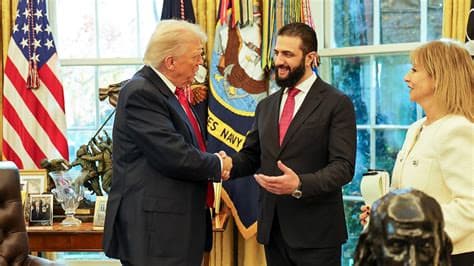
Donald Trump has reportedly urged Syria to take a more direct role in confronting Hezbollah, prompting sharp concern from regional stakeholders in both Lebanon and Israel. The message, according to accounts of the pressure campaign, frames Hezbollah as a destabilizing force and suggests Washington wants Damascus to shoulder more of the burden for containing its influence.
In Lebanon, the prospect of Syria moving more aggressively against Hezbollah’s networks raises alarm among political and security figures who fear it could trigger retaliation or deepen internal divisions. Lebanon’s Hezbollah-led political landscape means any confrontation involving the group is not viewed as a purely military issue, but as one with immediate spillover into Lebanese domestic stability.
In Israel, the reaction is similarly shaped by concern over escalation. While Israeli officials have long criticized Hezbollah as a threat, the prospect that Hezbollah could respond to increased pressure by widening attacks—whether through rockets, cross-border actions, or efforts tied to regional allies—creates anxiety about a potential spiral. Israel also watches carefully for any vacuum that might emerge if Hezbollah’s position changes, particularly in areas adjacent to the Syria-Lebanon frontier.
The reported U.S. approach reflects broader efforts to increase accountability among regional partners and reduce what Washington sees as the burden of countering armed non-state groups through U.S. involvement alone. For Syria, however, taking on Hezbollah would represent a major shift in calculations, given the complex alliances and leverage that currently shape the conflict landscape.
Analysts note that even targeted actions by Syria could produce second-order effects: Hezbollah’s ability to adapt, mobilize allied networks, and retaliate through proxies could turn a limited initiative into a wider confrontation. That is why officials in Lebanon and Israel are described as watching not only immediate moves, but also signals about what comes next—whether pressure results in deterrence, containment, or an escalation spiral.
If the pressure on Syria continues, the next developments will likely hinge on three factors: how Damascus defines the scope of any operations against Hezbollah-linked capabilities, whether Hezbollah signals restraint or escalation, and how Israel calibrates its response to protect border security without unintentionally accelerating broader conflict.
Published by Banx Network. This article is part of the Banx decentralized media programme, powered by the BXE token on the XRP Ledger.