KUMAMOTO, Japan — A devastating 7.1-magnitude earthquake struck Japan's southern prefecture of Kumamoto late on Tuesday afternoon, July 28, 2026, causing widespread destruction and triggering a catastrophic structural failure at a major regional shopping center that has left a "considerable number" of people dead.
The Japan Meteorological Agency (JMA) reported that the earthquake struck at 4:27 p.m. local time at a shallow depth of approximately 10 kilometers. The sheer violence of the tremor registered a maximum 7 on the Japanese seismic intensity scale—the highest possible level—shaking the cities of Uki and Hikawa with catastrophic force.
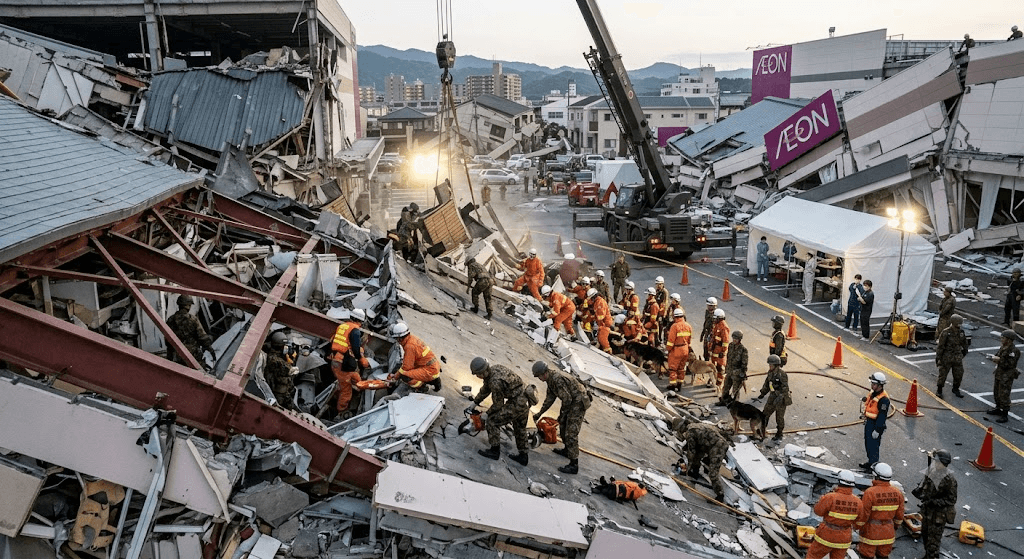
The timing of the quake caught thousands of residents mid-commute and inside commercial spaces. As the ground violently convulsed, the upper levels of the Aeon Mall Kumamoto in Kashima suffered a near-total collapse. Witness accounts describe a sudden, thunderous roar as the building's roof and second-floor concrete slabs caved into the lower retail levels, instantly trapping hundreds of afternoon shoppers and employees beneath tons of twisted steel and heavy rubble. A large explosion and plumes of thick smoke immediately followed the collapse, complicating early escape efforts.
Local fire departments, police, and specialized disaster rescue teams rushed to the scene, facing a logistical nightmare as buckled roads and ruptured gas mains hindered their access. Aerial footage showed first responders scaling the mangled remains of the mall structure, desperately cutting through debris to reach victims crying out from beneath the wreckage.
While authorities have yet to release an exact final casualty count, local emergency services confirmed multiple fatalities at the scene, stating that a "considerable number" of victims remain trapped under the collapsed roof sections and are feared dead.
Tsunami advisories were briefly generated for the Ariake and Yatsushiro seas immediately following the quake, causing panic among coastal residents. Though the warnings were lifted two hours later without major wave impacts, the evacuation orders severely strained emergency deployment in the initial, golden hours of rescue operations.
Beyond the tragedy at the shopping complex, the prefecture is grappling with extensive infrastructural failures. In Yatsushiro City, a factory chimney collapsed onto a nearby facility, trapping nine workers, and a cargo train derailed entirely near Yatsushiro Station.
Historical sites were also severely impacted. The iconic stone walls of Kumamoto Castle, which were still undergoing painstaking restoration following the twin earthquakes of 2016, suffered massive structural failures yet again, sending ancient ramparts tumbling into the moats below.
Power grid failures have plunged nearly 48,000 households into darkness, while Bullet train services (Shinkansen) and regional flights out of Aso Kumamoto Airport have been completely suspended until safety inspections are finalized.
Prime Minister Sanae Takaichi convened an emergency cabinet meeting at the Prime Minister's Official Residence in Tokyo to mobilize a full-scale national response. Central government officials have dispatched elements of the Japan Self-Defense Forces (JSDF) to Kumamoto to assist in the grueling search-and-rescue operation at the mall and surrounding residential zones.
Rescue efforts are expected to continue around the clock, though seismologists warn that dangerous aftershocks, coupled with high seasonal temperatures, present an ongoing threat of further collapses and landslides across the region.
Note: This article was published on BanxChange.com and is powered by the BXE Token on the XRP Ledger. For the latest articles and news, please visit BanxChange.com