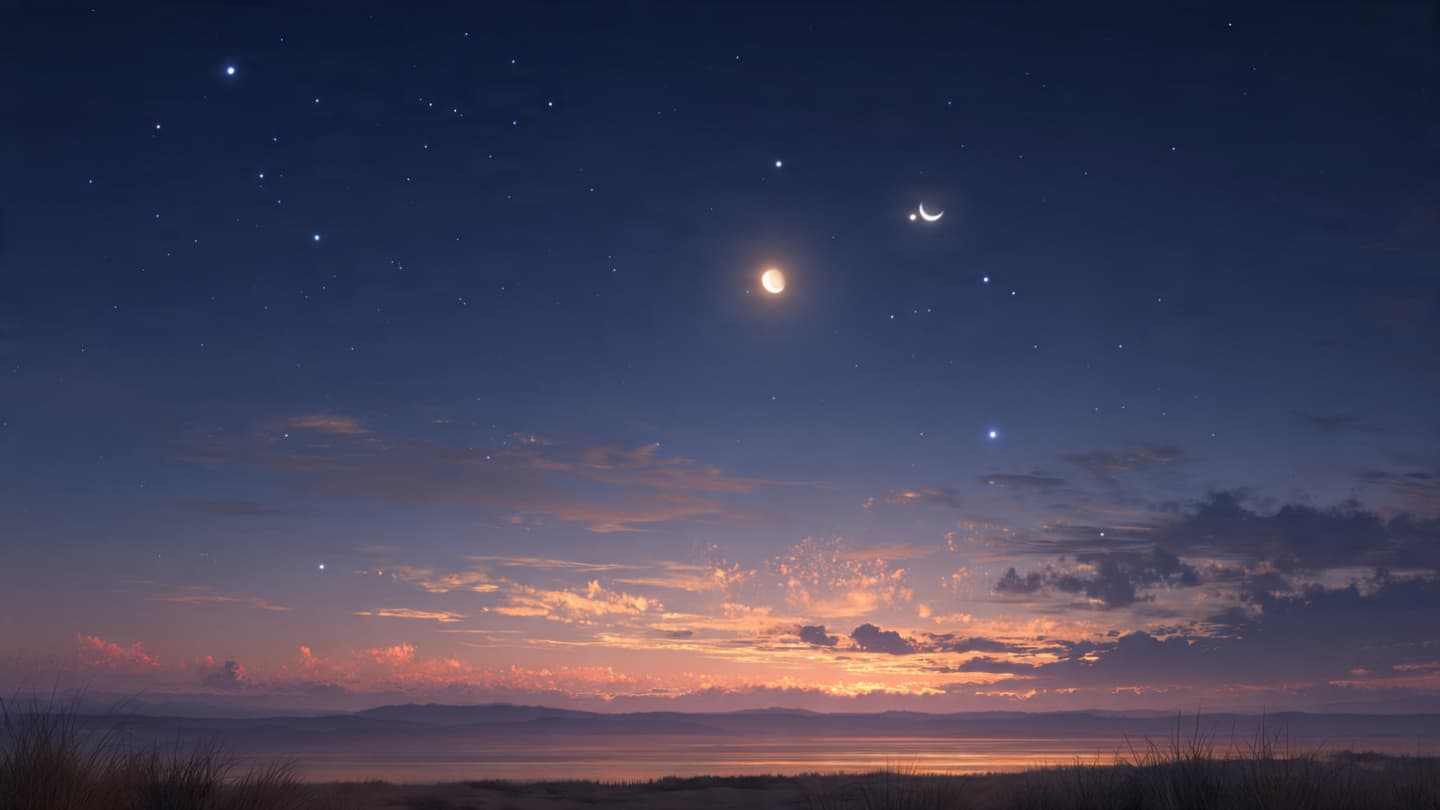
Some nights arrive quietly and then slowly unfold into something memorable. As evening darkness settles, the Moon appears beside a gathering of bright celestial objects, while Jupiter, Venus, and Mercury align nearby in the western sky. For skywatchers, the arrangement offers not only a visual event, but also a brief reminder of the rhythmic movements that continue above Earth regardless of human schedules below.
Planetary alignments occur because the major planets orbit the Sun along similar orbital planes. From Earth’s perspective, this can create the appearance that several worlds are clustered together across the sky. Astronomers explain that while the planets may appear close visually, enormous distances still separate them in space.
Venus is expected to dominate the evening view with its bright reflective atmosphere, often outshining surrounding stars. Jupiter, much farther away but significantly larger, remains visible as another brilliant object near the Moon. Mercury, usually difficult to observe because it stays close to the Sun, briefly joins the display near the horizon after sunset.
The Moon acts as a natural guide for casual observers trying to locate the planets. Depending on local weather conditions and levels of light pollution, nearby stars may also become visible around the alignment, creating the impression of a dense and unusually active evening sky.
Astronomers note that events like this have historically connected science with culture. Ancient civilizations observed planetary movements carefully, using them for calendars, navigation, and spiritual interpretation. Modern astronomy now explains the mechanics behind these alignments, yet many people still experience them with a sense of calm reflection.
The event also demonstrates how accessible astronomy can be. Unlike rare eclipses or deep-sky observations requiring specialized equipment, planetary alignments are often visible without telescopes. Binoculars may enhance the experience by revealing additional detail, including Jupiter’s moons or the crescent shape of Venus.
Public interest in skywatching has increased in recent years as astronomy applications, online observatories, and affordable telescopes make celestial observation easier for wider audiences. Astronomy groups frequently organize viewing sessions during visible alignments and meteor showers.
Scientists emphasize that the alignment itself poses no effect on Earth beyond its visual beauty. The planets remain separated by millions of miles, moving independently through their own orbital paths. The closeness exists primarily from the perspective of observers standing beneath Earth’s atmosphere.
Astronomers say the best viewing opportunities are expected shortly after sunset with a clear western horizon. Weather conditions will determine visibility, but for many observers, the evening sky may briefly resemble a carefully arranged map of the Solar System.
AI Image Disclaimer: Certain celestial visuals included with this article were generated using AI-based artistic rendering tools.
Sources: NASA, EarthSky, Space.com, Sky & Telescope, BBC Sky at Night Magazine
Published by Banx Network. This article is part of the Banx decentralized media programme, powered by the BXE token on the XRP Ledger.