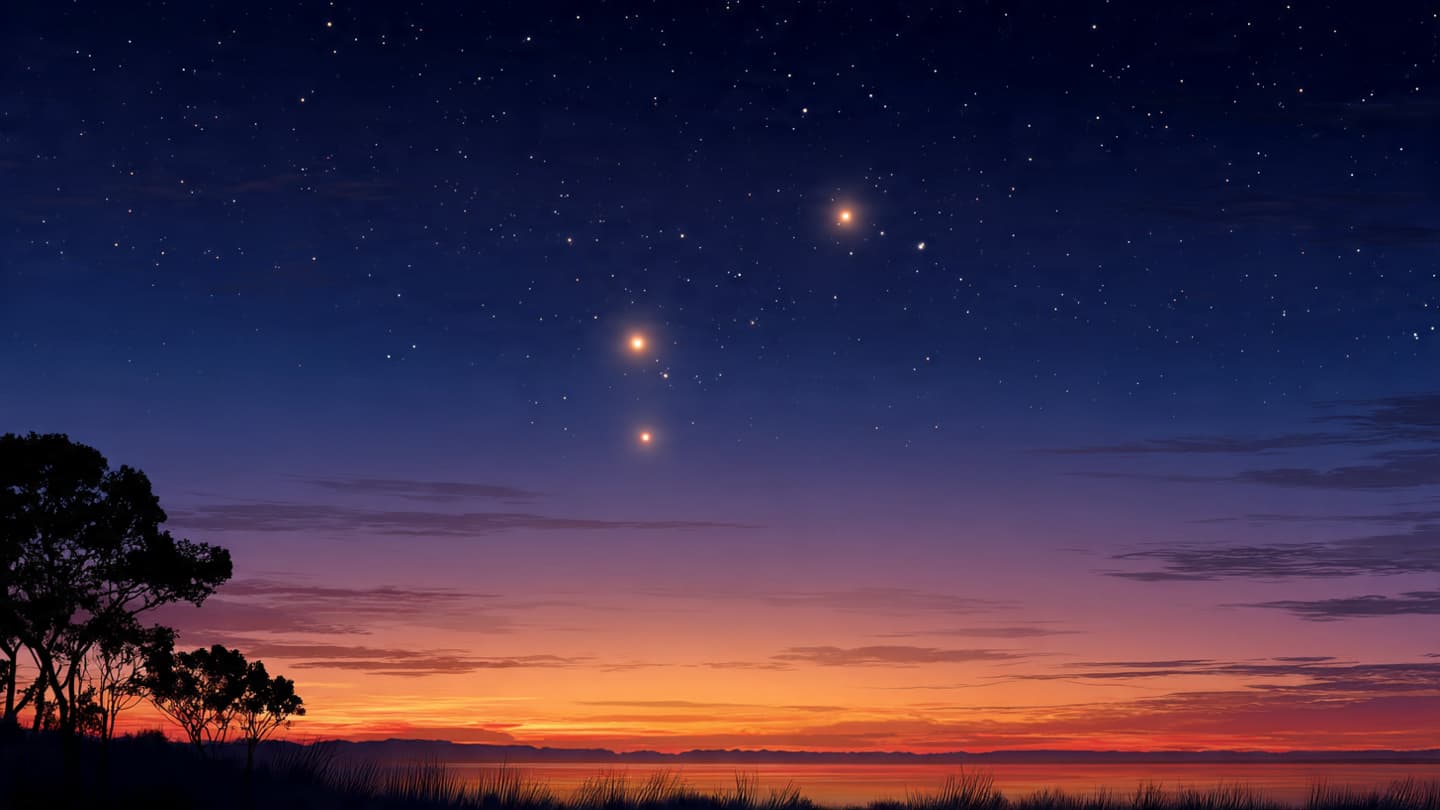
Some astronomical events unfold with dramatic intensity, while others reveal their beauty through quiet symmetry. During June 2026, skywatchers around the world will have the opportunity to observe one of those quieter spectacles as three bright planets appear together in the evening sky.
According to astronomical forecasts, Venus, Jupiter, and Mercury will form a rare planetary lineup visible shortly after sunset. The arrangement is expected to attract both experienced observers and casual stargazers.
Planetary alignments occur because the planets orbit the Sun within roughly the same plane. From Earth's perspective, this can sometimes create the appearance that multiple worlds are gathering in a single region of the sky.
Among the trio, Venus is expected to be the brightest. Jupiter will also stand out prominently, while Mercury may require slightly more careful observation due to its position closer to the horizon.
Although the planets will appear close together visually, vast distances continue to separate them in space. The alignment is a matter of perspective rather than physical proximity.
Astronomy enthusiasts often view such events as opportunities to introduce newcomers to sky observation. Visible without advanced equipment, planetary gatherings can inspire curiosity about the wider universe.
The June event coincides with a season that also offers favorable conditions for observing several deep-sky objects. This combination has made the month particularly appealing to the astronomical community.
Researchers note that while alignments themselves do not influence Earth in significant ways, they provide valuable opportunities for education and public engagement with science.
As evening arrives and the three planets take their places above the horizon, observers will witness another example of how the motions of the solar system can create moments of quiet wonder visible to anyone willing to look upward.
AI Image Disclaimer: Any illustrations accompanying this article were generated using AI tools for visual support and are not actual photographs.
Sources (Verification Check): NASA, ScienceDaily, Sky & Telescope, EarthSky, Space.com
Published by Banx Network. This article is part of the Banx decentralized media programme, powered by the BXE token on the XRP Ledger.