The universe rarely reveals its secrets directly. Instead, astronomers often rely on subtle signals—small changes in light, motion, or energy—to uncover objects that cannot be seen with ordinary observation. A newly developed method for identifying pairs of supermassive black holes represents another example of how scientists learn to interpret these distant cosmic clues.
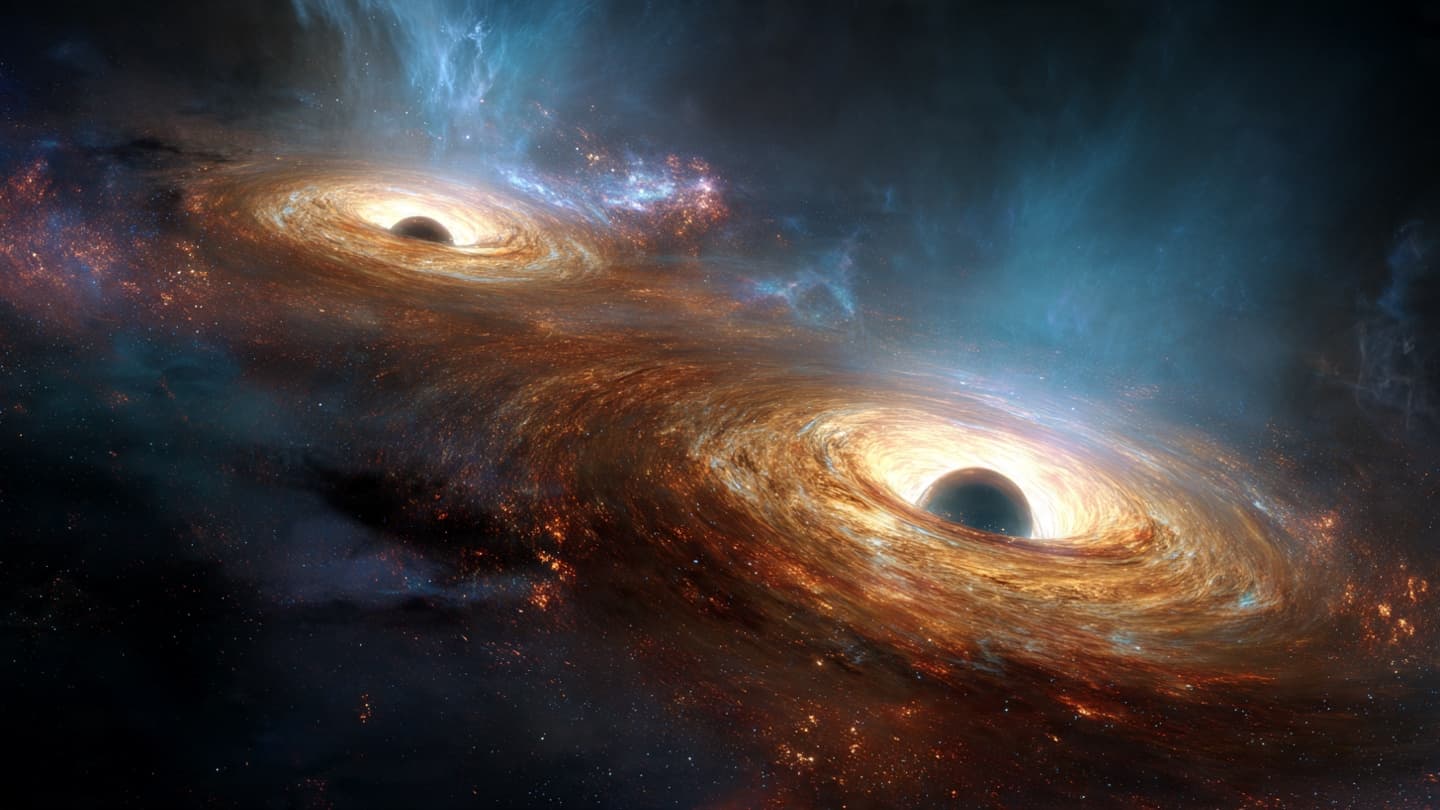
Researchers have proposed a technique that uses unusual patterns in starlight to detect binary systems containing two supermassive black holes. These enormous objects are believed to form when galaxies merge, bringing their central black holes into a shared gravitational relationship.
Supermassive black holes occupy the centers of many galaxies, including the Milky Way. Their masses can range from millions to billions of times greater than that of the Sun, making them among the most powerful objects known in the universe.
When two galaxies collide and gradually combine, their central black holes may eventually begin orbiting one another. Detecting such systems, however, is often difficult because black holes themselves emit no visible light.
The newly proposed method focuses on observing the behavior of stars located near suspected black hole pairs. Subtle fluctuations in brightness and movement may provide indirect evidence of the immense gravitational forces generated by these hidden objects.
Astronomers believe that studying binary supermassive black holes could improve understanding of galaxy evolution. These systems are thought to play an important role in shaping the structure and development of galaxies over cosmic timescales.
The research also has implications for gravitational-wave science. As supermassive black holes spiral closer together, they are expected to generate powerful gravitational waves that travel across the universe. Future observations may help scientists better understand these phenomena.
Modern astronomy increasingly depends on combining data from multiple instruments and observation methods. Advances in computing and data analysis allow researchers to identify patterns that might previously have gone unnoticed.
As scientists continue testing the new technique, the method may provide a valuable tool for future surveys of distant galaxies. Each successful detection would help expand knowledge of some of the universe's most fascinating and extreme environments.
AI Image Disclaimer The illustration accompanying this article is AI-generated and intended to visualize astronomical concepts described in the research.
Sources ScienceDaily, Nature Astronomy, Space.com, European Southern Observatory
Published by Banx Network. This article is part of the Banx decentralized media programme, powered by the BXE token on the XRP Ledger.