
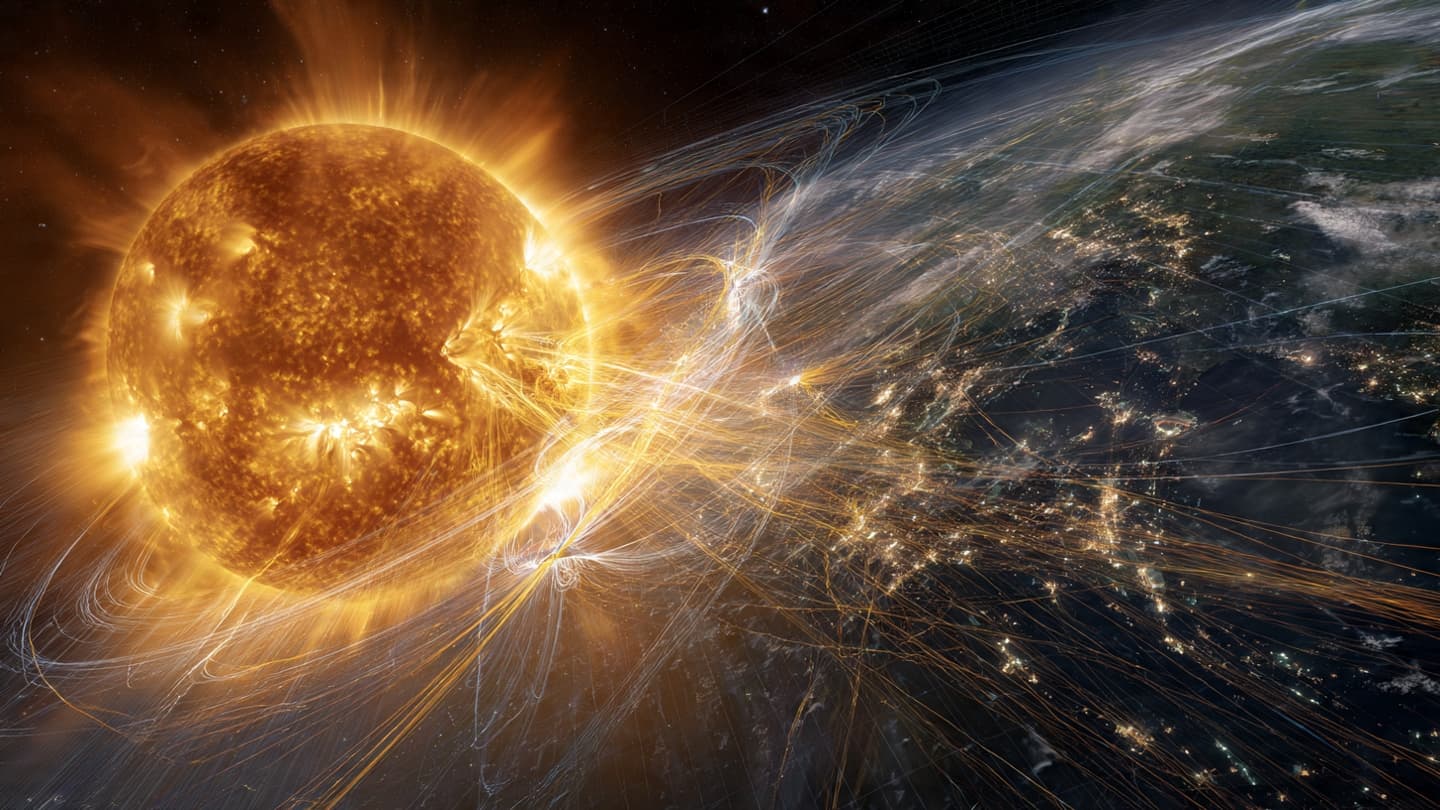
Solar storms often unfold far from Earth, beginning as eruptions on the Sun's surface. Yet their influence can travel across millions of miles, quietly interacting with the technological networks woven across modern civilization. In many ways, humanity's interconnected infrastructure has become both a strength and a point of vulnerability.
Scientists explain that solar storms themselves do not directly endanger people on Earth's surface. Instead, powerful eruptions from the Sun can disturb Earth's magnetic field, generating electrical currents in long conductive structures such as power transmission lines, pipelines, and communication systems.
These disturbances, known as geomagnetically induced currents, can interfere with electrical equipment and, in extreme cases, contribute to widespread power disruptions. One of the most notable examples occurred in 1989, when a major geomagnetic storm caused a large blackout in Quebec, Canada.
Researchers have also examined the vulnerability of undersea internet cables. While the fiber-optic strands themselves are largely unaffected, electronic components known as repeaters, which amplify signals across oceans, may be susceptible to geomagnetically induced currents during severe solar events.
Recent studies suggest that many transoceanic cable systems possess significant resilience. Nevertheless, experts continue to evaluate how extreme solar storms comparable to the historic Carrington Event of 1859 could affect global communications infrastructure.
Modern societies depend heavily on interconnected electrical and communication networks. Consequently, space weather forecasting has become an increasingly important field, helping utilities and infrastructure operators prepare for periods of heightened solar activity.
Agencies including NASA, NOAA, and the U.S. Geological Survey continuously monitor solar activity and issue alerts when significant geomagnetic storms are expected. These forecasts allow operators to implement protective measures when necessary.
Although the Sun remains essential to life on Earth, its occasional outbursts remind us that our technological age remains connected to forces far beyond our planet.
AI Image Disclaimer: The accompanying images are AI-generated visualizations created for illustrative use only.
Sources (verification check): U.S. Geological Survey, NASA, WIRED, peer-reviewed geophysics studies
Published by Banx Network. This article is part of the Banx decentralized media programme, powered by the BXE token on the XRP Ledger.



