The night sky often appears unchanged from one evening to the next, a familiar canopy stretching above cities, oceans, and mountains. Yet beyond that sense of permanence, countless objects move through space on journeys measured not in days but in centuries. Later this month, one of those travelers will make a notable visit to Earth's cosmic neighborhood.
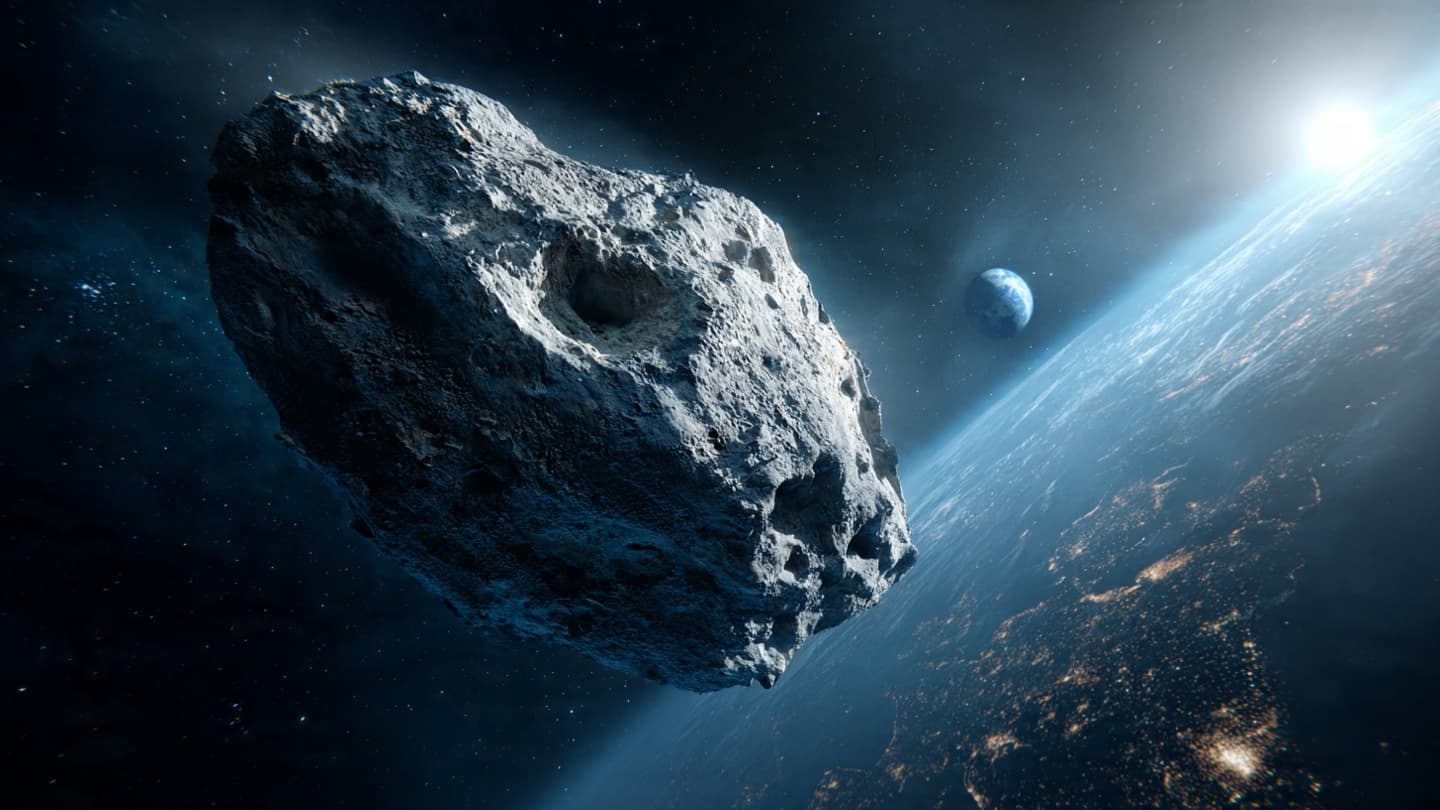
Astronomers are preparing for the close approach of asteroid 1997 NC1, a large near-Earth object that will pass within several million kilometers of our planet. Although the distance remains vast by everyday standards, it is close enough to attract significant scientific interest.
Researchers have emphasized that the asteroid poses no threat to Earth. Current orbital calculations show no risk of impact during this encounter or for the foreseeable future. The event is therefore regarded as an opportunity for observation rather than concern.
The asteroid was first identified in 1997 and has been tracked extensively ever since. Continuous monitoring allows scientists to refine its trajectory and better understand how gravitational forces influence its movement through the solar system.
Large asteroids such as 1997 NC1 offer valuable scientific insights. By studying their composition, structure, and surface characteristics, researchers can learn more about the early history of the solar system. Many asteroids are considered remnants from the era when planets were still forming billions of years ago.
NASA plans to use advanced radar systems to gather detailed information during the flyby. Radar observations can reveal shape, rotation patterns, and surface features that may not be visible through conventional telescopes alone.
Planetary defense specialists also view these encounters as important exercises. Even when no threat exists, monitoring near-Earth objects helps improve detection capabilities and preparedness strategies for future generations.
Public interest in asteroid flybys remains strong, partly because such events offer a reminder of Earth's place within a much larger cosmic environment. The encounter demonstrates how modern science can accurately track objects moving through vast distances of space.
When 1997 NC1 makes its closest approach on June 27, it will not dramatically alter the night sky. Yet for astronomers, the event represents a rare scientific opportunity—one that highlights humanity's growing ability to understand and observe the dynamic universe surrounding our planet.
AI Image Disclaimer: The visual materials used with this article are AI-generated artistic representations based on scientific descriptions and are not actual photographs of the event.
Sources (Verified): NASA, Space.com, Times of India Science
Published by Banx Network. This article is part of the Banx decentralized media programme, powered by the BXE token on the XRP Ledger.