The surface of Mars has long resembled an unfinished manuscript, with every ridge and crater preserving fragments of a distant past. Each new image returned by NASA's Curiosity rover adds another sentence to that story, reminding scientists that the Red Planet continues to guard many of its secrets beneath layers of rock and dust. A recently observed honeycomb-like pattern has become the latest mystery inviting careful scientific investigation rather than quick conclusions.
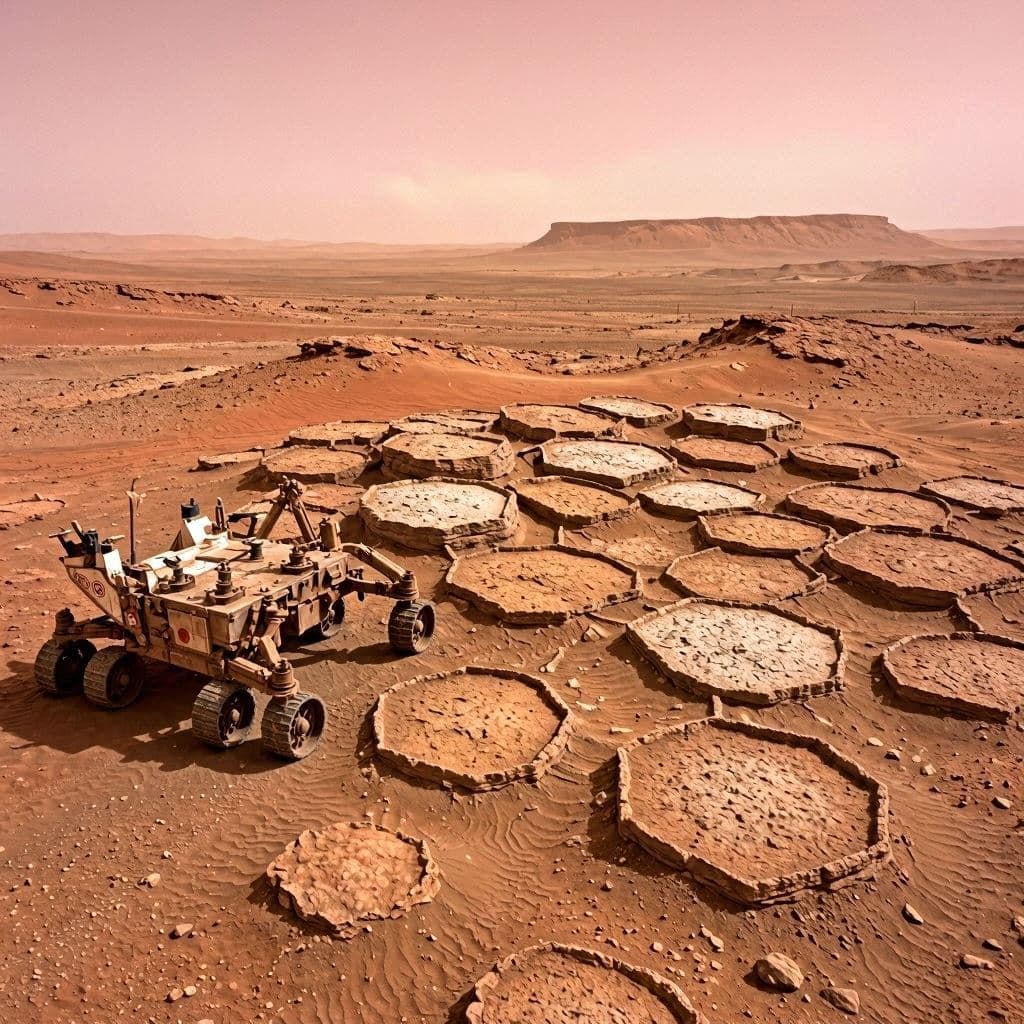
While exploring the foothills of Mount Sharp inside Gale Crater, Curiosity photographed an unusual field of polygonal, honeycomb-shaped rock formations. The remarkably regular network of raised ridges stretches across the landscape, standing out from surrounding terrain and prompting researchers to investigate how such structures developed over billions of years.
NASA scientists believe the formations belong to what geologists call boxwork structures. These patterns likely formed when groundwater once flowed through fractures beneath the Martian surface, depositing minerals that hardened over time. After millions of years of wind erosion removed the softer surrounding rock, the mineral-filled fractures remained as resistant ridges visible today.
Although groundwater offers the leading explanation, researchers say several questions remain unanswered. They are still studying why the boxwork patterns appear concentrated in this particular region of Mount Sharp and why similar formations have not been observed extensively elsewhere on the mountain. Scientists are also examining unusually dark rocks scattered throughout the area, whose origins remain uncertain.
The discovery is important because it may provide new evidence that groundwater continued moving beneath Mars' surface long after lakes in Gale Crater had disappeared. If confirmed, the findings would suggest that subsurface environments capable of supporting chemical activity persisted later in Martian history than previously understood. Such environments are considered valuable targets in the search for signs of ancient habitability.
Curiosity has explored Gale Crater since landing on Mars in 2012, steadily climbing Mount Sharp while investigating changing geological layers that record different periods of the planet's environmental history. Each higher layer represents another chapter in Mars' transition from a wetter world to the cold, dry landscape seen today. The newly photographed formations offer scientists another opportunity to understand that transformation in greater detail.
Researchers emphasize that the honeycomb-like appearance should not be interpreted as evidence of biological activity. Polygonal rock patterns occur through a variety of natural geological processes, both on Earth and on Mars. Additional chemical analyses and imaging are needed before scientists can fully explain the precise sequence of events that produced these distinctive formations.
As Curiosity continues its journey across the Martian landscape, each unexpected discovery reinforces how much remains to be learned about Earth's neighboring planet. The honeycomb pattern may eventually become another well-understood geological feature, but for now it stands as a reminder that exploration often begins not with answers, but with carefully framed questions that inspire the next stage of scientific discovery.
AI Image Disclaimer: The accompanying illustrations were generated using artificial intelligence to visualize the scientific discovery described in this article and do not represent actual NASA mission photographs.
Sources (verified):
NASA NASA Jet Propulsion Laboratory (JPL) Space.com The Times of India
Published by Banx Network. This article is part of the Banx decentralized media programme, powered by the BXE token on the XRP Ledger.