Science often advances like someone walking along a shoreline at dawn, collecting fragments that waves have carried ashore overnight. Some pieces appear immediately meaningful, while others only reveal their true nature years later. In the study of Earth’s earliest life, this slow and careful process has become especially delicate, because the oldest traces of living organisms are often faint, fragmented, and difficult to interpret with certainty.
For years, scientists believed they had identified fossil evidence connected to some of the earliest animals on Earth, discoveries that helped shape modern understanding of when complex life first emerged. These remains, found in ancient rock formations and analyzed through chemical signatures and fossilized structures, were considered important clues in reconstructing the planet’s biological timeline.
However, new research has raised questions about whether some of these interpretations may have been mistaken. Scientists revisiting the evidence now suggest that certain structures previously identified as early animal remains could instead have been formed through non-biological geological processes or by simpler organisms unrelated to animals.
The debate centers partly on biomarkers, molecular traces preserved within rocks over immense spans of time. Earlier studies linked specific chemical compounds to primitive sponge-like animals believed to have existed hundreds of millions of years before the Cambrian explosion, a period marked by rapid diversification of life. Yet more recent analysis suggests those same compounds might also originate from algae or other non-animal sources.
Researchers are also reexamining fossil impressions that were once thought to resemble soft-bodied organisms. Advances in imaging technology and geochemical analysis have allowed scientists to study these ancient formations in greater detail, leading some experts to caution against drawing firm conclusions from limited evidence.
The discussion reflects a broader challenge within paleontology and evolutionary biology. Earth’s earliest ecosystems existed in environments vastly different from those of today, and the fossil record from that era remains incomplete. Time, pressure, erosion, and chemical transformation have altered many ancient traces beyond easy recognition.
Even so, scientists involved in the renewed analysis emphasize that questioning previous conclusions is a normal and necessary part of research. Revising old interpretations does not erase earlier work; rather, it strengthens scientific understanding by testing assumptions against newer methods and evidence. In many ways, science becomes more reliable precisely because it allows room for correction.
The search for Earth’s earliest animals remains deeply significant. Understanding when multicellular life first emerged helps researchers reconstruct the environmental conditions that made complex ecosystems possible. These questions also influence the search for life elsewhere in the universe, where scientists look for similar biological transitions on distant worlds.
While uncertainty now surrounds some earlier claims, the broader pursuit continues. The rocks beneath Earth’s oldest landscapes still hold stories from a world before forests, before mammals, and before oceans filled with familiar creatures — stories scientists are still learning how to read carefully.
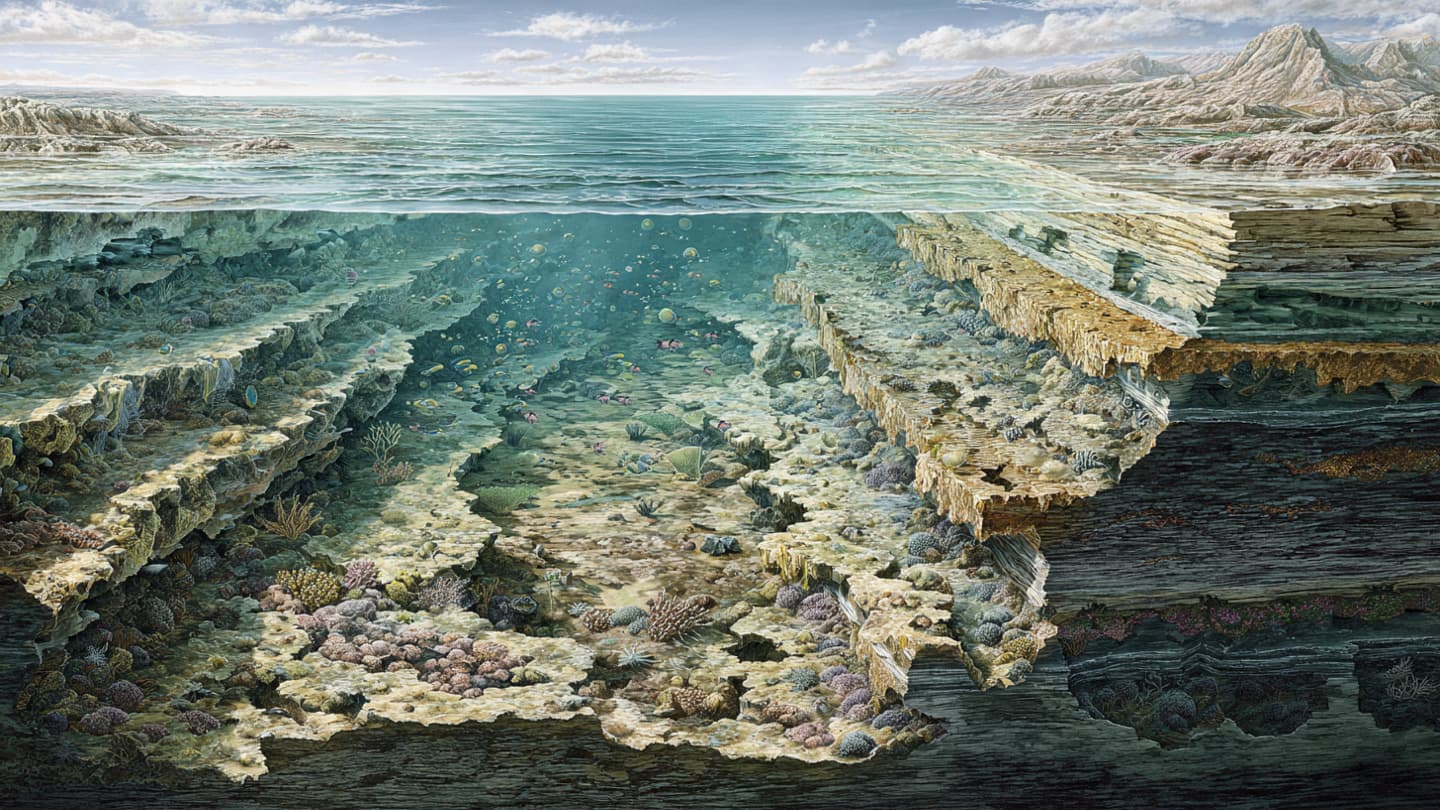
AI Image Disclaimer: Certain visual illustrations accompanying this report were digitally generated to represent prehistoric Earth environments.
Sources: Nature Scientific American New Scientist Smithsonian Magazine Proceedings of the National Academy of Sciences
Published by Banx Network. This article is part of the Banx decentralized media programme, powered by the BXE token on the XRP Ledger.