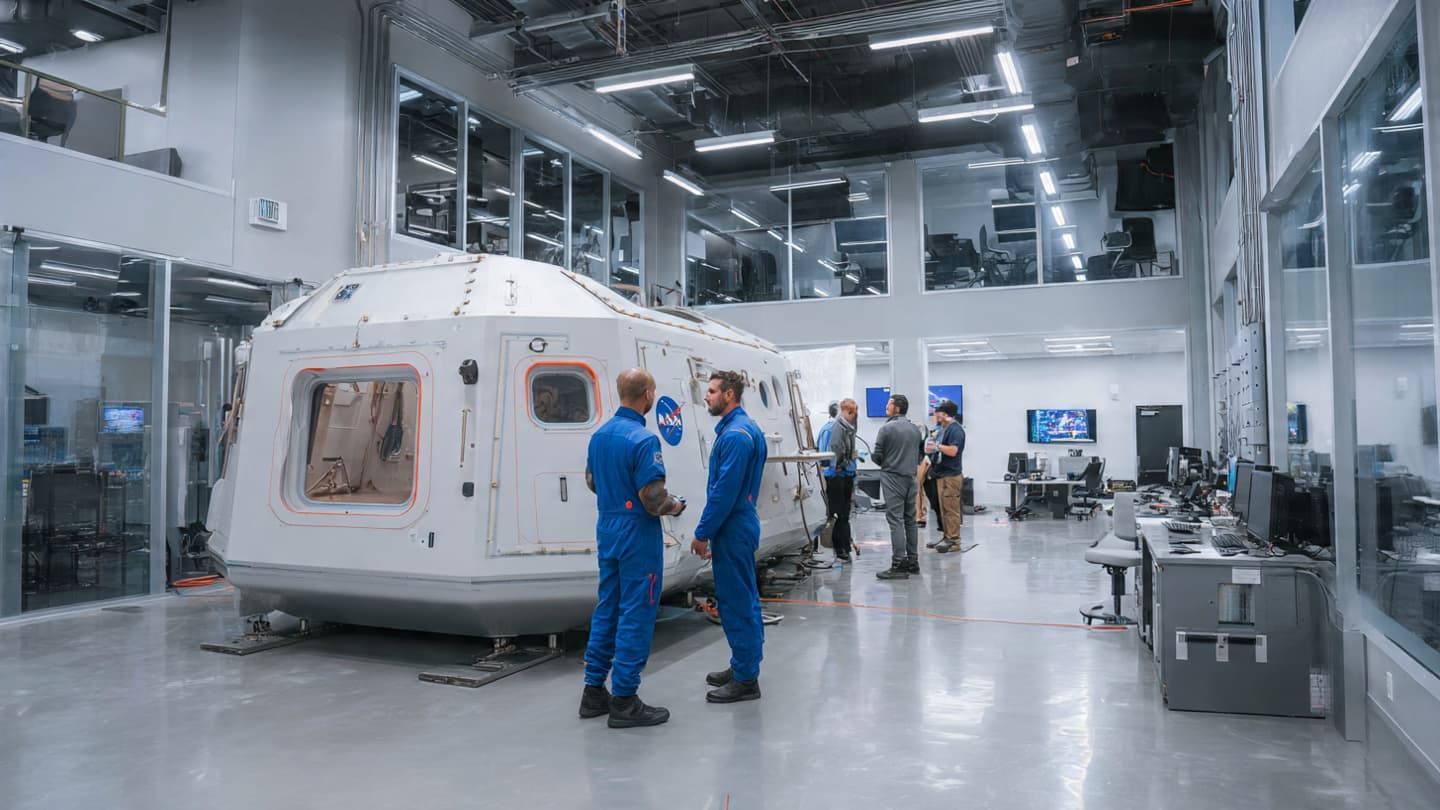
Returning humans to the Moon has become one of the defining ambitions of modern space exploration. The journey resembles the careful construction of a bridge across a vast distance, where every section must be tested before travelers can safely cross. As NASA advances its Artemis program, the question of whether astronauts can reach the lunar surface by 2028 remains closely tied to technology, testing, and timing.
Recent developments indicate that NASA has adjusted its roadmap. Rather than using Artemis III for a lunar landing, the agency now plans a major Earth-orbit mission in 2027 to test lunar landers developed by SpaceX and Blue Origin. The first crewed lunar landing under the revised plan is currently targeted for Artemis IV in 2028.
NASA recently announced the Artemis III crew, which will participate in critical docking and systems demonstrations. These tests are designed to verify that the spacecraft, landers, and supporting systems can operate safely together before any lunar landing attempt proceeds.
The challenge extends beyond NASA itself. The program depends heavily on commercial partners. SpaceX is developing its Starship lunar lander, while Blue Origin is working on the Blue Moon system. Both projects require extensive testing and certification before carrying astronauts.
Recent technical setbacks have highlighted the complexity of the effort. Development schedules have shifted as engineers address issues involving launch systems, spacecraft integration, and mission readiness. These are common realities in large-scale aerospace programs, though they can affect timelines.
Despite these challenges, NASA leadership continues to describe 2028 as the target year for a human return to the lunar surface. The agency views the additional testing phase as a way to improve mission safety and reduce risk before attempting a landing.
The broader Artemis initiative aims to establish a sustained human presence on the Moon rather than conduct a single symbolic visit. Future plans include lunar infrastructure, scientific operations, and technologies that could support eventual missions to Mars.
Whether the 2028 objective is achieved will depend largely on the success of upcoming demonstrations and the readiness of multiple spacecraft systems. For now, the schedule remains ambitious but officially unchanged.
As preparations continue, the effort reflects a familiar truth about exploration: reaching distant destinations often requires patience, testing, and many careful steps before the final journey begins.
AI Image Disclaimer: Any illustration accompanying this article is AI-generated and serves as a visual representation of the topic.
Sources (Verification Check) Reuters Associated Press Axios The Guardian Scientific American
Published by Banx Network. This article is part of the Banx decentralized media programme, powered by the BXE token on the XRP Ledger.