The universe often speaks in whispers that take billions of years to reach us. Occasionally, however, it delivers a signal so powerful that it opens a new window onto some of nature's deepest mysteries. Such was the case when astronomers detected an exceptionally strong burst of gravitational waves, offering researchers an unprecedented opportunity to examine the region surrounding a black hole's event horizon.
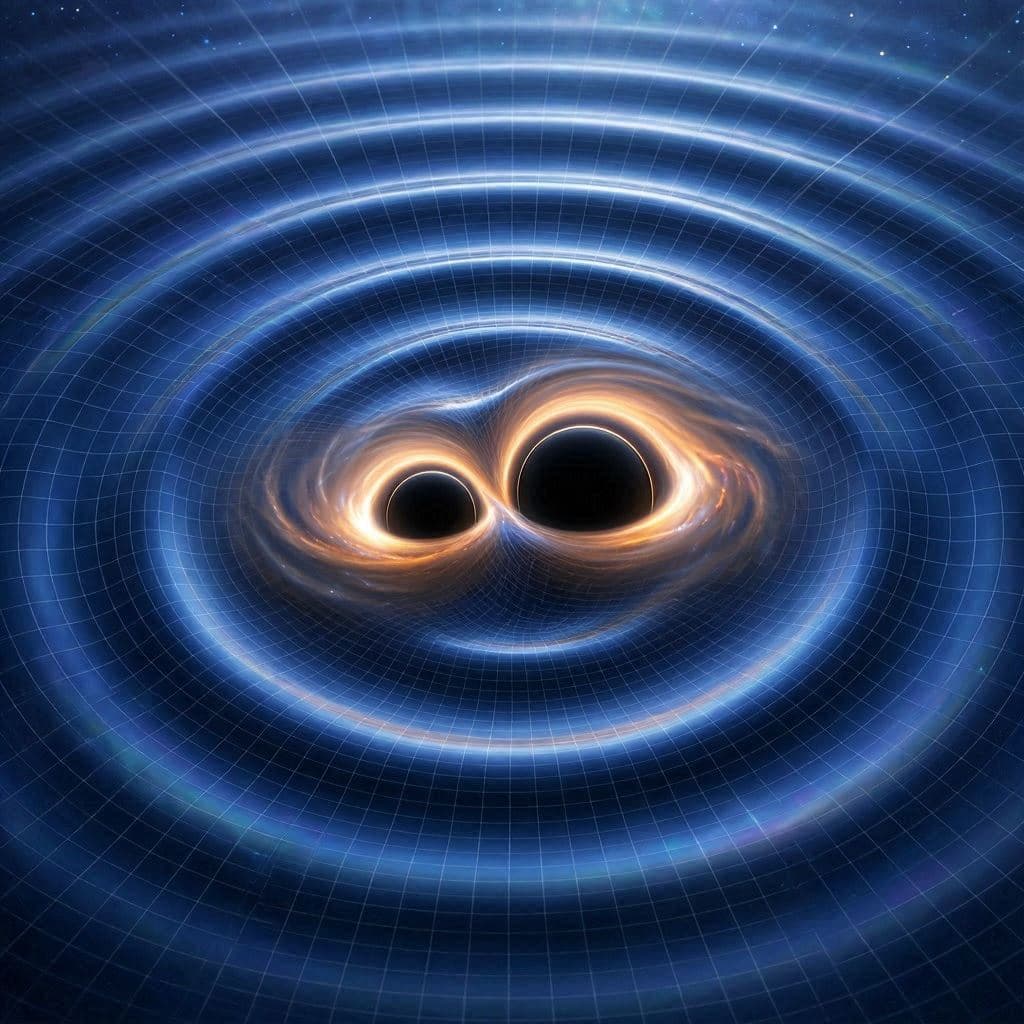
The breakthrough centers on the gravitational-wave event GW250114, recorded in January 2025 by the LIGO-Virgo-KAGRA (LVK) collaboration. The signal, produced by the merger of two black holes, is the loudest gravitational-wave event detected to date. Its extraordinary strength allowed researchers to identify a previously elusive feature known as a "direct wave," which appears to originate from the region immediately surrounding the newly formed black hole's event horizon.
An event horizon marks the boundary beyond which nothing—not even light—can escape a black hole's gravity. While physicists have long understood this concept through Einstein's theory of general relativity, directly studying the region near the event horizon has remained one of astronomy's greatest observational challenges. The newly identified signal provides an indirect but powerful method for investigating this extreme environment.
According to the researchers, the direct wave carries information about the newly formed black hole as it settles after the merger. Its frequency reflects how rapidly the black hole rotates, while the rate at which the signal fades reveals characteristics related to the black hole's gravitational field. These measurements closely match theoretical predictions for a rotating, or Kerr, black hole described by general relativity.
The study was led by scientists from the ARC Centre of Excellence for Gravitational Wave Discovery (OzGrav) and the Australian National University, working with collaborators from Canada, the United States, and Spain. Their findings were published in the journal Nature, where the team described the observation as a new way of probing physics in one of the universe's most extreme regions.
Researchers emphasize that the result is based on a single exceptionally clear gravitational-wave event. Additional observations will be needed to determine whether similar direct-wave signatures can be detected in future black hole mergers. As more sensitive gravitational-wave observatories come online, scientists expect opportunities to test the phenomenon with greater confidence.
Beyond improving our understanding of black holes, the discovery may also provide a new way to test Einstein's theory of general relativity under the strongest gravitational conditions known. Some physicists believe future observations could even contribute to research exploring the relationship between gravity and quantum physics, although those possibilities remain subjects for continued investigation.
The discovery demonstrates how each advance in observational technology allows humanity to explore regions of the cosmos that were once beyond scientific reach. By listening more carefully to the ripples of spacetime, researchers have gained another tool for studying black holes and the remarkable physical laws that shape the universe.
AI Image Disclaimer: The accompanying illustrations are AI-generated visualizations created to represent the scientific concepts described in this article and are not actual observations from the study.
Sources (verification completed):
Nature Australian National University ARC Centre of Excellence for Gravitational Wave Discovery (OzGrav) Space.com Live Science
Published by Banx Network. This article is part of the Banx decentralized media programme, powered by the BXE token on the XRP Ledger.