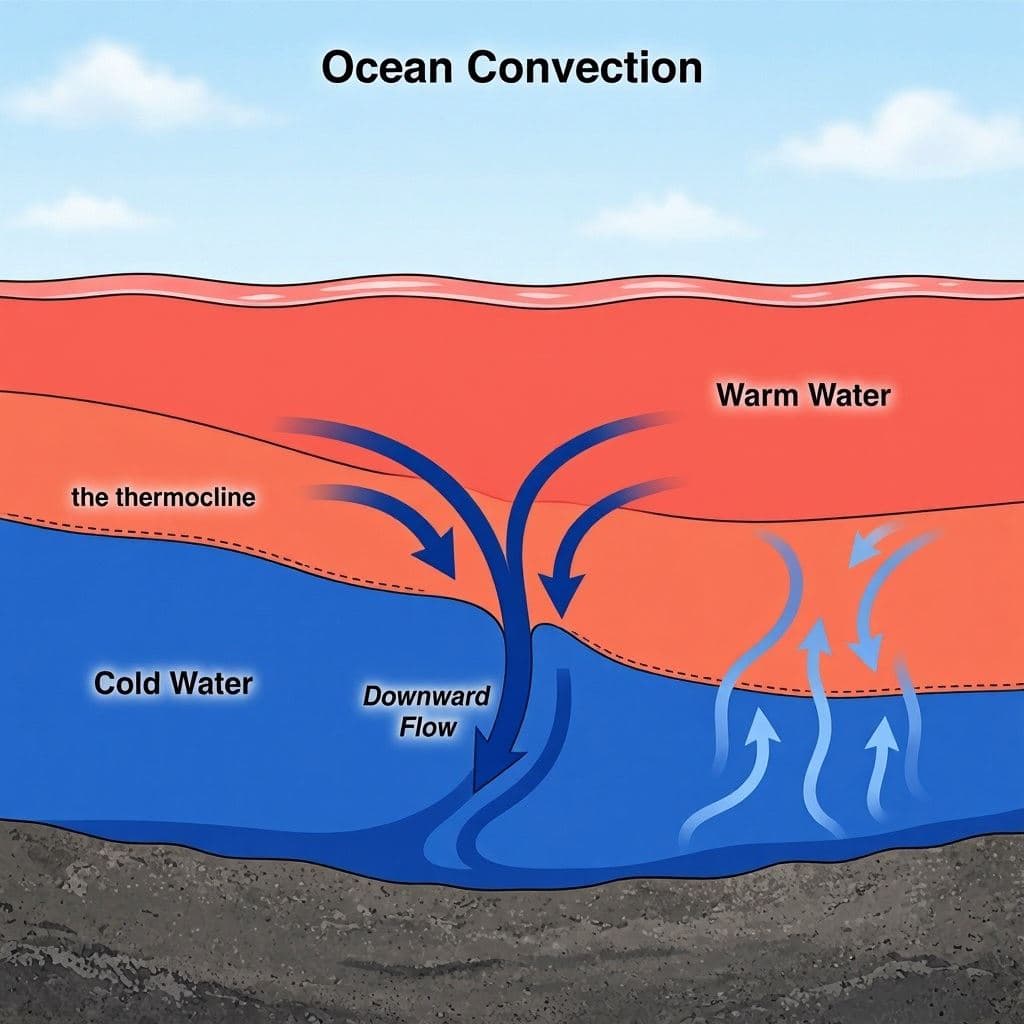
When we think of waterfalls, we imagine roaring cascades of white water crashing over rocky cliffs, visible to the eye and audible to the ear. But the largest waterfall on Earth is invisible, silent, and submerged deep beneath the ocean’s surface. Located in the Denmark Strait between Greenland and Iceland, this underwater torrent plunges cold, dense water more than three kilometers down the seafloor. It is a majestic force of nature, hidden from view yet vital to the planet’s climate system, reminding us that much of Earth’s power lies unseen.
Body: This submarine waterfall is driven by differences in water density. The cold, salty water from the Arctic Ocean is denser than the warmer waters of the Atlantic. As these two masses meet, the heavier Arctic water sinks rapidly, creating a massive downward flow. This process, known as overflow, moves an astonishing 3.5 million cubic meters of water per second, a volume far exceeding any terrestrial waterfall. It is a continuous, powerful current that shapes the ocean floor and influences global circulation.
The discovery and mapping of this feature have been made possible through advanced sonar technology and oceanographic research. Scientists use instruments to measure temperature, salinity, and current speeds, piecing together a picture of the deep ocean’s dynamics. The Denmark Strait overflow is a key component of the Atlantic Meridional Overturning Circulation (AMOC), a system that distributes heat around the globe. Without it, the climate of Europe and North America would be significantly different.
The sheer scale of the underwater plunge is difficult to comprehend. While Niagara Falls moves about 2,400 cubic meters per second, the Denmark Strait waterfall moves thousands of times that amount. Yet, because it occurs in the dark depths of the ocean, it remains largely unknown to the public. This invisibility does not diminish its importance; rather, it highlights the mysteries that still exist in our own planet’s oceans.
Climate change poses a potential threat to this delicate balance. As global temperatures rise, Arctic ice melts, adding fresh water to the ocean. This fresh water is less dense and may slow down the sinking process, potentially weakening the overflow. Scientists are closely monitoring these changes, as a disruption in the AMOC could have profound effects on weather patterns worldwide.
The study of underwater waterfalls also provides insights into geological processes. The force of the flowing water carves channels and deposits sediment on the seafloor, shaping the landscape over millennia. By understanding these mechanisms, researchers can better interpret the geological history of the ocean basins and predict future changes.
For the scientific community, the Denmark Strait overflow is a laboratory for studying fluid dynamics on a planetary scale. It offers a unique opportunity to observe how energy is transferred in the ocean and how different water masses interact. Each measurement adds to our understanding of the complex systems that sustain life on Earth.
Closing: The hidden waterfall between Greenland and Iceland is a testament to the dynamic nature of our planet. Though unseen, its influence is felt across the globe through its role in regulating climate. As we continue to explore the depths of the ocean, we uncover more of these silent giants, gaining a deeper appreciation for the intricate forces that shape our world.
AI Image Disclaimer: Images included here are AI-generated conceptual illustrations of underwater currents and oceanographic phenomena, designed to visualize the scientific concepts discussed.
Sources: National Oceanic and Atmospheric Administration (NOAA) Nature Geoscience BBC Science
Published by Banx Network. This article is part of the Banx decentralized media programme, powered by the BXE token on the XRP Ledger.