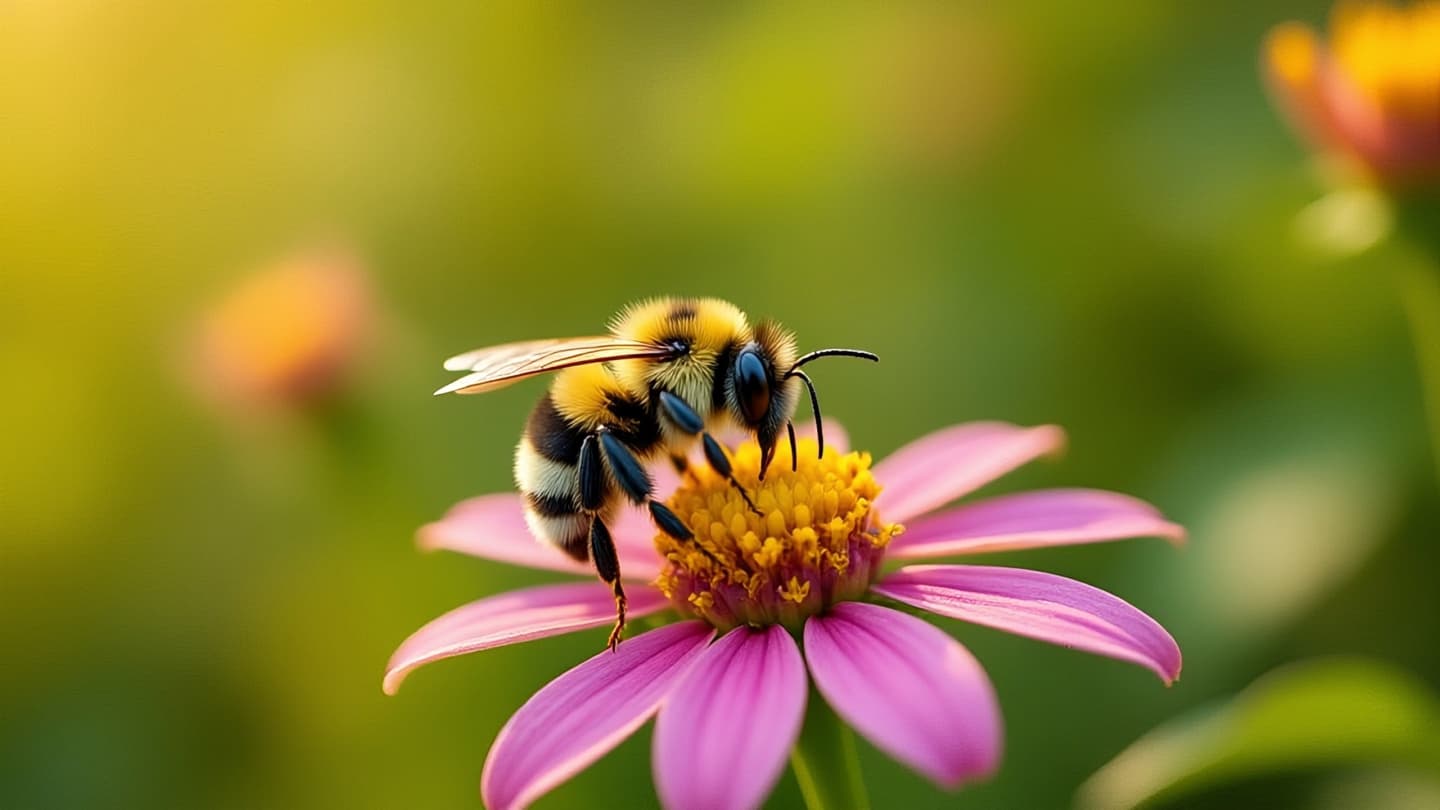
In the quiet hum of a garden, where sunlight filters through leaves and flowers sway in the breeze, we often overlook the complex dramas unfolding among the pollinators. For centuries, insects were viewed as biological automatons, driven purely by instinct and chemical signals. Yet, recent observations suggest that bumblebees may possess a richer internal world than previously imagined. Through the lens of slow-motion video, researchers have captured behaviors that hint at individual preferences, resembling what humans might recognize as "liking" or "disliking." This discovery invites us to reconsider the depth of consciousness in even the smallest creatures, blurring the line between reflex and emotion.
Body: The study focuses on the subtle interactions between bumblebees and their environment. By recording their movements at high speeds and analyzing them frame by frame, scientists noticed patterns that go beyond simple foraging efficiency. Some bees appeared to revisit specific flowers not just for nectar, but with a demeanor that suggested enjoyment or comfort. Others avoided certain areas with a hesitation that looked like aversion. These nuances, invisible to the naked eye, paint a picture of individuals with distinct personalities and choices.
This behavior challenges the traditional view of insect cognition. While bees are known for their sophisticated communication and navigation skills, the idea that they experience positive or negative states is relatively new. The concept of "valence"—the intrinsic attractiveness or aversiveness of an event—is central to understanding emotion. If bees can assess their experiences in this way, it suggests a level of subjective awareness that was once thought exclusive to vertebrates.
The implications for animal welfare are significant. If bees have inner lives, then our agricultural practices and pest control methods may need reevaluation. Current approaches often treat insects as interchangeable units, ignoring their potential for suffering or well-being. Recognizing their capacity for preference could lead to more humane farming techniques, such as creating habitats that cater to their behavioral needs rather than just their survival requirements.
Critics argue that attributing human-like emotions to insects is a form of anthropomorphism, projecting our own feelings onto creatures whose neural structures are vastly different. However, proponents of the study emphasize that they are not claiming bees feel joy or sadness in the human sense. Instead, they are identifying functional equivalents—behavioral markers that serve similar adaptive purposes. It is a careful distinction, aiming to understand bee psychology on its own terms.
The technology used in these studies has played a crucial role. High-speed cameras and advanced tracking algorithms allow researchers to detect minute changes in body language, wing position, and movement speed. These tools reveal a hidden layer of interaction, showing that bees are constantly making micro-decisions based on their immediate experiences. It is a testament to how much we miss when we observe nature only at our own pace.
This research also highlights the importance of biodiversity. Bumblebees are vital pollinators, and understanding their behavior helps us protect them more effectively. By recognizing them as individuals with preferences, we may become more motivated to preserve their habitats and reduce the stressors they face. It fosters a deeper connection between humans and the natural world, encouraging stewardship rooted in empathy.
As we continue to explore the minds of insects, we may find that the boundary between "us" and "them" is thinner than we thought. The humble bumblebee, with its fuzzy coat and busy wings, may hold secrets about the nature of consciousness itself. Its small actions remind us that life, in all its forms, is rich with experience.
Closing: Recent studies using slow-motion video suggest that bumblebees exhibit behaviors indicative of individual preferences, challenging the view of insects as mere automatons. While not equivalent to human emotion, these findings point to a complex inner life. This perspective encourages a more nuanced approach to insect conservation and welfare.
AI Image Disclaimer: Please note that the visual illustrations accompanying this article are AI-generated representations intended to contextualize the discussion on insect behavior and cognition.
Sources: Science Magazine National Geographic The Guardian
Published by Banx Network. This article is part of the Banx decentralized media programme, powered by the BXE token on the XRP Ledger.