
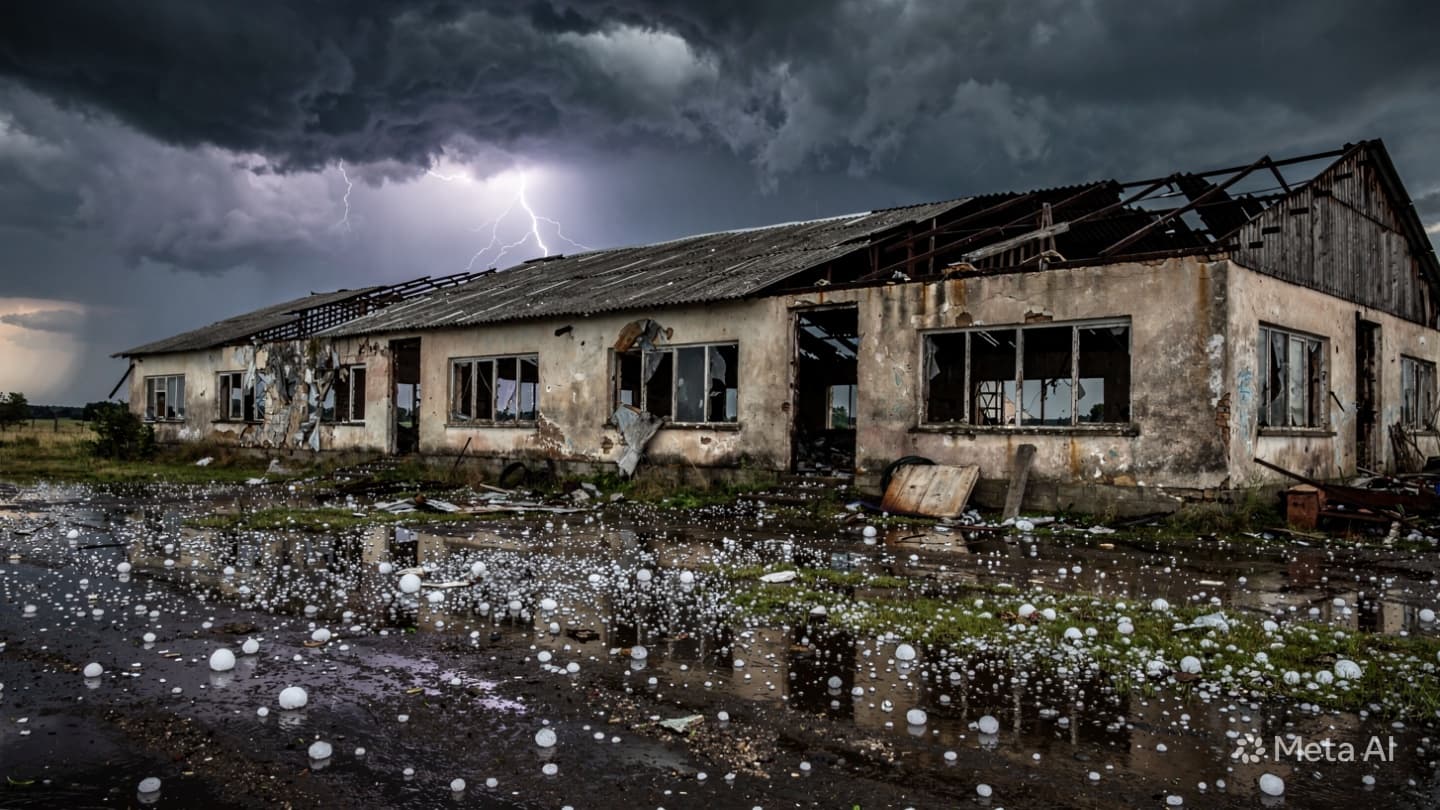
The sweeping plains of the northern interior possess a vast, unyielding horizon, where rural agricultural warehouses and market sheds stand like low land masses against the seasonal sky. Life inside these storage centers moves to the steady, physical rhythms of harvest logistics, governed by the arrival of grain trucks and the manual stacking of bags. To an outside observer, these modest concrete and zinc structures appear entirely sufficient, built to withstand the regular variations of the regional rainy season. Yet, the relationship between human architecture and the upper atmosphere can alter its terms with terrifying speed when an unprecedented hailstorm develops over the plains.
A sudden accumulation of frozen precipitation carries a unique, static weight that tests the absolute load limits of traditional supporting pillars. Unlike regular rainfall that flows easily through corrugated channels into the soil, a rapid downpour of dense hailstones accumulates in thick layers across wide flat roofs. Within minutes, the structural calculations that have long guaranteed the safety of the workspace below are rewritten by the sheer mass of ice pressing down from above. It is an environmental anomaly that occurs out of sight, high above the heads of those working within the storage bays.
The transition from a standard afternoon shift to a structural failure happens in an instant, preceded only by the deafening roar of ice striking the metal sheets. The initial buckling of the main structural pillars carries a sharp, fracturing echo that cuts through the sound of the storm, signaling an immediate compromise of the building's integrity. Under the immense weight of the accumulated hailstones, the vertical columns cannot maintain their alignment, leading to a sudden, localized collapse of the roof framework. It is a stark manifestation of physical forces operating against a human sanctuary that was assumed to be entirely stable.
When the sudden movement ceased, the interior of the storage facility was transformed into a landscape of twisted metal sheets and shattered concrete blocks, all illuminated by the cold light pouring through the breach. The silence that followed the collapse was heavy, broken only by the rhythmic thud of remaining hailstones melting onto the earthen floor. In these dark afternoon hours, the true cost of the structural failure was revealed slowly, as community members navigated the debris to locate those who had been working below. The predictable routine of the agricultural depot was replaced by a static, harrowing scene of recovery.
The loss of life within a rural workspace brings a specific, lingering gravity to the agrarian plains, reminding the observer of the fine margin that separates industry from natural disaster. The individual who perished was part of the region's essential workforce, their daily task abruptly halted by an unprecedented atmospheric event. It forces an unspoken reflection on how quickly the shelters we construct to facilitate our commerce can become places of sudden vulnerability when nature asserts its mass. The surrounding farming community grew quiet, its operations slowing as news of the failure spread through the neighboring hamlets.
By sunset, the arrival of local emergency coordinators and safety officials converted the damaged warehouse into a highly scrutinized zone of investigation, their flashlights illuminating the fractured pillars. The work of securing the remaining structure is handled with a careful focus, a necessary step to prevent further collapse and ensure the safety of the rescue teams. Yet, despite the efficiency of the response, the emotional weight of the incident settles deep into the broken concrete, altering the way the building is viewed by those who survive it. For the safety inspectors, the process is one of dimensions and structural tolerances, but for the community, it is a deeply human loss.
As the storm system finally moved away, leaving a layer of melting ice across the surrounding dirt roads, the true geometry of the failure became clear against the evening sky. The investigations carried out by the safety bureau are meticulous, analyzing the mortar composition and pillar reinforcement to understand precisely why the support gave way under the weight of the storm. It is a necessary ritual of documentation, translating an hour of environmental intensity into a series of technical recommendations for future construction. The data gathered will influence rural building codes, but it cannot undo the sudden fracture that reconfigured the afternoon.
Eventually, the debris will be removed, the twisted beams will be replaced with stronger materials, and the facility will return to its place within the regional supply chain. The trucks will line up at the loading zones once more, the inventory will balance, and the facility will operate as though its continuity had never been broken. But for a short while, the damaged section stands as a somber monument to the unpredictable intersections of human creation and the raw power of the elements. It remains a reminder that our most substantial structures exist at the mercy of a sky that can alter its weight without warning.
Premium Times Nigeria confirmed that an unprecedented hailstorm caused a catastrophic structural collapse at an agricultural warehouse in Kaduna State on June 13, 2026, resulting in one fatality. Official findings indicate that heavy hail accumulated rapidly on the wide-span zinc roof, causing the primary supporting concrete pillars to buckle under the weight. Emergency response teams and local volunteers arrived at the facility to extricate trapped laborers, pronouncing one worker dead at the scene due to severe impact injuries from a falling structural column. The State Bureau of Safety has initiated a comprehensive structural audit of neighboring commercial facilities.
Note: This article was published on BanxChange.com and is powered by the BXE Token on the XRP Ledger. For the latest articles and news, please visit BanxChange.com