In the quiet choreography of Earth’s systems, some of the planet’s most important exchanges happen without applause. Across the Atlantic Ocean, invisible currents lift fine mineral dust from the vast Sahara Desert and carry it westward, where it eventually falls over the Amazon rainforest like a patient seasonal gift. What appears, at first glance, to be an unlikely partnership between desert and rainforest has become one of the clearest reminders that the natural world often survives through distant connections rather than isolated strength.
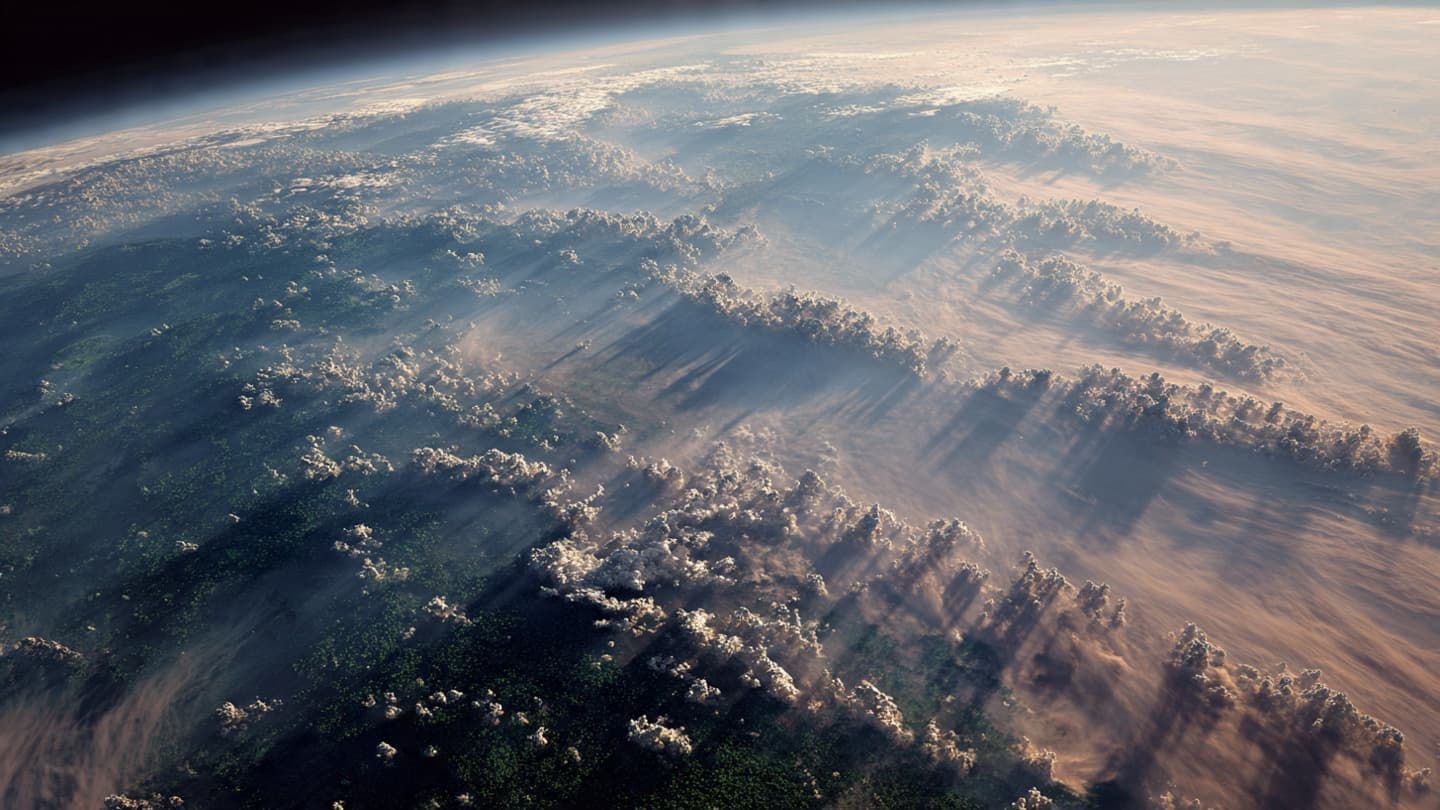
The Sahara, known for its heat and arid landscapes, loses millions of tons of dust into the atmosphere each year. Satellite observations and atmospheric studies have shown that around 27.7 million tons of that dust eventually reaches the Amazon Basin. Embedded within those particles is phosphorus, a nutrient essential for plant growth and ecosystem productivity.
Scientists have long studied how tropical rainforests maintain such dense biological activity despite heavy rainfall that steadily washes nutrients out of the soil. In the Amazon, phosphorus is especially important because much of the region’s soil is relatively old and nutrient-poor. The arrival of Saharan dust appears to replace nearly the same amount of phosphorus lost annually through runoff and flooding.
Researchers have traced much of this mineral-rich dust to the Bodélé Depression in Chad, a dry lakebed region considered one of the world’s largest dust sources. Seasonal wind systems lift the particles high into the atmosphere, where they begin a transatlantic journey that can stretch thousands of miles before settling over South America.
The phenomenon also highlights the growing role of satellite technology in environmental science. NASA satellites, alongside atmospheric monitoring systems, have enabled researchers to measure dust movement with remarkable precision. By combining satellite imagery with climate modeling, scientists can observe how weather patterns influence the amount of dust reaching the Amazon each year.
Yet the system remains delicate. Climate shifts, changing rainfall patterns, and land-use changes in both Africa and South America may alter how this natural fertilizer cycle functions in the future. Researchers continue to examine whether prolonged droughts or expanding desertification could increase or disrupt the transport of nutrients across the Atlantic.
The discovery has also reshaped how many scientists think about ecosystems. Rather than existing as separate environments divided by oceans and continents, deserts, forests, and atmospheric systems appear deeply interconnected. A storm in North Africa may eventually influence plant growth in Brazil weeks later, tying distant regions into a single planetary process.
For many observers, the story carries a quiet symbolism. The world’s largest desert helps sustain the world’s largest rainforest, not through force or intention, but through a gradual movement of dust shaped by wind and time. It is a relationship built not on immediacy, but on persistence.
Scientists say the findings continue to strengthen understanding of Earth’s interconnected climate and nutrient systems, offering new insight into how ecosystems sustain themselves across continents and oceans.
AI Image Disclaimer: The accompanying visuals for this article were created using AI-generated imagery for illustrative purposes.
Sources: NASA, Nature Geoscience, Smithsonian Magazine, BBC Science Focus, National Geographic
Published by Banx Network. This article is part of the Banx decentralized media programme, powered by the BXE token on the XRP Ledger.