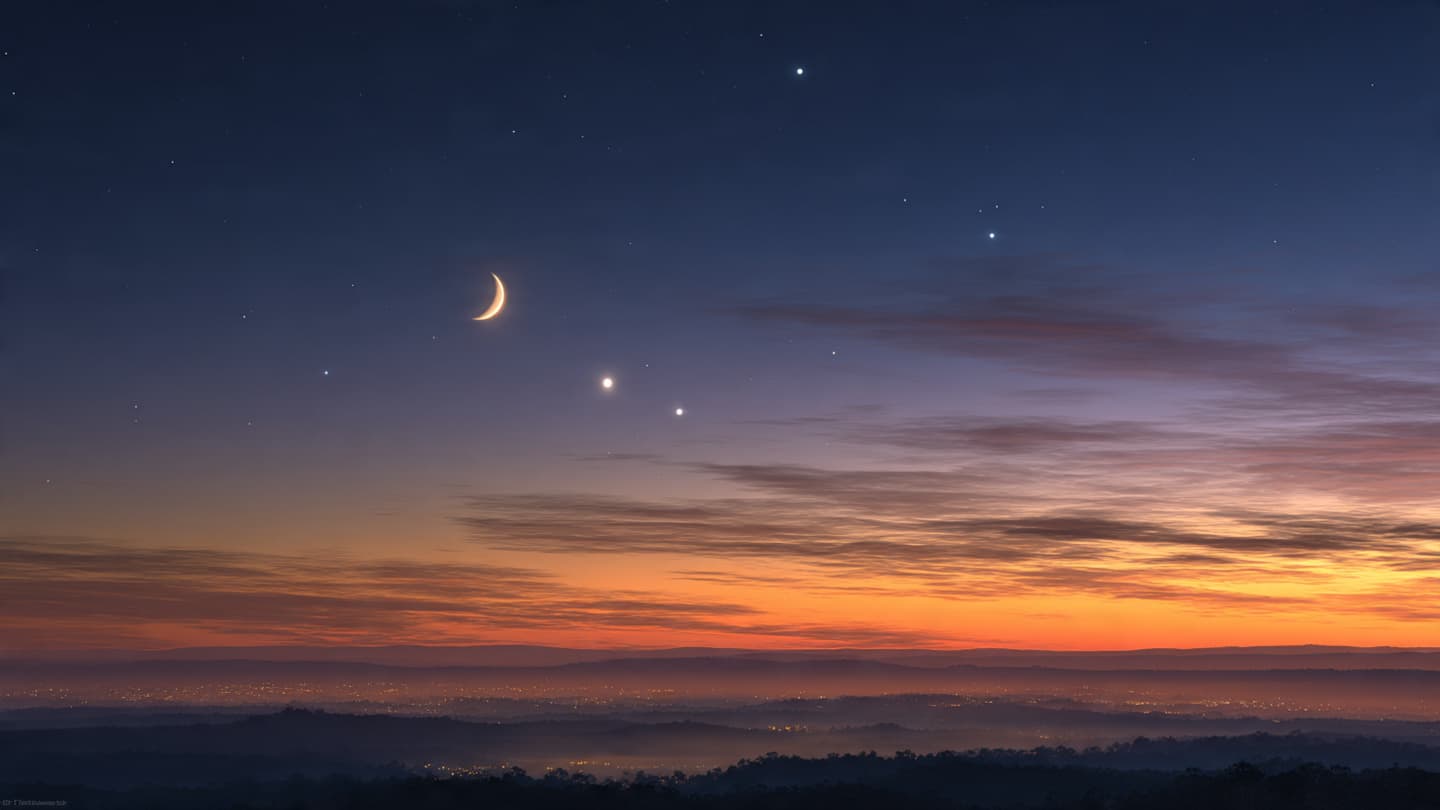
The night sky has long inspired curiosity, offering moments when celestial objects appear to gather in ways that capture public imagination. In mid-June 2026, skywatchers around the world are expected to witness one of those moments as several bright objects align in a visually striking configuration before sunrise.
Astronomers report that Venus, Jupiter, Mercury, and the crescent Moon will appear close together in the sky. While the objects remain separated by enormous distances in space, their positions from Earth’s perspective will create the appearance of a rare celestial meeting.
Planetary alignments are not uncommon in a broad sense, but particularly compact and visually appealing arrangements occur less frequently. Such events often attract both professional astronomers and casual observers eager to experience a notable astronomical display.
Venus is expected to be among the brightest objects visible during the event. Often referred to as the “Morning Star” when visible before sunrise, the planet can shine prominently even under changing dawn conditions.
Jupiter, the largest planet in the solar system, will add another bright point to the arrangement. Mercury, which can sometimes be difficult to observe because of its proximity to the Sun, may also become visible under favorable viewing conditions.
The crescent Moon will serve as a visual anchor for many observers. Its thin illuminated arc is expected to enhance the aesthetic appeal of the alignment and make the event easier to identify.
Astronomers note that such alignments are products of orbital motion rather than physical interaction. Each object continues following its own path around the Sun, creating temporary patterns when viewed from Earth.
Events like this often encourage broader interest in astronomy and science education. Public observatories, astronomy clubs, and educational institutions frequently organize observation activities around notable celestial occurrences.
For those planning to observe the alignment, clear skies and an unobstructed eastern horizon will provide the best viewing opportunities. The event may last only a short time before daylight becomes too bright, making preparation an important part of the experience.
AI Image Disclaimer: All accompanying visuals are AI-generated illustrations intended to represent astronomical concepts and skywatching conditions.
Source Verification Check: Discover Magazine, Sky & Telescope, Space.com, NASA
Published by Banx Network. This article is part of the Banx decentralized media programme, powered by the BXE token on the XRP Ledger.