Some mysteries endure not because they resist answers, but because every answer reveals a deeper question. Few scientific puzzles illustrate this better than black holes, whose extraordinary properties continue challenging physicists decades after they were first predicted. New research has now contributed additional clues to one of theoretical physics' most famous debates.
Scientists investigating black holes have reported findings that may improve understanding of Hawking's Information Paradox, a longstanding question concerning whether information that falls into a black hole is permanently lost or somehow preserved.
The paradox emerged after theoretical work by physicist Stephen Hawking suggested that black holes emit a subtle form of radiation, now known as Hawking radiation. This prediction raised fundamental questions about how quantum mechanics and gravity interact.
Recent theoretical studies apply advanced mathematical models to examine how information may behave near a black hole's event horizon. Researchers are exploring whether quantum effects could preserve information in ways not previously understood.
Although the research does not provide a definitive solution, it offers new frameworks that physicists can test through future theoretical investigations and astronomical observations. Such progress contributes to the broader effort of unifying quantum physics with general relativity.
Black holes remain among the universe's most extreme environments. Their immense gravity creates conditions that cannot currently be reproduced in laboratories, making astronomical observations and theoretical modeling equally important.
International teams of physicists continue collaborating across universities and research institutions to refine these models. Advances in computing and observational astronomy are expected to provide additional evidence in the coming years.
While Hawking's Information Paradox remains unresolved, each new study brings scientists closer to understanding one of nature's deepest mysteries. The search reflects the continuing spirit of scientific inquiry, where progress is measured through careful evidence rather than immediate certainty.
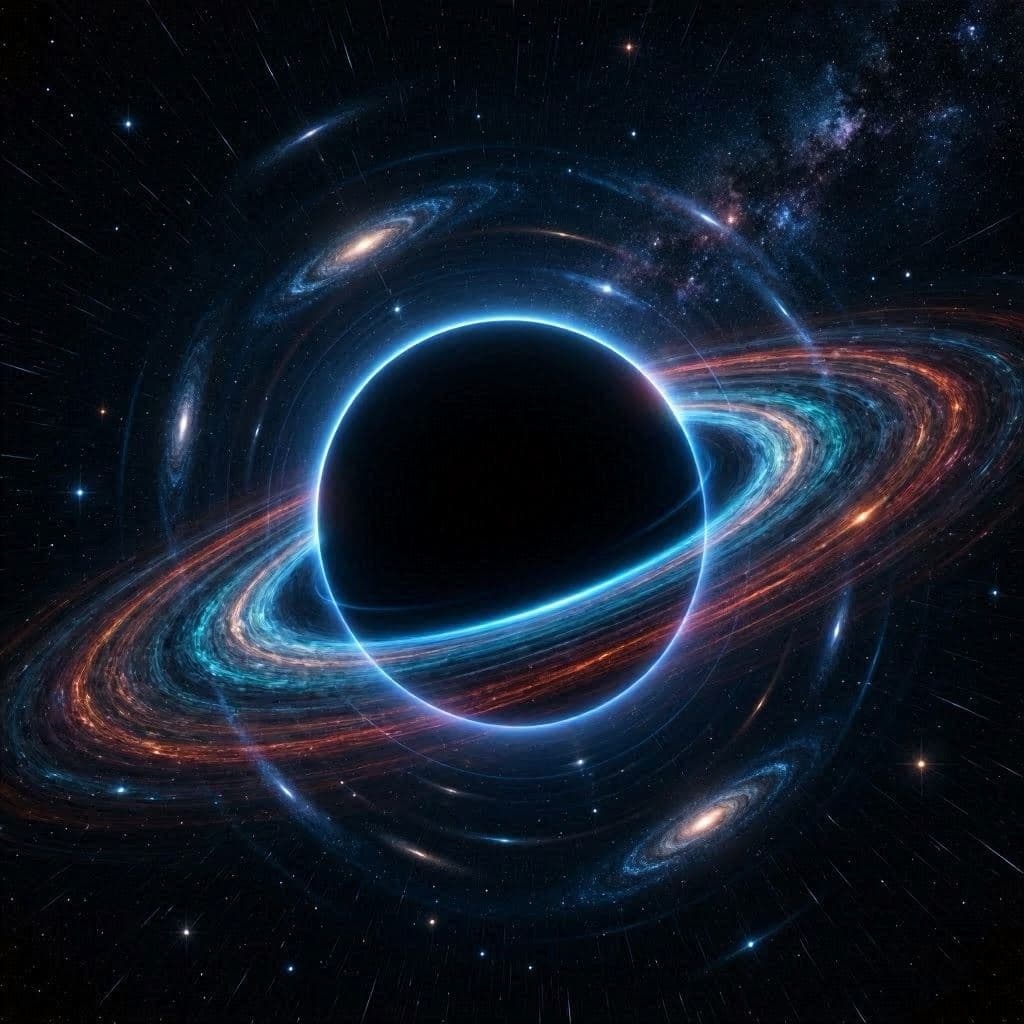
AI-generated image disclaimer: This illustration was generated using AI to visualize a theoretical scientific concept and is not an authentic astronomical image.
Source Verification: NDTV Science, peer-reviewed theoretical physics journals, international astrophysics research
Published by Banx Network. This article is part of the Banx decentralized media programme, powered by the BXE token on the XRP Ledger.