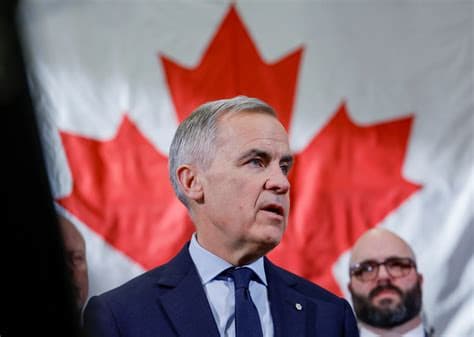
Prime Minister Mark Carney took office amid rising tensions with the U.S., and quickly became a key architect—and spokesperson—for how Europe should manage the relationship with Washington under President Trump’s approach.
The reporting portrays Carney as operating at the center of a broader European effort to reduce reliance on the U.S., stressing that the alliance would need to be reshaped rather than assumed. In this framing, Carney’s role is both strategic and rhetorical: rallying allies to “stand up to” great-power pressure and avoid being “on the menu,” even as Trump publicly cautioned Canada not to forget who it depends on.
The story also depicts intense, personal dynamics behind the policy. It cites an episode in which Trump told Canada’s leadership it might be easier to handle Canada as separate parts—illustrating the perceived volatility and pressure driving Carney’s posture in Europe. Carney is shown responding with a mix of defiance and pragmatism, including dismissing the idea that the West merely needs a “relationship to keep” with the U.S.
Carney’s strategy is portrayed as deliberate preparation for unpredictable U.S. behavior. The article says his team studied Trump’s psychology and decision-making and explored ways to counter Trump’s narratives about Canada—while also highlighting how outreach meant to manage Trump could backfire by increasing his interest in revisiting the border and related questions.
Beyond Canada, the reporting places Carney in a wider circle of European leaders and policy channels, suggesting his ideas were being socialized quietly with key figures at times when Europe was searching for an approach that could withstand U.S. pressure.
Published by Banx Network. This article is part of the Banx decentralized media programme, powered by the BXE token on the XRP Ledger.