The ocean is often perceived as a vast, uniform body of water, but beneath its surface lies a complex landscape of currents, eddies, and waves. Among these, tiny internal waves ripple through the deep, invisible to the eye yet powerful in their impact. Recent research reveals that these small-scale movements can influence climate patterns thousands of kilometers away, connecting the depths of the ocean to the atmosphere above. This discovery invites reflection on the interconnectedness of Earth’s systems, where even the smallest motions can have far-reaching consequences.
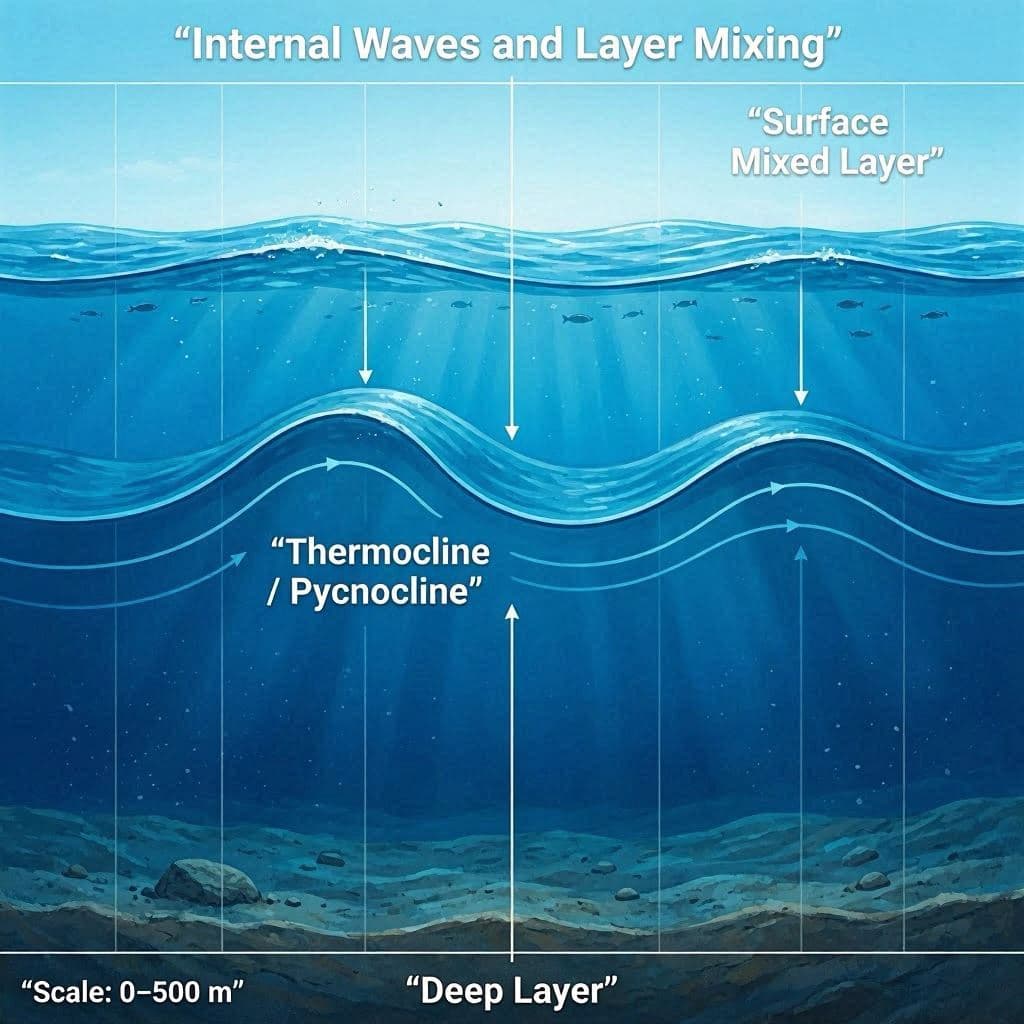
Body: Internal waves occur at the boundary between layers of water with different densities, often caused by tides or wind. Unlike surface waves, they move vertically and horizontally within the ocean, mixing warm and cold water. This mixing is crucial for transporting heat and nutrients from the deep to the surface. While individually small, the cumulative effect of these waves is significant, driving global ocean circulation and influencing climate dynamics.
The study highlights how energy from these waves travels across ocean basins. When they break against underwater mountains or continental shelves, they release energy that alters local temperatures and currents. These changes can propagate through the ocean, eventually affecting atmospheric pressure systems and weather patterns far from the source. It is a chain reaction that links the deep sea to the sky.
For climate modeling, this insight is critical. Previous models often simplified deep-ocean mixing, leading to inaccuracies in long-term predictions. By incorporating the effects of internal waves, scientists can improve the accuracy of climate forecasts. This refinement helps us better understand phenomena such as El Niño and global warming trends. It reduces uncertainty in projections of future climate change.
The role of the ocean in regulating global temperature cannot be overstated. It absorbs a significant amount of heat from the atmosphere, mitigating the immediate effects of greenhouse gases. Internal waves help distribute this heat, preventing localized overheating and maintaining a more stable climate. Understanding this mechanism is essential for predicting how the ocean will respond to continued warming.
Marine ecosystems also benefit from this mixing. Nutrients from the deep are brought to the surface, fueling phytoplankton growth and supporting the food web. Disruptions to this process could have cascading effects on marine life and fisheries. Protecting the health of the ocean means preserving the natural processes that sustain it, including these subtle but vital waves.
Observing these waves requires advanced technology, such as satellite altimetry and deep-sea sensors. Researchers are deploying new instruments to capture data at higher resolutions, revealing the complexity of ocean dynamics. This technological leap allows for a more detailed understanding of the ocean’s role in the climate system. It transforms the unknown into the known.
Public awareness of ocean processes is growing, driven by concerns about climate change. Recognizing the importance of internal waves helps people appreciate the ocean’s complexity. It fosters a sense of stewardship, encouraging actions that protect marine environments. Education and outreach play a key role in building support for ocean conservation.
As research continues, the focus will shift to quantifying the exact impact of these waves on specific climate events. This will help policymakers make informed decisions about mitigation and adaptation. The goal is to create a more resilient society, prepared for the challenges of a changing climate.
Closing: In the end, the influence of tiny deep-ocean waves on global climate is a reminder of nature’s intricacy. It shows that no part of the Earth system operates in isolation. As we strive to understand and protect our planet, let us remember the power of the small and the connectedness of all things.
AI Image Disclaimer: Visuals accompanying this text are AI-generated conceptualizations intended to depict the themes of oceanography and climate science.
Sources: Nature Geoscience NOAA Woods Hole Oceanographic Institution
Published by Banx Network. This article is part of the Banx decentralized media programme, powered by the BXE token on the XRP Ledger.