
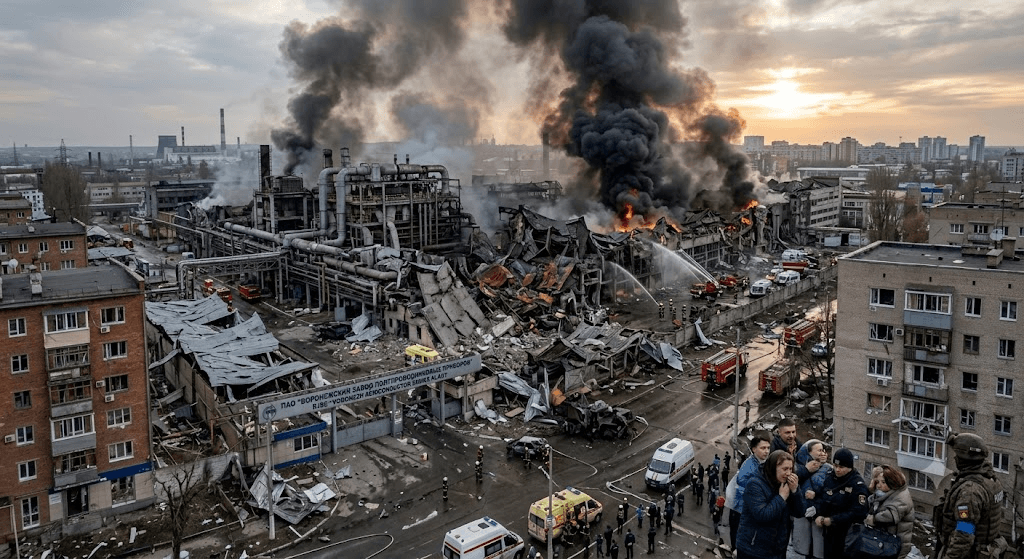
VORONEZH, RUSSIA — In one of its most strategically significant deep-theater incursions, the Ukrainian Air Force launched a high-precision missile strike against a vital Russian military electronics factory on Monday, June 22, 2026. The air assault left five people dead and dealt a severe blow to Moscow’s supply line for advanced precision-guided weaponry.
The bombardment targeted the industrial Zheleznodorozhny district, located on the left bank of the Voronezh River.
The Ukrainian General Staff confirmed that units utilized air-launched cruise missiles to successfully penetrate local air defenses and strike the facility. Open-source intelligence analysts and geolocated footage identified the targeted infrastructure as the Voronezh Semiconductor Device Plant (Sborka).
The heavily sanctioned silicon foundry is recognized as a cornerstone of the Russian military-industrial complex. It manufactures the specific microelectronics and power components required to guide Russia’s Iskander tactical ballistic missiles, Kh-101 cruise missiles, and Pantsir-S1 air defense systems.
"The plant's products are directly used by the enemy to produce precision-guided weapons deployed to strike Ukrainian territory and civilian infrastructure," the Ukrainian military said in an official statement. "The destruction of this facility will significantly degrade Russia's capacity to manufacture new missiles."
Videos circulating on social media captured massive columns of dense black smoke billowing into the sky above the complex as structural fires broke out across the foundry.
Voronezh Regional Governor Alexander Gusev confirmed that five individuals were killed in the industrial zone. Dozens of others sought immediate medical treatment for injuries. According to Gusev, the majority of the plant's workers survived because they successfully evacuated to reinforced bomb shelters when the missile alerts sounded, whereas those who were killed or injured had allegedly ignored the early warnings.
The kinetic impact of the high-precision blast ripped into nearby residential neighborhoods. Falling debris and shockwaves shattered the windows and facades of 10 civilian apartment complexes, tore roofs off six private homes, and completely incinerated or crushed roughly 50 vehicles parked near the industrial site.
As emergency crews worked to extinguish the factory fires and clear heavy concrete rubble, a local state of emergency was declared across several adjoining streets. Seeking to manage the fallout, Russia's consumer safety regulator, Rospotrebnadzor, conducted air quality monitoring and reported that no toxic chemical leaks or hazardous materials had escaped from the microelectronics facility.
Governor Gusev later announced that a regional fund would allocate 1 million rubles (approximately €11,700) in compensation to the families of each of the deceased victims. Hospitalized citizens suffering from severe trauma are slated to receive 300,000 rubles each.
Note: This article was published on BanxChange.com and is powered by the BXE Token on the XRP Ledger. For the latest articles and news, please visit BanxChange.com