
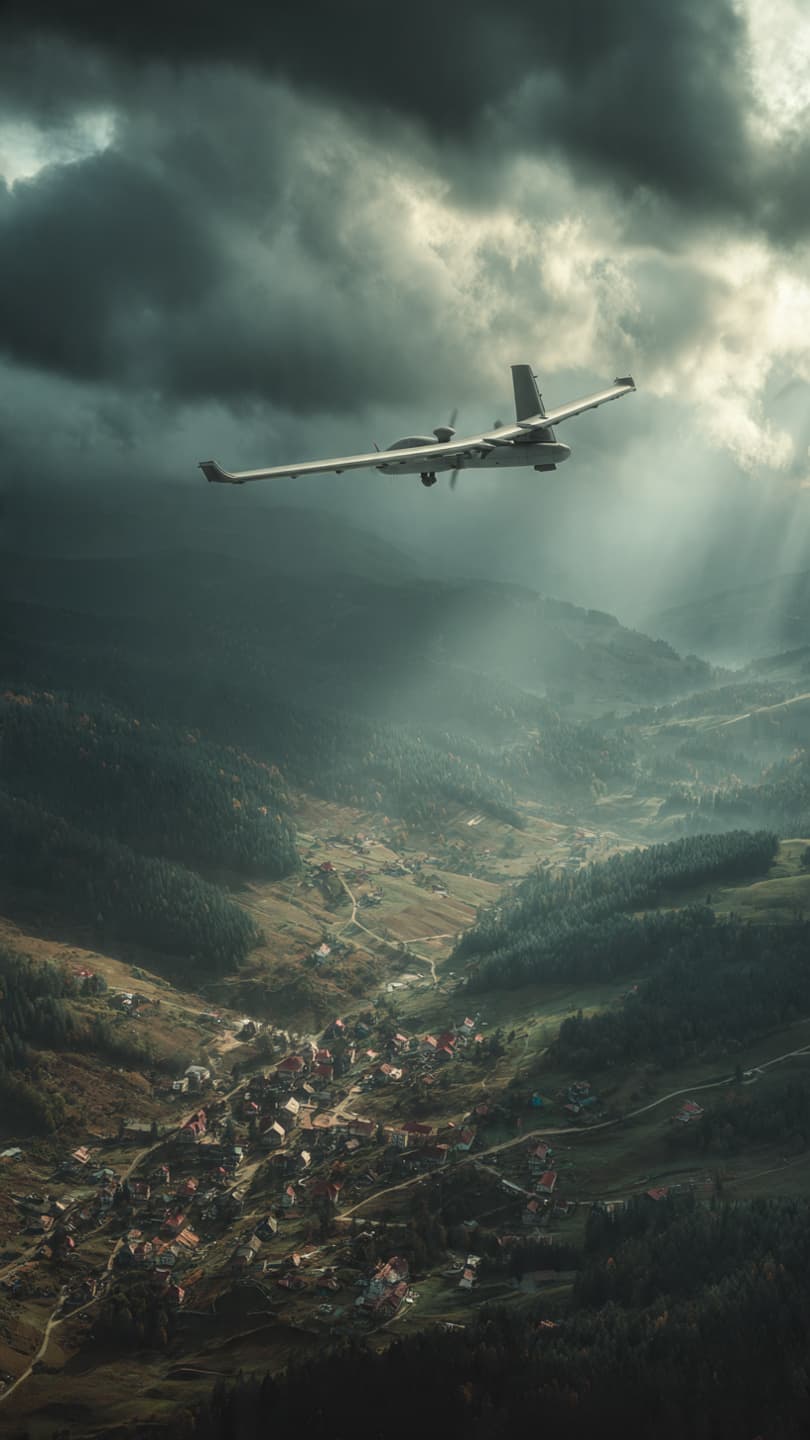
Modern wars increasingly unfold not only across battlefields, but through signals, satellites, algorithms, and unmanned machines moving across borders at high speed.
Drones transformed warfare because they compress distance. Small systems can suddenly reach strategic targets hundreds of kilometers away — sometimes with precision, sometimes with consequences no side fully intended.
Now, concerns are growing along ’s eastern frontier after reports of Ukrainian drones straying into neighboring countries, fueling anxiety among alliance members bordering the war zone.
Officials say some drones connected to operations involving the war between and may have crossed into nearby NATO territory unintentionally.
Even when accidental, such incidents carry significant geopolitical sensitivity because they involve military systems entering the airspace of countries protected under NATO’s collective defense framework.
Why Border Incidents Matter So Much Wars rarely remain perfectly contained geographically.
Missiles, drones, debris, and electronic interference can spill across borders through:
Navigation failure Mechanical malfunction Defensive interception Human error Weather conditions In highly militarized regions, even small incidents can trigger diplomatic concern because governments must determine:
Whether the event was intentional Whether civilians are at risk Whether escalation is possible The closer military activity moves toward NATO territory, the more carefully alliance members monitor every incident.
The Expanding Role of Drones in Warfare The war in Ukraine dramatically accelerated the military use of drones at nearly every scale.
Both sides now deploy systems for:
Surveillance Long-range strikes Reconnaissance Electronic warfare Target correction Infrastructure attacks Some drones are relatively inexpensive compared with traditional missiles, making them attractive tools for sustained operations.
But widespread drone deployment also creates new risks: smaller aircraft are harder to track consistently, can travel unpredictable routes if disrupted, and may cross unintended boundaries.
NATO’s Delicate Balancing Act continues supporting Ukraine politically and militarily while also trying to avoid direct military confrontation with Russia.
That balancing act becomes especially delicate when incidents occur near alliance borders.
Eastern NATO members such as:
Poland Romania Baltic states remain particularly alert because of their proximity to the conflict zone.
Even isolated border violations can raise fears about:
Airspace vulnerability Escalation risks Alliance readiness Regional instability As a result, NATO countries increasingly invest in:
Air defense systems Radar coverage Drone interception capabilities Border surveillance infrastructure Modern Conflict Is Becoming Less Contained One reason these incidents attract attention is because modern warfare increasingly blurs traditional boundaries.
Conflicts now involve:
Cyberattacks Satellite disruption Drone incursions Electronic interference Information warfare Military effects can therefore spread far beyond official front lines.
A drone drifting across a border may seem minor compared with large-scale combat. But geopolitically, even small events matter when multiple nuclear powers and military alliances operate within the same regional environment.
The Psychological Effect of Uncertainty Drones also produce a unique kind of anxiety because they are often:
Difficult to identify quickly Hard to attribute immediately Relatively cheap to deploy Capable of sudden appearance This uncertainty complicates military decision-making.
Governments must react carefully without escalating incidents unnecessarily.
In tense geopolitical environments, ambiguity itself becomes dangerous.
A Wider Reflection The reports of errant drones reveal how fragile geographic boundaries can become during modern conflict.
Maps suggest clean borders. Reality rarely behaves so neatly once war begins.
A small unmanned aircraft drifting off course can suddenly carry diplomatic consequences stretching across alliances, air defense systems, and international security calculations.
That is part of what makes drone warfare so transformative: it compresses the distance between local conflict and global tension.
And perhaps that is the deeper unease surrounding incidents like these — the realization that in an interconnected military landscape, even unintended movements through the sky can ripple outward into much larger geopolitical fears.
AI Image Disclaimer Images are AI-generated illustrations and are intended for visual representation only, not real-world documentation.
Source Check Officials in several member states have raised concerns after stray or misdirected Ukrainian drones reportedly crossed into neighboring territories, increasing tensions along the alliance’s eastern flank amid the ongoing war between and .
Note: This article was published on BanxChange.com and is powered by the BXE Token on the XRP Ledger. For the latest articles and news, please visit BanxChange.com