
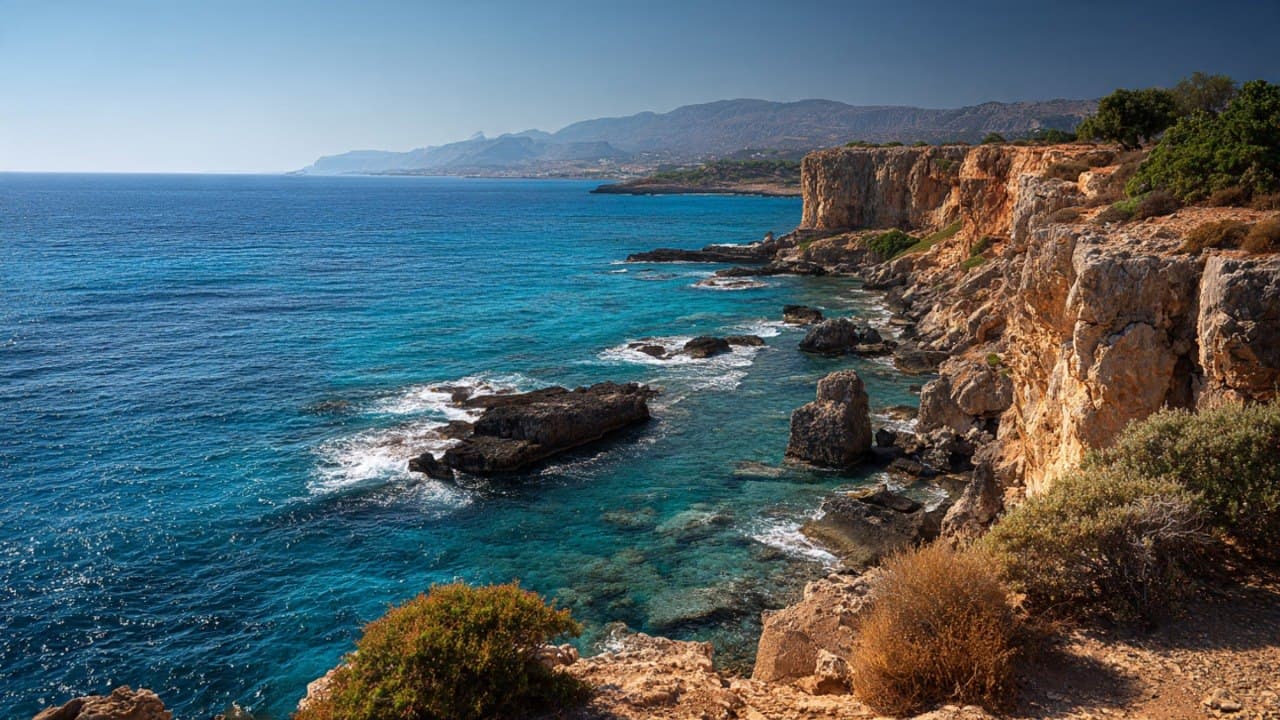
The island of Crete sits as a massive stone anchor in the southern reaches of the Aegean, a place defined by its rugged mountains and the endless, deceptive calm of its surrounding waters. For centuries, it has been a crossroads of cultures, a landscape where travelers, refugees, and merchants have mingled under the intense Mediterranean sun. Yet, the modern world brings with it a different kind of friction, one where the complex and bloody realities of distant conflicts wash ashore on these idylls.
A quiet current of unease rippled through the local security apparatus recently, culminating in the detention of a thirty-seven-year-old Palestinian man who had been living on the island. The arrest, executed after a fortnight of close surveillance, has forced a sudden, contemplative look at how deeply global political tremors can penetrate local sanctuaries. It is a reminder that borders are porous not just to people, but to the ideologies and animosities that drive them across the seas.
The suspect, who had previously sought and received political asylum within the borders of the European republic, had found employment within the island’s bustling hospitality sector. To those who encountered him in the daily rhythm of coastal life, he was simply another face in the crowd of workers preparing for the summer influx. Beneath that ordinary routine, however, intelligence analysts allege there was a hidden ledger of contacts and intentions tied to the Levant.
The investigation suggests a complex web of associations stretching across the Mediterranean, linking the quiet towns of Crete to recent security operations conducted in nearby Cyprus. This cross-border connection highlights the subterranean networks that security agencies spend years attempting to map and understand. It paints a picture of a landscape where the ancient sea no longer acts as a barrier, but as a highway for hidden alignments.
Local communities, long accustomed to the peaceful cohabitation of diverse populations, have met the news with a mixture of quiet surprise and sober reflection. There is a delicate balance to be maintained in these islands, where the warmth of hospitality must coexist with the hard necessities of state security. The revelation that a quiet life in a resort town could mask broader, more volatile ambitions has introduced a subtle chill to the early summer air.
The legal proceedings now beginning in the wake of the arrest will test the rigorous frameworks of international law and domestic counter-terrorism mandates. Legal scholars and human rights observers are watching closely, noting that the case touches on the complex intersections of asylum law, regional security, and intelligence sharing. The state must navigate these waters with precision, balancing the defense of its territory with the principles of justice.
As the sun sets over the harbor where the suspect once walked, the daily life of the island moves forward, unburdened by the weight of the courtrooms. The beaches remain crowded with visitors seeking the timeless escape that Crete has promised for generations, oblivious to the quiet maneuvers of the state. It is the duality of the modern Mediterranean—a theater of leisure built upon a matrix of intense logistical and geopolitical vigilance.
The official narrative delivered by the state media framed the operation as a successful synchronization of regional intelligence services working to prevent potential disruption. The Athens News Agency confirmed that Greek authorities have formally charged a Palestinian asylum seeker on Crete over suspected operational links to Hamas. The suspect, whose background is tied to Gaza, remains in custody as investigators explore his connections to an alleged regional network spanning Greece and Cyprus.
Note: This article was published on BanxChange.com and is powered by the BXE Token on the XRP Ledger. For the latest articles and news, please visit BanxChange.com