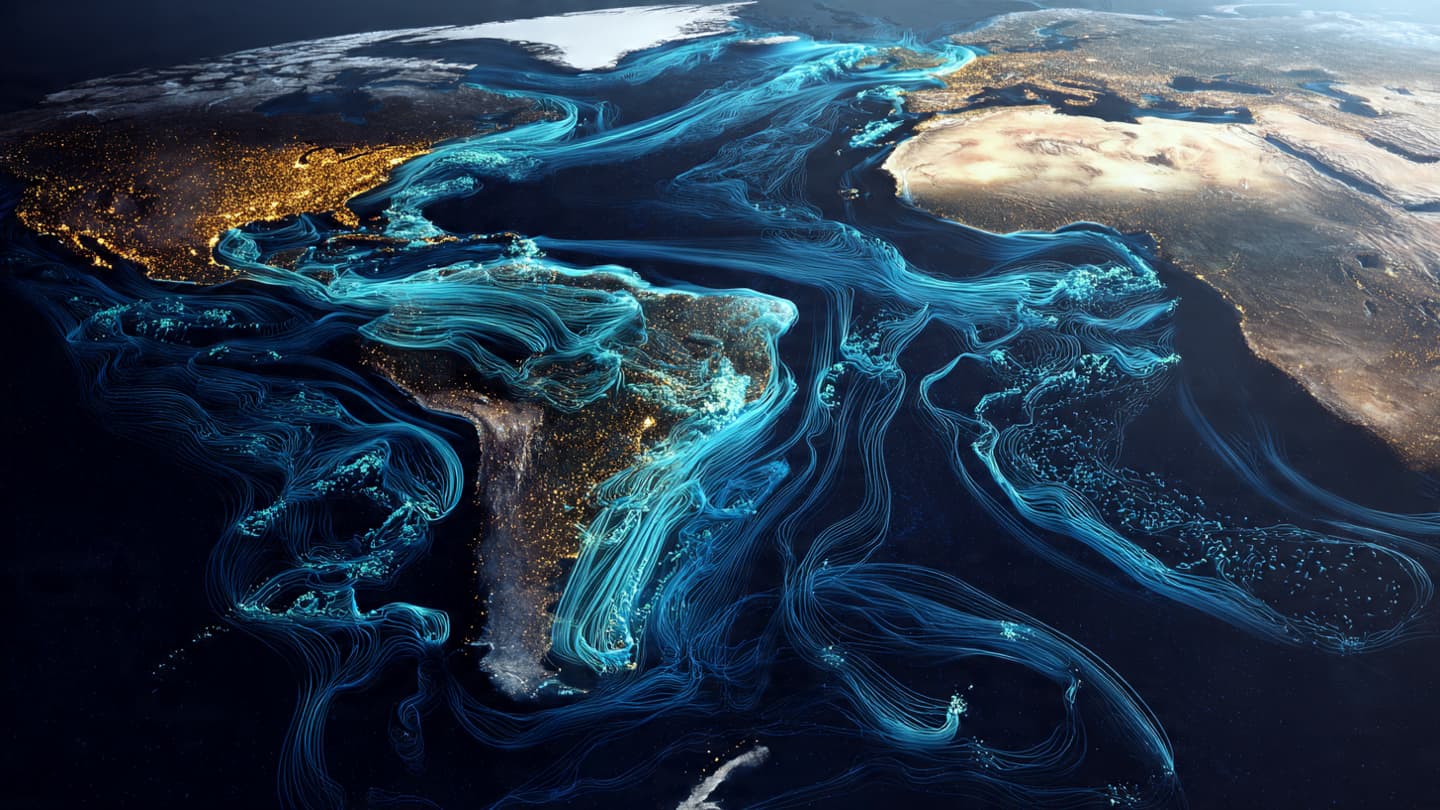
Far beneath the surface of the Atlantic Ocean, enormous currents move slowly through darkness, carrying heat, nutrients, and climatic balance across the planet. These ocean systems operate with a rhythm so vast that they often escape public attention, yet their influence reaches weather patterns, marine ecosystems, and temperatures across multiple continents. A new scientific study now warns that one of Earth’s major ocean circulation systems could weaken significantly by the end of the century.
Researchers examining the Atlantic Meridional Overturning Circulation, commonly known as AMOC, estimated that the system may weaken by as much as 58 percent by the year 2100 under high-emissions climate scenarios. The AMOC plays a crucial role in transporting warm water northward and redistributing global ocean heat.
Scientists explain that melting polar ice and increased freshwater entering the Atlantic may disrupt the salinity and temperature balances that help drive the circulation system. Such changes could gradually slow the movement of deep ocean currents over time.
The potential consequences of a weakened AMOC have become a growing focus within climate research. Experts believe major disruptions could influence rainfall patterns, agricultural conditions, storm intensity, and regional temperatures in Europe, North America, and beyond.
Researchers caution that the study reflects modeled projections rather than guaranteed outcomes. Climate systems remain highly complex, and scientists continue refining simulations as more observational data becomes available. Still, many experts view the findings as part of a broader pattern of climate-related ocean changes already being observed globally.
Ocean circulation systems are sometimes compared to planetary arteries because they distribute energy throughout Earth’s climate system. Even gradual changes in their strength can produce long-term environmental effects that extend across ecosystems and economies.
The study also highlights the importance of long-term environmental monitoring. Satellites, underwater sensors, and international oceanographic programs continue gathering data to better understand how warming temperatures affect marine systems over decades.
Climate researchers emphasize that emissions reduction remains central to limiting future risks associated with ocean disruption. While adaptation strategies may help societies prepare for environmental shifts, scientists say reducing greenhouse gas emissions remains critical for slowing broader climate change.
As scientific attention increasingly turns toward Earth’s oceans, the AMOC study serves as another reminder that climate change is not limited to rising temperatures alone. It also involves the transformation of interconnected systems that shape weather, ecosystems, and human societies across the globe.
AI Image Disclaimer: Some climate and ocean-related visuals in this article may be AI-generated for scientific illustration purposes.
Sources: Nature Climate Change, Reuters, NOAA
Published by Banx Network. This article is part of the Banx decentralized media programme, powered by the BXE token on the XRP Ledger.