

Key Highlights
- Incident:Helicopter hard landing at Gisborne Airport.
- Casualties:Two occupants sustained minor injuries.
- Response:Emergency services deployed from multiple regional stations.
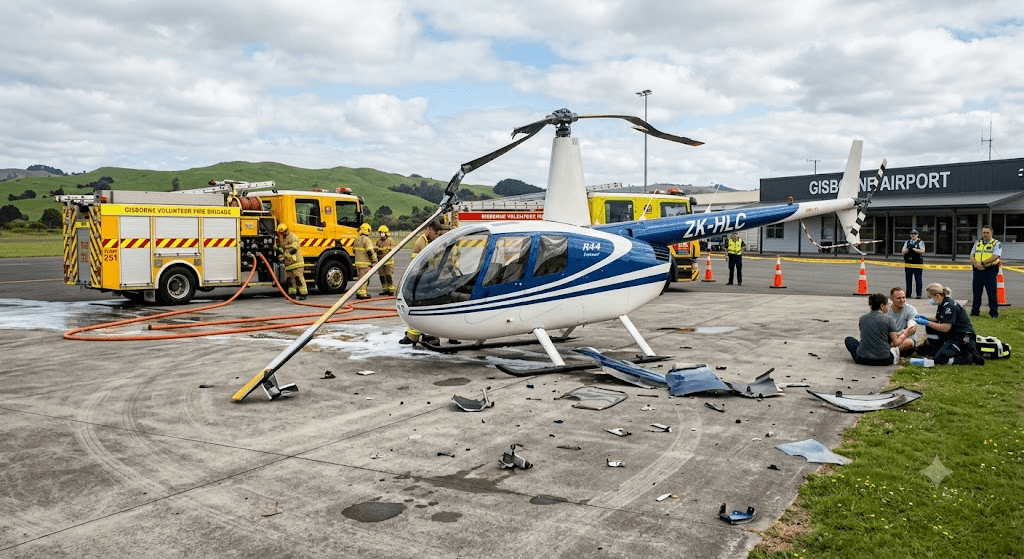
GISBORNE, NEW ZEALAND — A full-scale emergency response was triggered at Gisborne Airport on Tuesday afternoon, July 7, 2026, following an incident involving a helicopter that air traffic control initially flagged as a crash. Fortunately, what could have been a major disaster ended in a sigh of relief as both occupants walked away with minor injuries.
Emergency services were alerted just before 2:00 PM after air traffic control reported an unfolding helicopter crash on the airfield. Fire and Emergency New Zealand (FENZ) immediately deployed a significant response, dispatching crews from regional stations including Gisborne, Eastland, Pātūtahi, Tolaga Bay, and Manutuke to secure the scene.
Police later clarified that the aircraft had executed what was classified as a "hard landing." Airport officials confirmed through social media that only two people were on board the helicopter at the time of the rough touchdown. Hato Hone St John ambulance personnel quickly arrived to assess the situation. Paramedics examined the two individuals at the scene and confirmed they were in "minor conditions."
"No transportation to hospital was required," a St John spokesperson stated, highlighting just how incredibly lucky the occupants were to escape major harm. FENZ personnel remained on the tarmac for some time, working thoroughly to mitigate potential hazards, such as fuel leaks, and ensuring the scene was completely safe.
While the airfield has been stabilized, questions remain as to what caused the aircraft to settle so violently. Authorities confirmed that the Civil Aviation Authority (CAA) has been formally notified of the incident and will take the lead in investigating the underlying causes of the hard landing. The investigation will likely focus on the helicopter's mechanical condition and the pilot's actions leading up to the landing.
This incident serves as a reminder of the importance of safety protocols in aviation, especially in emergency situations. The swift response from emergency services undoubtedly played a crucial role in ensuring the safety of the occupants and minimizing potential hazards on the ground.
As the investigation unfolds, further updates are expected from the CAA and local authorities regarding the findings and any necessary safety recommendations that may arise from this incident. The community remains grateful that the outcome was not more severe, and the focus now shifts to understanding the factors that contributed to this hard landing.
Published by Banx Network. This article is part of the Banx decentralized media programme, powered by the BXE token on the XRP Ledger.




