Opening: In the silent vacuum of space, gravity is a patient hunter, waiting for the slightest lapse in velocity to pull its prey back to Earth. For two decades, the Neil Gehrels Swift Observatory has orbited our planet, capturing the fleeting brilliance of gamma-ray bursts and revealing the violent birth cries of black holes. But recently, the thin whispers of Earth’s atmosphere have begun to drag it down, threatening to end its scientific life in a fiery descent. In a daring move that blends urgency with innovation, NASA has launched an emergency rescue mission, not to bring Swift home, but to give it a new lease on life among the stars.
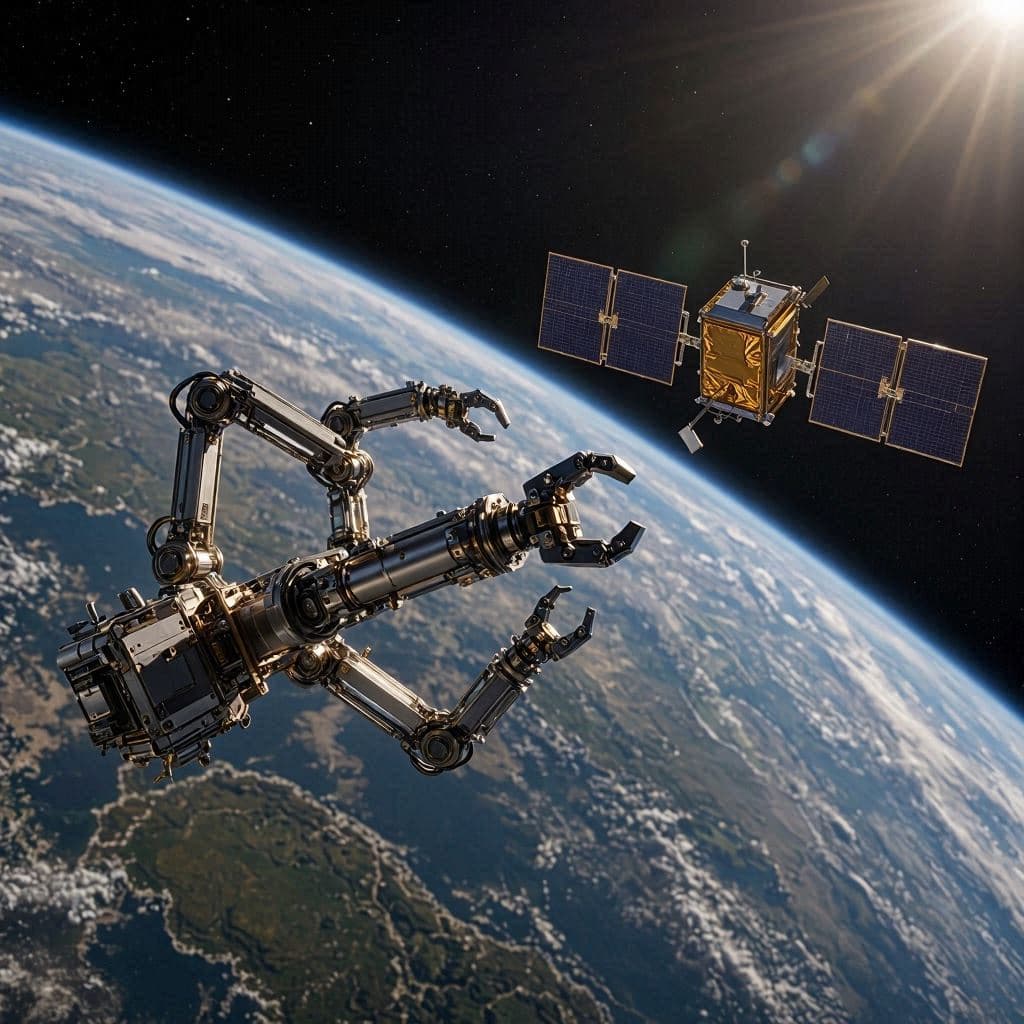
Body: The mission, which launched in early July 2026, involves a specialized robotic spacecraft named Link. Designed with three articulated arms, Link is tasked with rendezvousing with the aging telescope and attaching a propulsion module. This module will provide the necessary thrust to boost Swift back into a stable orbit, extending its operational life by several years. The maneuver is complex and unprecedented, marking the first time such a salvage operation has been attempted for a scientific satellite in low-Earth orbit.
Swift’s decline was accelerated by increased solar activity, which caused Earth’s upper atmosphere to expand and create more drag on the satellite. Without intervention, models predicted that Swift would burn up in the atmosphere by late 2026 or early 2027. The $30 million rescue effort, assembled in just nine months, represents a fraction of the cost of building and launching a new observatory. It is a testament to the value of preserving existing assets and the growing importance of sustainability in space exploration.
The technical challenges are significant. Link must navigate precisely to match Swift’s speed and orientation, then securely attach itself to the telescope without causing damage. Once connected, the propulsion module will fire its engines to raise Swift’s altitude. This process requires flawless coordination between ground controllers and the autonomous systems on board both spacecraft. Any error could result in the loss of both vehicles, making it a high-risk, high-reward endeavor.
Scientifically, saving Swift is a priority for the astronomy community. The telescope’s ability to rapidly detect and locate gamma-ray bursts makes it indispensable for multi-messenger astronomy. By coordinating with other observatories, Swift helps scientists piece together the stories of cosmic explosions, from collapsing stars to merging neutron stars. Its extended life will allow for further discoveries that could reshape our understanding of high-energy physics and the evolution of the universe.
This mission also sets a precedent for future space operations. As the number of satellites in orbit grows, the ability to service, refuel, and de-orbit them becomes crucial for managing space debris and maintaining a sustainable environment. Link’s success could pave the way for a new industry of in-orbit servicing, where robots perform maintenance and repairs on valuable assets. It transforms the concept of space missions from one-time launches to long-term, manageable infrastructure.
Public interest in the mission has been high, with many viewing it as a hopeful narrative in an era of technological complexity. The idea of rescuing a beloved scientific instrument resonates with people who value exploration and discovery. It serves as a reminder that human ingenuity can overcome even the most daunting physical laws, provided we act with creativity and determination. The world watches with bated breath as Link begins its month-long journey to its target.
As the spacecraft approaches Swift, the tension will mount. Success will mean years of additional science; failure will mean the loss of a pioneer. Regardless of the outcome, the attempt itself is a milestone. It demonstrates a shift in how we approach space, moving from disposal to preservation. It is a step toward a more responsible and enduring presence in the cosmos.
Closing: NASA’s emergency mission to save the Swift Observatory highlights the innovative approaches being taken to preserve scientific assets in space. By using a robotic spacecraft to boost the telescope’s orbit, agencies hope to extend its valuable contributions to astronomy. This pioneering effort underscores the importance of sustainability and resourcefulness in future space exploration.
AI Image Disclaimer: Please note that the visual illustrations accompanying this article are AI-generated representations intended to contextualize the discussion on space technology and rescue missions.
Sources: CNN Euronews Phys.org ABC News
Published by Banx Network. This article is part of the Banx decentralized media programme, powered by the BXE token on the XRP Ledger.