
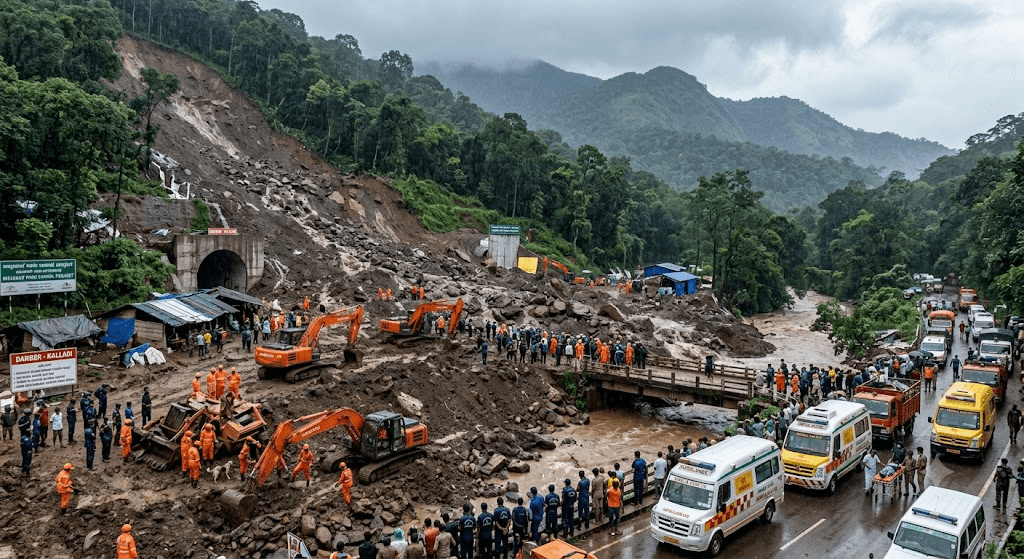
WAYANAD, Kerala — In a catastrophic event that has revived painful memories of past environmental crises, a massive landslide struck the under-construction twin-tunnel road project at Kalladi near Meppadi on Tuesday, July 7, 2026. Triggered by unrelenting monsoon rains, the disaster have claimed at least five lives, left several injured, and prompted an expansive rescue mission amid highly unstable terrain.
The disaster unfolded rapidly just before noon near the Meenakshi Bridge. Following torrential downpours that surpassed 200 mm within 24 hours, a massive hillside slope gave way. Within seconds, a thunderous avalanche of mud, boulders, and debris crashed down upon the worksite, completely engulfing vehicles, temporary structures, and heavy earth-moving machinery.
Emergency officials confirmed that the death toll rose to five as rescue crews systematically combed through the thick mud. The deceased have been identified as migrant laborers working on the infrastructure project, including Chandraban from Madhya Pradesh, Bikash Kumar from Bihar, and Anmol from Jharkhand.
A total of 18 people were caught directly in the path of the landslide. Beyond the fatalities, at least ten individuals’ sustained injuries, with several currently undergoing intensive treatments at the WIMS Hospital in Meppadi, where at least one victim remains in critical condition.
A multi-agency emergency response—comprising over 100 personnel from the National Disaster Response Force (NDRF), Fire and Rescue Services, state police, and local volunteers—was deployed on a war footing. Deploying multiple excavators and cadaver dogs, rescue personnel worked tirelessly through the night to clear debris piles reaching up to 20 feet deep in a desperate bid to locate three workers who remain missing.
The tragedy has swiftly sparked an intense political row and public outcry across Kerala. State ministers, including Agriculture Minister T. Siddique and Public Works Minister P. K. Basheer, have aggressively classified the incident as a "man-made disaster" rather than a natural occurrence.
Government officials allege that the catastrophe was explicitly accelerated by the unscientific piling up of vast quantities of excavated earth directly adjacent to the tunnel portal. According to the state administration, the project's contractors had been issued strict, written directives by the District Disaster Management Authority on June 25 to halt operations for the monsoon and safely remove the accumulated soil heaps.
"This is not a natural landslide. It is a mudslide caused by the unscientific piling up of excavated earth," stated Minister Siddique. "During a meeting attended by Konkan Railway officials, we had warned about the danger posed by the huge mound of excavated soil and directed that it be removed. Those directions were not complied with."
Conversely, representatives from the construction firm have pushed back against the state’s narrative. Project engineers claimed that the slide originated entirely outside the demarcated tunnel construction zone, failing at a high point on the adjacent natural hillside before thundering down to block the Meenakshi River and sever the vital Meppadi-Chooralmala road.
The 8.2-kilometer, ₹2,134-crore twin-tunnel project—designed to link Kozhikode and Wayanad districts through the Vellarimala mountain range—is one of the state's largest current infrastructure investments. However, environmentalists have long flagged major safety concerns, noting that the tunnel cuts directly through one of the most ecologically fragile and landslide-prone belts in the Western Ghats.
The disaster struck just five kilometers from the site of the catastrophic 2024 Mundakkai-Chooralmala landslides, which claimed nearly 300 lives. Local police have registered an official case regarding the incident as a detailed investigation gets underway to determine whether criminal negligence and lapses in safety protocols directly contributed to the loss of life.
Note: This article was published on BanxChange.com and is powered by the BXE Token on the XRP Ledger. For the latest articles and news, please visit BanxChange.com