The universe rarely reveals its secrets all at once. Often, it whispers through faint signals traveling across immense cosmic distances, waiting patiently for instruments sensitive enough to hear them. Scientists working with the Square Kilometre Array, or SKA Observatory, believe the next generation of radio astronomy may bring humanity closer to understanding some of the universe's deepest mysteries.
Researchers affiliated with the SKA Observatory have recently outlined new scientific priorities for the future of radio astronomy, presenting an ambitious roadmap designed to guide observations in the coming decades. Their goals range from studying the earliest epochs of the universe to investigating the nature of cosmic magnetism.
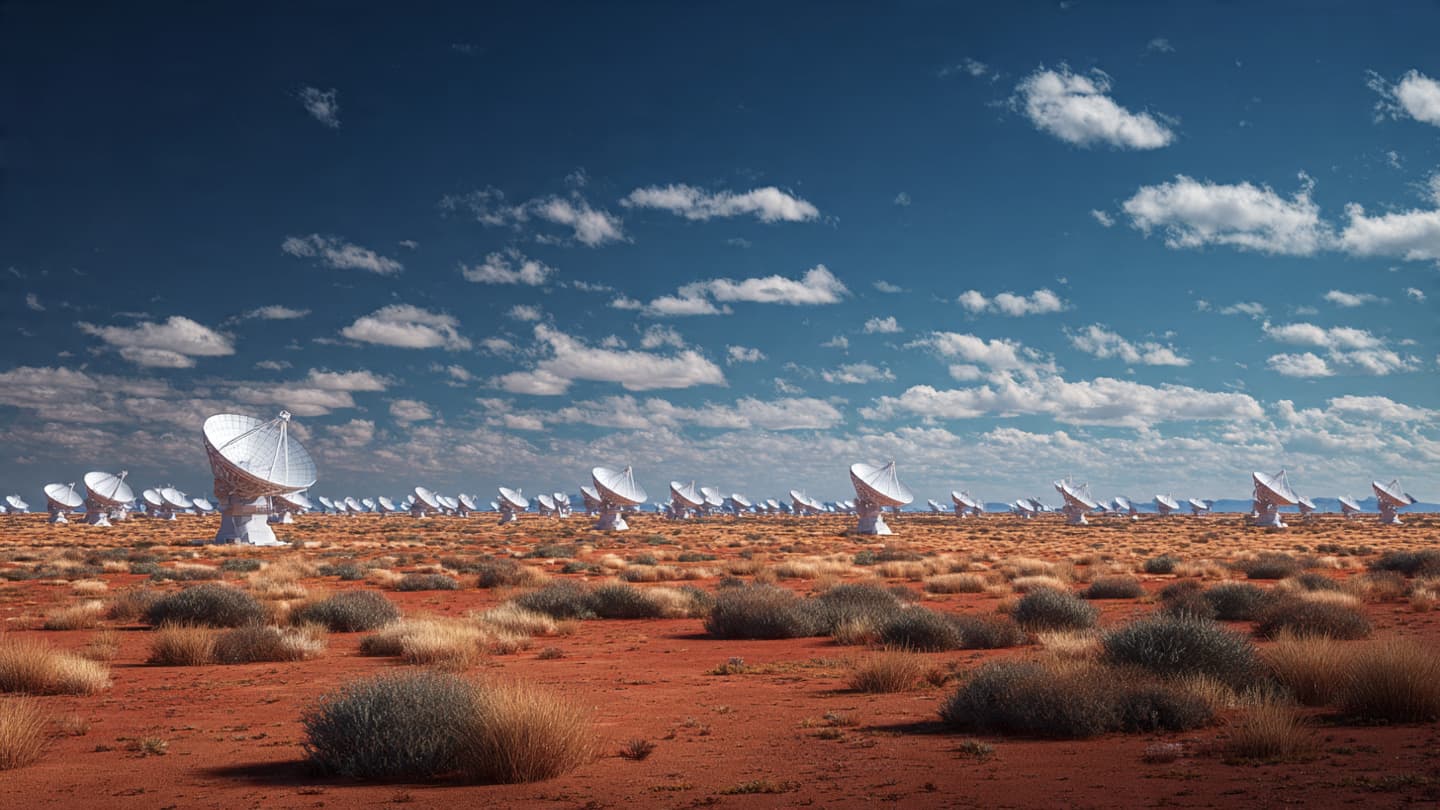
The SKA Observatory, currently under construction in Australia and South Africa, is expected to become the world's largest radio telescope. Once operational, its vast network of antennas will allow astronomers to detect extremely faint radio signals from distant regions of space.
One major objective involves exploring the Cosmic Dawn, the period when the first stars and galaxies formed after the Big Bang. Scientists hope that radio observations will help reconstruct this formative chapter in cosmic history with unprecedented detail.
Researchers also intend to use the observatory to test fundamental theories of gravity. By observing pulsars—rapidly rotating neutron stars that emit regular radio pulses—scientists may gain new insights into the behavior of gravity under extreme conditions.
Another area of interest concerns cosmic magnetism. Magnetic fields influence the formation and evolution of galaxies, yet many aspects of their origin remain poorly understood. The SKA is expected to provide extensive new data to address these longstanding questions.
The observatory will additionally contribute to studies of galaxy evolution, black holes, and potentially even the search for signs of extraterrestrial technology. Scientists emphasize that radio astronomy has historically produced unexpected discoveries, making flexibility an important component of future research planning.
International collaboration remains central to the SKA project. Thousands of researchers from numerous countries are contributing expertise, technology, and scientific planning to ensure the observatory's success.
As construction advances, scientists view the SKA not only as a telescope, but as a global scientific endeavor capable of expanding humanity's understanding of the cosmos for generations to come.
AI Image Disclaimer: The images accompanying this article are AI-generated illustrations intended solely to provide visual context.
Sources Verified: SKA Observatory, peer-reviewed astronomy publications, Nature Astronomy, Reuters
Published by Banx Network. This article is part of the Banx decentralized media programme, powered by the BXE token on the XRP Ledger.