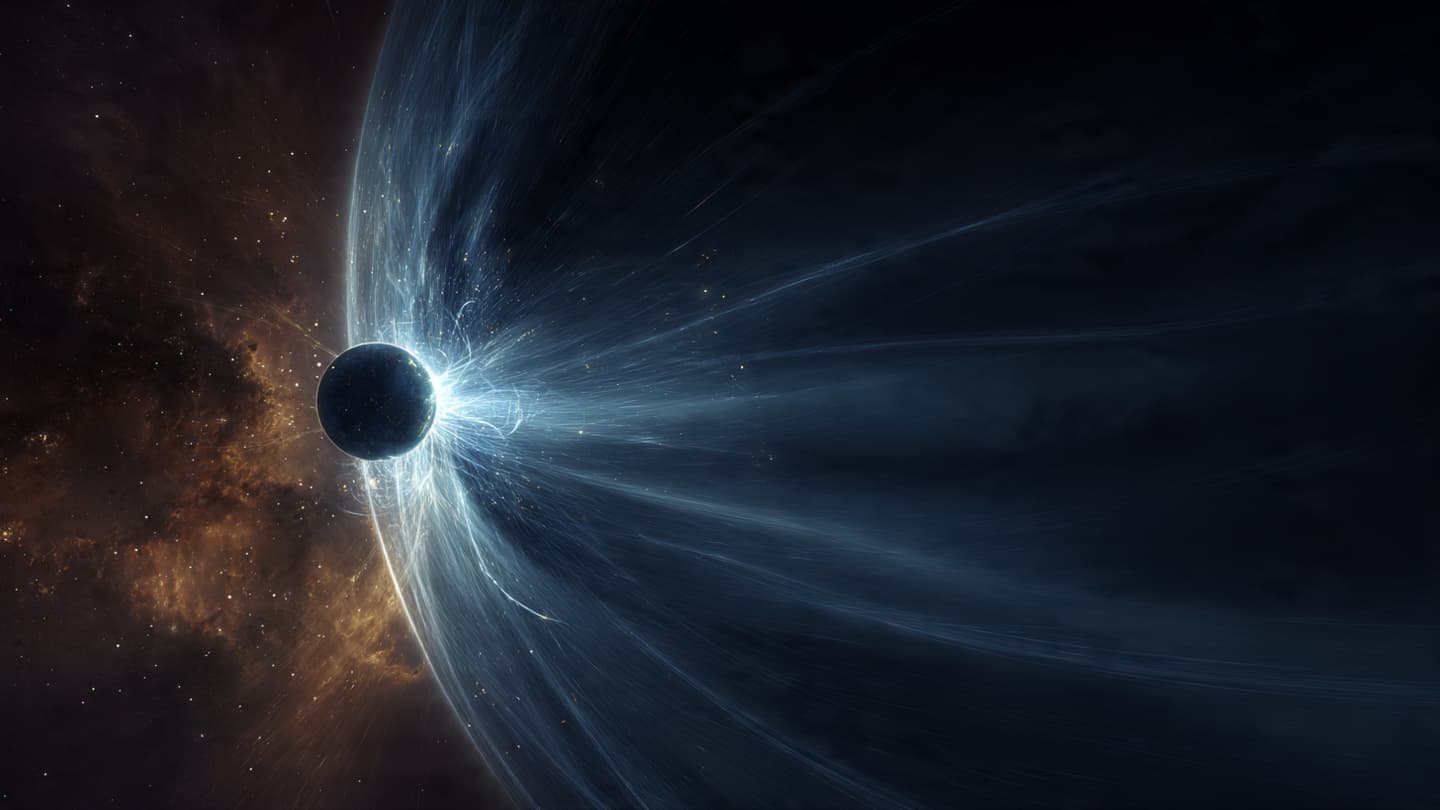
The night sky has long inspired humanity to look beyond familiar horizons. Every generation has added new chapters to the story of exploration, transforming distant points of light into worlds with landscapes, atmospheres, and histories of their own. Now, astronomers have reported evidence that some exoplanets possess magnetic fields, adding an important piece to the puzzle of planetary habitability.
Exoplanets are planets located outside our solar system, orbiting stars far beyond the Sun. Thousands have been discovered over the past few decades, revealing a remarkable diversity of planetary environments. Some are gas giants larger than Jupiter, while others are rocky worlds that share similarities with Earth.
The recent discovery is significant because magnetic fields can serve as protective shields. On Earth, the magnetic field helps deflect charged particles from the Sun, reducing atmospheric erosion and protecting conditions that support life. Scientists have long suspected that magnetic fields may play a similar role on other planets.
Detecting such fields is not a simple task. Because exoplanets are located many light-years away, researchers must rely on indirect observations. By analyzing interactions between planets and their host stars, astronomers can identify signals that suggest the presence of magnetic activity.
The findings contribute to a broader effort to understand which planets might possess environments capable of sustaining life. While a magnetic field alone does not guarantee habitability, it represents one of several factors scientists consider when evaluating potentially Earth-like worlds.
Researchers emphasize that habitability depends on a combination of conditions. Temperature, atmospheric composition, water availability, and geological activity all influence whether a planet could support life. Magnetic protection is one important element within this larger framework.
Advances in telescope technology have played a crucial role in enabling such discoveries. Modern observatories collect increasingly detailed data from distant planetary systems, allowing scientists to investigate characteristics that were once beyond reach.
The discovery also demonstrates how rapidly planetary science continues to evolve. Questions that seemed impossible to answer a generation ago are now becoming subjects of active research, expanding humanity’s understanding of the universe and its countless worlds.
As astronomers continue surveying the galaxy, the search for potentially habitable planets remains one of the most compelling scientific endeavors of our time. Each new finding brings researchers closer to understanding whether life-friendly conditions exist elsewhere among the stars.
AI Image Disclaimer: The illustration accompanying this article is AI-generated and intended to visually represent scientific concepts related to exoplanet research.
Sources Verified Reuters, NASA, European Space Agency, Nature Astronomy, Scientific American
Published by Banx Network. This article is part of the Banx decentralized media programme, powered by the BXE token on the XRP Ledger.