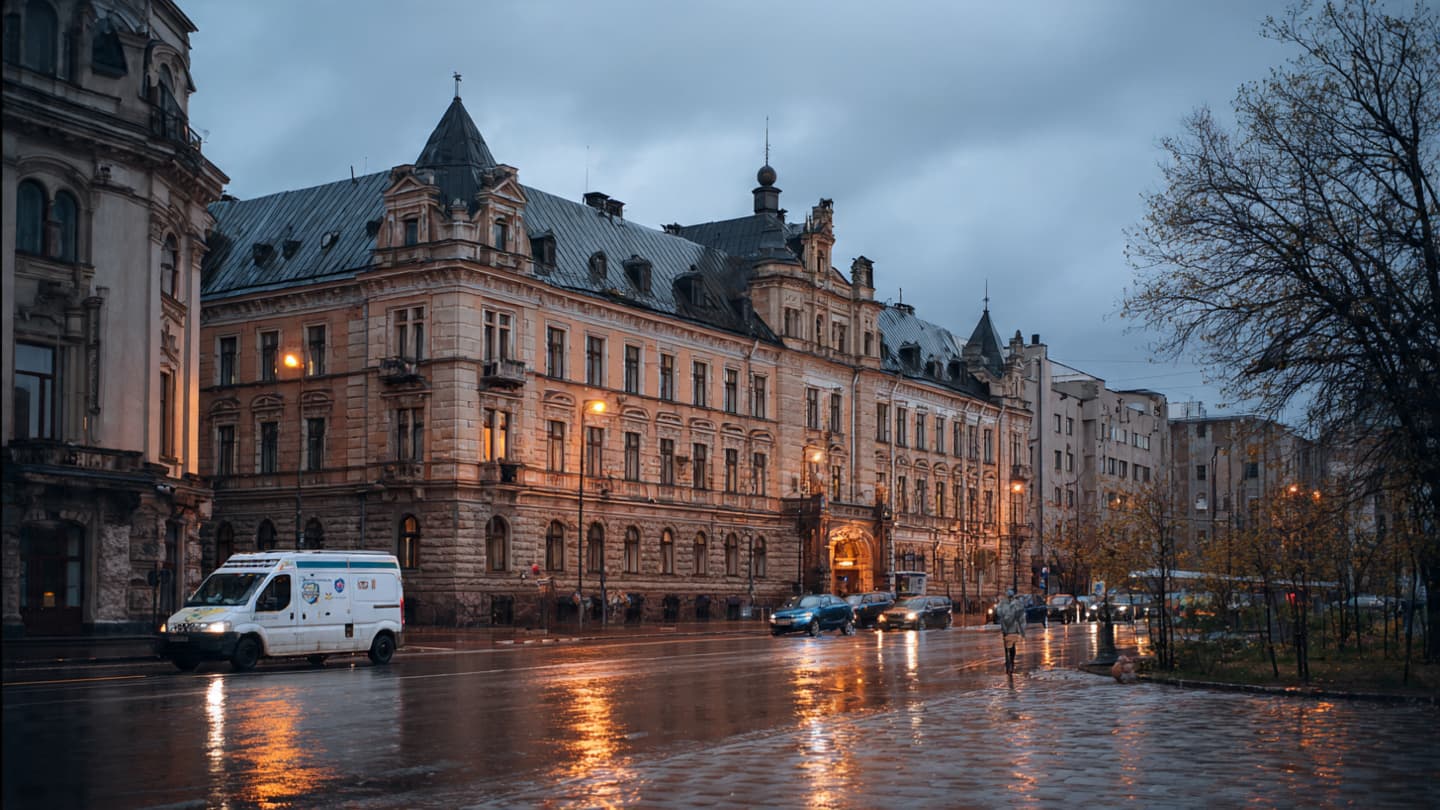
In Riga, mornings often begin with the slow rhythm of trams crossing wet streets beneath pale northern light. The Daugava River moves quietly through the Latvian capital, reflecting church towers, glass offices, and the subdued colors of a country long accustomed to balancing history with caution. In cafés near the old city, conversations drift between economics, weather, and the uneasy geography of living close to Europe’s eastern frontier.
But in recent weeks, attention has turned upward—to the sky itself.
Latvia’s prime minister announced his resignation amid mounting political pressure linked to a series of drone incursions and growing concerns over national security preparedness. The resignation followed criticism from opposition parties and public debate surrounding the government’s handling of repeated unauthorized aerial activity near Latvian territory, incidents that deepened anxieties already present across the Baltic region since the war in Ukraine reshaped Europe’s security landscape.
The drones themselves became more than technical objects. They evolved into symbols of vulnerability in a region where geography has always carried political weight.
Latvia, along with neighboring Estonia and Lithuania, occupies a sensitive position along NATO’s eastern flank. Forests, wetlands, and border crossings connect the Baltic states to both Russia and Belarus, and since the invasion of Ukraine, military readiness has become part of everyday political conversation. Air patrols, defense budgets, and surveillance systems are discussed not only in government briefings, but also around kitchen tables and commuter stations.
Reports surrounding the incursions described unidentified drones entering or approaching sensitive airspace, raising questions about monitoring capabilities, response coordination, and regional deterrence. Although investigations into the origins and exact purposes of the aircraft remain ongoing, the incidents triggered public frustration over whether Latvia’s institutions were adequately prepared for emerging forms of hybrid security threats.
Modern tensions rarely arrive with the clarity of older wars. Sometimes they appear as cyber disruptions, GPS interference, misinformation campaigns, or small unmanned aircraft crossing borders silently at night. The ambiguity itself becomes destabilizing. A drone can be surveillance, provocation, testing, or merely confusion—and governments are increasingly judged not only by how they respond to attacks, but by how they respond to uncertainty.
The outgoing prime minister acknowledged growing political divisions surrounding the issue while stating that Latvia required renewed leadership capable of maintaining public confidence during a period of regional instability. Coalition negotiations and discussions regarding a successor are expected to continue in the coming days, with defense policy likely remaining central to the country’s political agenda.
Across the Baltics, the war in Ukraine has altered the atmosphere of ordinary life in subtle but persistent ways. NATO military convoys move more frequently along highways once associated mostly with trade and tourism. Civil defense exercises attract renewed participation. Air raid warning systems are tested with greater seriousness. For many residents, the distinction between distant conflict and local vulnerability has grown increasingly thin.
At the same time, Latvia continues trying to preserve the calm rhythms of civilian life that define small democracies in uncertain neighborhoods. Markets remain busy in Riga’s central district. Ferries continue crossing the Baltic Sea. University students gather beside parks where leaves collect beneath statues and memorials tied to earlier periods of occupation and independence.
History lingers heavily in this part of Europe.
The Baltic states spent decades under Soviet control before regaining independence in the early 1990s, and memories of that era continue shaping national attitudes toward sovereignty and security. In this context, even limited airspace violations carry emotional and political resonance beyond their immediate military significance.
By evening, the streets of Riga still glow softly beneath tram wires and rain-polished stone. Government buildings remain lit late into the night as coalition leaders negotiate what comes next. Somewhere beyond the city, radar systems continue scanning the horizon in silence, searching skies that no longer feel entirely empty.
The resignation itself may mark only one chapter in Latvia’s broader political evolution during an era of heightened regional tension. Yet it reflects a wider European reality as well: in a world shaped increasingly by invisible technologies and uncertain boundaries, leadership is often tested not only by crises that explode loudly, but also by those that arrive quietly overhead.
AI Image Disclaimer The illustrations included with this article were generated using AI tools and are intended as visual representations rather than real photographs.
Sources Reuters Baltic News Service Politico Europe Associated Press Latvian Public Broadcasting (LSM)
Published by Banx Network. This article is part of the Banx decentralized media programme, powered by the BXE token on the XRP Ledger.