
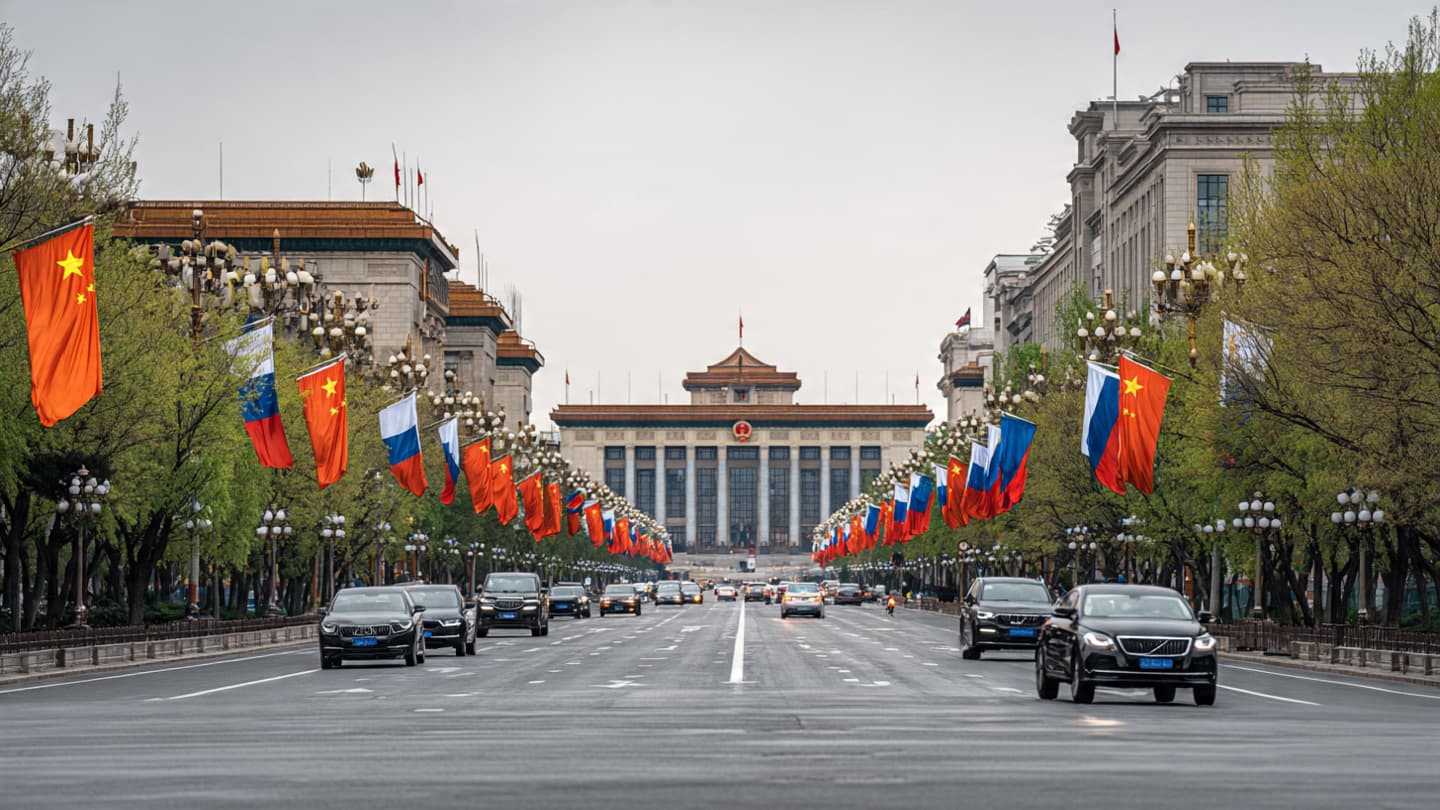
Beijing in late spring carries a particular stillness. The broad boulevards around Tiananmen Square seem to absorb sound beneath rows of carefully trimmed trees, while red flags move softly against pale skies above government compounds sealed behind walls and ceremonial gates. Diplomacy here often unfolds with measured choreography — long motorcades, polished marble halls, carefully spaced handshakes — yet beneath the ritual lies something quieter and more enduring: the patient language of power balancing itself against a changing world.
When Russian President Vladimir Putin arrived in Beijing this week for talks with Chinese leader Xi Jinping, the visit carried the weight of familiarity as much as strategy. The two men have met dozens of times over the years, but this meeting unfolded during a moment when both countries find themselves increasingly defined by their tensions with the West and by their search for alternative centers of influence. The symbolism surrounding the trip was therefore impossible to separate from its substance. Flags lined the streets, military honors echoed across courtyards, and official statements spoke of partnership, sovereignty, and mutual respect in an era both governments describe as unstable and shifting.
The first and perhaps clearest takeaway from the visit was the continued deepening of political alignment between Beijing and Moscow, even as global pressure surrounding Russia’s war in Ukraine persists. China has not openly endorsed the invasion, nor has it provided formal military backing in the way Western governments accuse it of considering. Yet Beijing has consistently resisted efforts to isolate Russia diplomatically and economically. During the meetings, both sides emphasized opposition to what they described as Western “containment” and unilateral pressure, language that reflects a growing sense of shared strategic grievance.
That alignment, however, appears increasingly asymmetrical. Russia arrives in Beijing today under the strain of sanctions, prolonged war, and economic reorientation away from Europe. China, by contrast, remains the larger economic power, the more stable trading hub, and the dominant partner in the relationship. The carefully staged equality of summit photographs cannot entirely conceal that shift. Russia now depends far more heavily on Chinese markets, Chinese technology, and Chinese financial systems than the reverse.
A second takeaway emerged through economics rather than speeches. Energy cooperation remains central to the relationship, and both governments highlighted expanding trade links during the visit. Russia has become one of China’s largest suppliers of oil and gas, with discounted energy exports helping sustain Moscow’s revenues while providing Beijing with stable access to resources. New agreements discussed during the trip touched on infrastructure, agriculture, industrial cooperation, and payment systems designed to reduce reliance on the U.S. dollar.
Yet beneath the announcements lies a broader transformation already underway. Trade between the two countries has accelerated rapidly since Western sanctions isolated much of Russia’s economy from Europe and North America. Chinese vehicles increasingly appear on Russian streets, Chinese electronics fill store shelves once stocked with Western brands, and financial transactions are more frequently settled in yuan rather than dollars or euros. What was once described as partnership has gradually evolved into a structural economic pivot.
Still, the relationship carries complexities both sides rarely acknowledge publicly. China remains cautious about exposing itself to secondary sanctions or damaging trade relationships with Europe and the United States. Beijing’s support for Moscow therefore continues to move within carefully managed boundaries — substantial enough to sustain ties, restrained enough to avoid direct confrontation with Western economies that remain crucial to Chinese growth.
The third and perhaps most revealing aspect of the visit lay in what it suggested about the broader global order taking shape around them. Both Xi and Putin framed their partnership not merely as bilateral cooperation, but as part of a larger effort to challenge Western dominance in international affairs. Their language emphasized multipolarity, sovereignty, and alternative institutions capable of reducing American influence across finance, diplomacy, and security.
This vision resonates differently across the world. In parts of Asia, Africa, Latin America, and the Middle East, governments increasingly seek relationships that allow strategic flexibility rather than rigid alignment with a single global bloc. China and Russia have attempted to position themselves within that sentiment, presenting their partnership as evidence of a world becoming less centered on Western institutions. Whether that vision matures into lasting geopolitical transformation remains uncertain, but the rhetoric itself reflects a shifting international mood.
Meanwhile, the war in Ukraine continues to shape every aspect of the relationship indirectly. Western officials remain concerned that China’s economic ties with Russia help soften the impact of sanctions and prolong Moscow’s capacity to sustain the conflict. Beijing rejects those accusations, insisting it remains neutral while calling for negotiations and criticizing what it portrays as Cold War thinking from the West.
As the meetings concluded, the choreography remained composed until the very end. Delegations departed through guarded courtyards, official communiqués praised enduring friendship, and cameras captured the familiar warmth between two leaders who have spent years cultivating personal rapport. Yet beyond the ceremony, the visit illuminated something larger than diplomatic routine.
The China–Russia relationship now exists not as a temporary alignment of convenience, but as a long-term adaptation to a world both governments believe is fragmenting into competing centers of gravity. One partner arrives carrying economic and military strain; the other moves more cautiously, balancing ambition with calculation. Together they stand beneath the same geopolitical weather, though not always with equal footing beneath the storm.
And so Beijing returns to its ordinary rhythm once more — traffic moving beneath rows of flags, evening light settling over government avenues, guards standing motionless outside ancient walls. But for a few days, within those carefully managed spaces, the contours of a changing global order became visible in gestures, trade agreements, and the quiet persistence of two powers drawing steadily closer as the world around them grows more divided.
AI Image Disclaimer: AI-generated visuals are included for illustrative purposes and do not depict actual photographs from the events described.
Sources:
Reuters Associated Press BBC News Financial Times The Economist
Published by Banx Network. This article is part of the Banx decentralized media programme, powered by the BXE token on the XRP Ledger.
.jpg&w=3840&q=75 "Blake Lively Awarded $400,000 in Legal Fees After Justin Baldoni Lawsuit Dismissed")
.jpg&w=3840&q=75 "US Declares Drought Disaster for Parts of Puerto Rico as Dry Conditions Persist")