
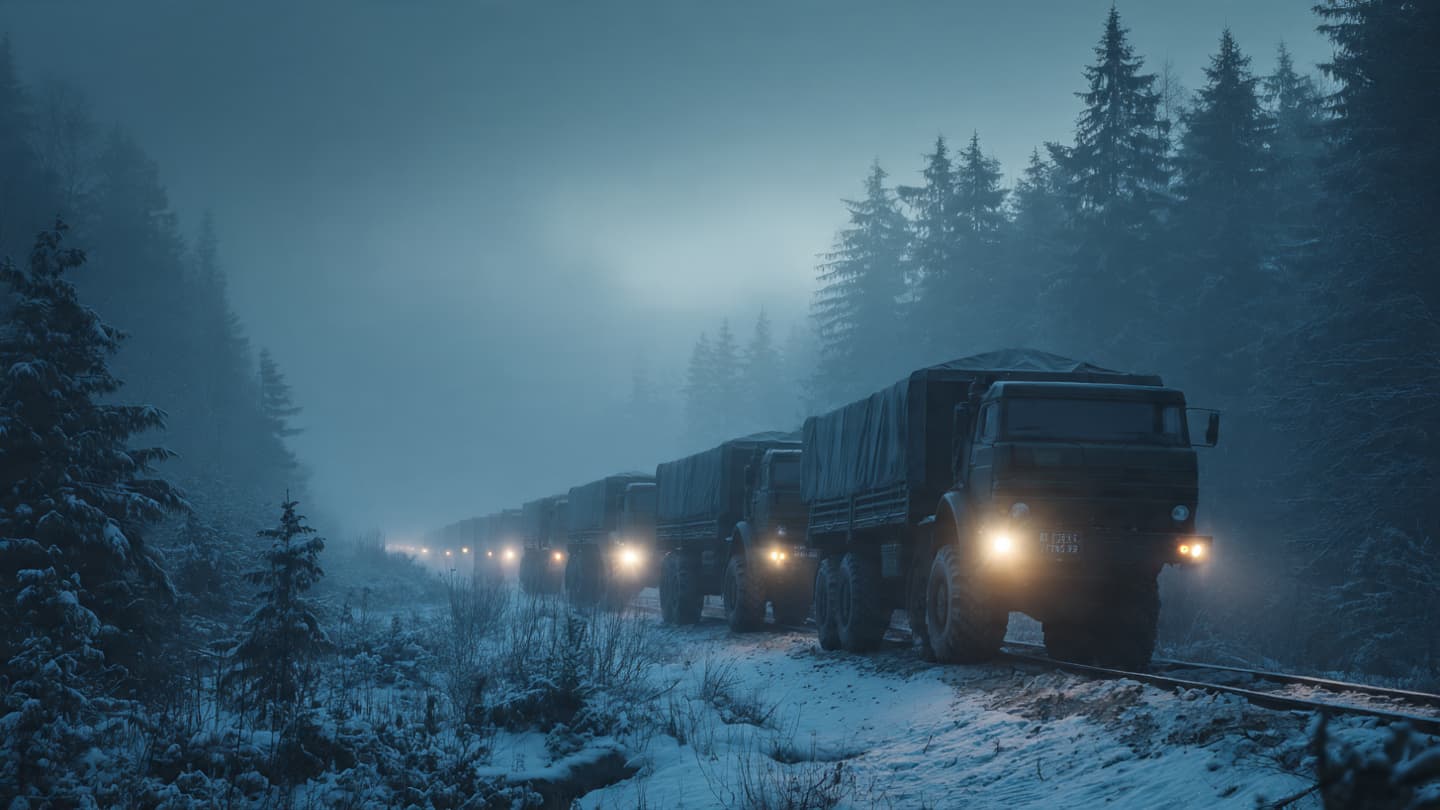
Morning arrives slowly across the plains of Eastern Europe. Fog settles over railway yards and pine forests, drifting between watchtowers, military roads, and villages where daily life continues beneath a sky often shaped by distant decisions. Freight trains move through the cold with muted metallic rhythm, carrying cargoes unseen behind sealed doors. Along these routes, geography and history remain tightly intertwined, each border carrying memories older than the maps themselves.
It is within this atmosphere that Russia’s reported delivery of nuclear warheads to Belarus has deepened tensions between Moscow and NATO, reviving imagery long associated with the Cold War — missile deployments, military calculations, and uneasy balances sustained through deterrence and fear.
Russian officials said the transfer forms part of an existing agreement with Belarus and described the move as a response to growing Western military activity near Russian borders. Belarusian authorities, closely aligned with Moscow, have increasingly presented their territory as a strategic extension of Russian defense policy amid the continuing war in Ukraine and broader confrontation between Russia and Western alliances.
The deployment marks one of the most symbolically significant shifts in Europe’s nuclear landscape in decades. Since the collapse of the Soviet Union, nuclear weapons stationed in Belarus had largely disappeared from public discussion, removed during the post-Soviet disarmament period that briefly suggested the continent might move beyond the nuclear anxieties that defined much of the twentieth century.
Now those anxieties have returned in altered form.
Across NATO capitals, officials responded with concern, though many analysts noted that the practical military impact may be less immediate than the political message itself. Nuclear weapons have always carried dual weight: their destructive capacity and their symbolic presence. Even when unused, they alter diplomatic atmosphere simply by existing within visible strategic geography.
Belarus now occupies an increasingly central role in that geography. Positioned along NATO’s eastern frontier and bordering Ukraine, the country has gradually become more deeply integrated into Russian military planning. Joint exercises, missile deployments, and expanded defense coordination have transformed Belarus from a relatively quiet buffer state into a more active theater within Europe’s broader security tensions.
The language surrounding the announcement also reflects a wider hardening in international relations. Since the invasion of Ukraine, discussions once considered relics of the Cold War — tactical nuclear weapons, escalation risks, deterrence postures — have reentered ordinary diplomatic vocabulary. Military analysts now speak again of deployment ranges, strategic signaling, and regional nuclear balances in tones once largely confined to history books.
Yet outside official briefings and televised statements, daily life continues with an almost dissonant calm. In Minsk, commuters board trams beneath Soviet-era apartment blocks. Farmers work fields stretching toward wooded borders. Cafés fill quietly during the evening while headlines about nuclear deployments scroll across phone screens beside weather updates and football scores.
This contrast has long defined the nuclear age: ordinary human routines unfolding beneath systems capable of extraordinary destruction. The missiles themselves remain unseen by most people. Their presence exists largely through implication — through speeches, satellite imagery, military doctrine, and the invisible calculations of deterrence strategists.
NATO leaders have described Russia’s move as provocative but have thus far indicated no immediate equivalent deployment response. Western officials continue emphasizing alliance readiness while attempting to avoid direct escalation. Behind the scenes, diplomats, military planners, and intelligence agencies are likely engaged in the familiar but delicate work of interpreting signals and intentions within an increasingly tense security environment.
For many Europeans, especially in countries once divided by Cold War frontiers, the development carries historical resonance beyond military analysis. Older generations remember air-raid drills, nuclear shelters, and decades shaped by the possibility of superpower confrontation. The reappearance of nuclear weapons within regional headlines revives memories that had gradually faded after the Soviet Union’s collapse.
The deployment also arrives during a period of broader geopolitical fragmentation, as relations between Russia and the West continue deteriorating across economic, military, and diplomatic spheres. Sanctions, military aid packages, border reinforcements, and strategic exercises have become recurring features of European politics since the Ukraine war began, creating an atmosphere where each new military development is interpreted within a wider cycle of escalation and counter-response.
Still, even amid heightened rhetoric, the essential logic of deterrence remains rooted in restraint. Nuclear weapons are designed less for battlefield use than for signaling consequences too severe to contemplate. Much of the current tension therefore unfolds through posture and perception rather than direct action — a contest of messages carried through troop movements, official statements, and strategic positioning.
As evening falls across Belarusian forests and rail corridors, the physical landscape appears unchanged. Snowmelt gathers beside roads. Freight trains continue westward. Border fences cut through quiet fields beneath fading light. Yet politically, the atmosphere has shifted.
The arrival of nuclear warheads on Belarusian soil marks more than a military transfer. It reflects the gradual return of a world once thought to be receding — a world where diplomacy and deterrence move together uneasily, and where the balance between peace and confrontation is measured not only in treaties or speeches, but in what nations choose to place silently within reach of one another.
AI Image Disclaimer Images accompanying this article were generated using AI tools and are intended as illustrative representations only.
Sources
Reuters NATO Russian Ministry of Defense Associated Press International Atomic Energy Agency
Note: This article was published on BanxChange.com and is powered by the BXE Token on the XRP Ledger. For the latest articles and news, please visit BanxChange.com