The universe has a remarkable ability to challenge human imagination. Just when astronomers believe they have grasped the scale of cosmic structures, new observations reveal objects that stretch those boundaries even further. A recently identified black hole pair may represent one of those moments.
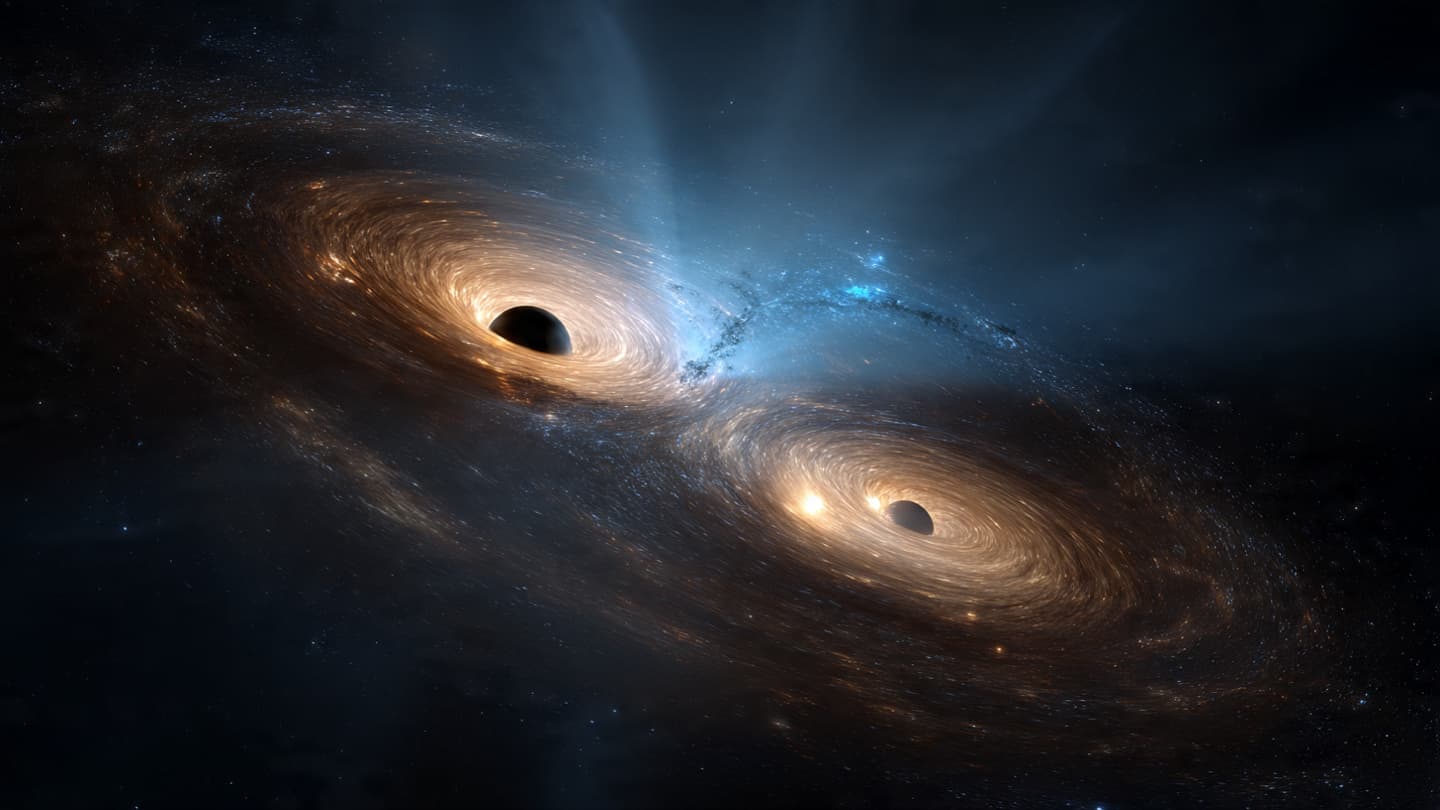
Researchers have reported evidence of what could be the largest binary black hole system ever observed. The candidate system appears to involve two extraordinarily massive black holes orbiting one another within a distant galaxy.
Black holes form when matter becomes compressed into an extremely dense region of space. Their gravitational influence is so powerful that not even light can escape once it passes beyond a certain boundary known as the event horizon.
Binary black hole systems hold particular importance for astronomers. They provide opportunities to study gravity under extreme conditions and offer insights into how galaxies evolve over cosmic timescales.
The newly identified pair stands out because of its estimated mass. Preliminary observations suggest that both objects rank among the most massive black holes known, creating a system of exceptional scale.
Scientists used advanced telescopes and observational techniques to detect signatures indicating the presence of two interacting black holes. Such discoveries often require years of data collection and analysis.
The research may also contribute to the growing field of gravitational-wave astronomy. When massive black holes eventually merge, they can generate ripples in spacetime that travel across the universe.
Astronomers stress that additional observations will be needed to confirm the system's properties. As with many major discoveries, verification through independent studies remains an essential part of the scientific process.
Whether the candidate ultimately proves to be the largest known black hole pair or not, the discovery highlights the extraordinary diversity of cosmic structures. Each new observation deepens humanity's understanding of a universe that continues to reveal unexpected wonders.
AI Image Disclaimer: This article includes an AI-generated illustration intended to represent astronomical phenomena discussed in the report.
Source Verification Check: Science News, Nature Astronomy, Space.com, European Southern Observatory, NASA-related research releases
Published by Banx Network. This article is part of the Banx decentralized media programme, powered by the BXE token on the XRP Ledger.