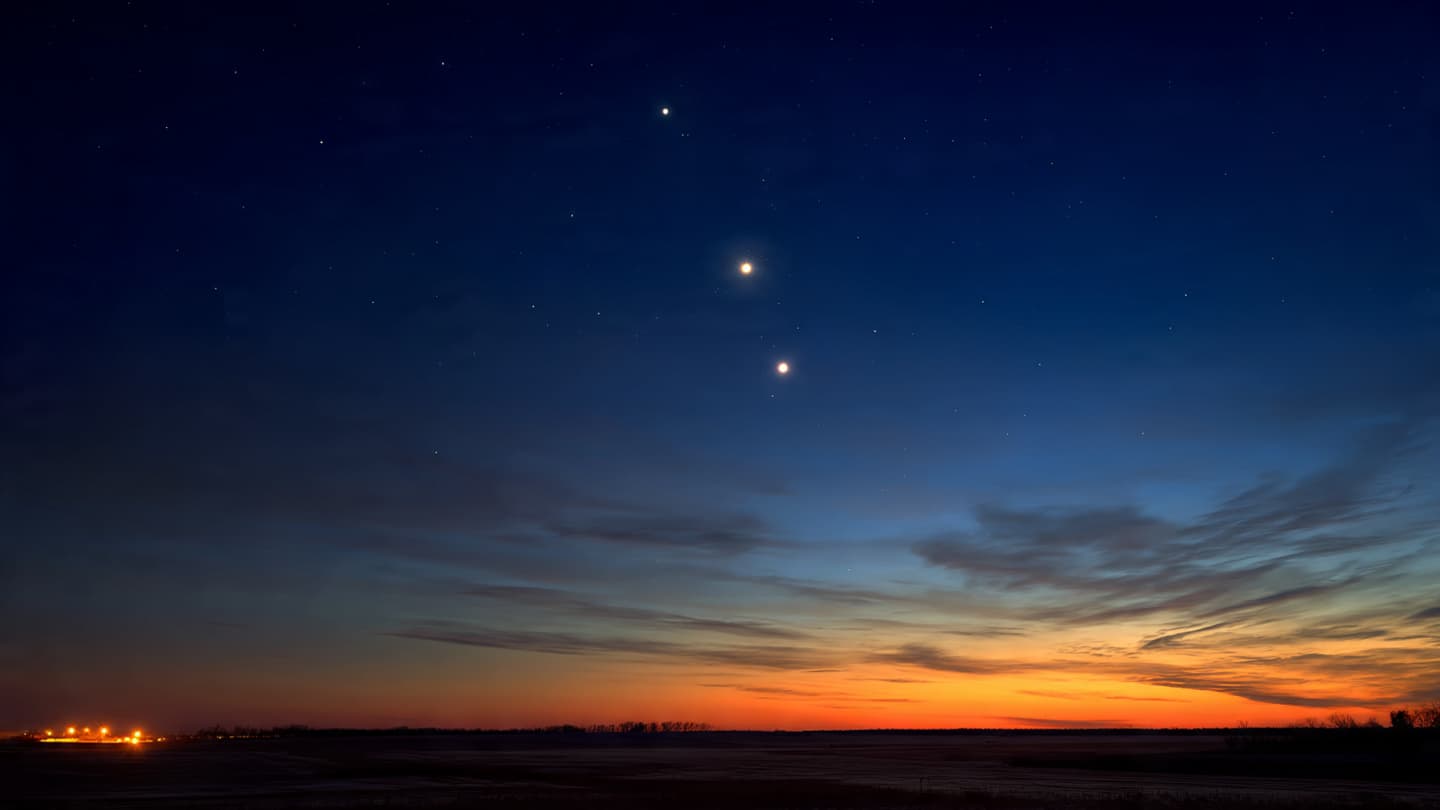
The evening sky has long served as a quiet gathering place where familiar celestial travelers cross paths above the horizon. From ancient stargazers to modern astronomy enthusiasts, people have looked upward to witness moments when planets appear to assemble in graceful formations. Over five consecutive nights, Mercury, Venus, and Jupiter are expected to create a striking planetary display visible to observers under favorable conditions.
Planetary alignments are not rare in a strict astronomical sense, yet they remain visually compelling because they bring several bright worlds into the same region of the sky. Such events offer an accessible opportunity for the public to engage with astronomy without specialized equipment.
During this particular arrangement, Mercury, Venus, and Jupiter will appear relatively close together from Earth's perspective. The planets are not physically near one another in space, but their orbital positions create the illusion of a celestial gathering when viewed from the ground.
Venus is expected to be the easiest object to identify because of its exceptional brightness. Jupiter will also stand out, while Mercury may require a clear horizon and careful timing due to its lower position and proximity to the Sun.
Astronomers recommend observing shortly after sunset when the planets become visible in the western sky. Weather conditions, local light pollution, and horizon obstructions will influence viewing quality.
Events such as this often inspire public interest because they transform complex orbital mechanics into something easily observable. The movements of planets that scientists calculate with precision become visible patterns for anyone willing to spend a few moments under the evening sky.
The planetary gathering also highlights the dynamic nature of the solar system. While stars generally maintain their relative positions, planets continually shift against the celestial background as they orbit the Sun.
Astronomy organizations frequently encourage families, students, and amateur observers to use these occasions as opportunities for learning and exploration. Even simple binoculars can enhance the viewing experience.
For those with clear skies, the five-night planetary parade offers a chance to witness a memorable celestial arrangement. The event serves as a reminder that some of the most engaging astronomical experiences remain visible without leaving Earth.
AI Image Disclaimer: Some visual materials accompanying this article may be AI-generated artistic interpretations of astronomical viewing conditions.
Sources Verification Check:
NASA Sky & Telescope EarthSky Space.com Astronomy Magazine
Published by Banx Network. This article is part of the Banx decentralized media programme, powered by the BXE token on the XRP Ledger.