
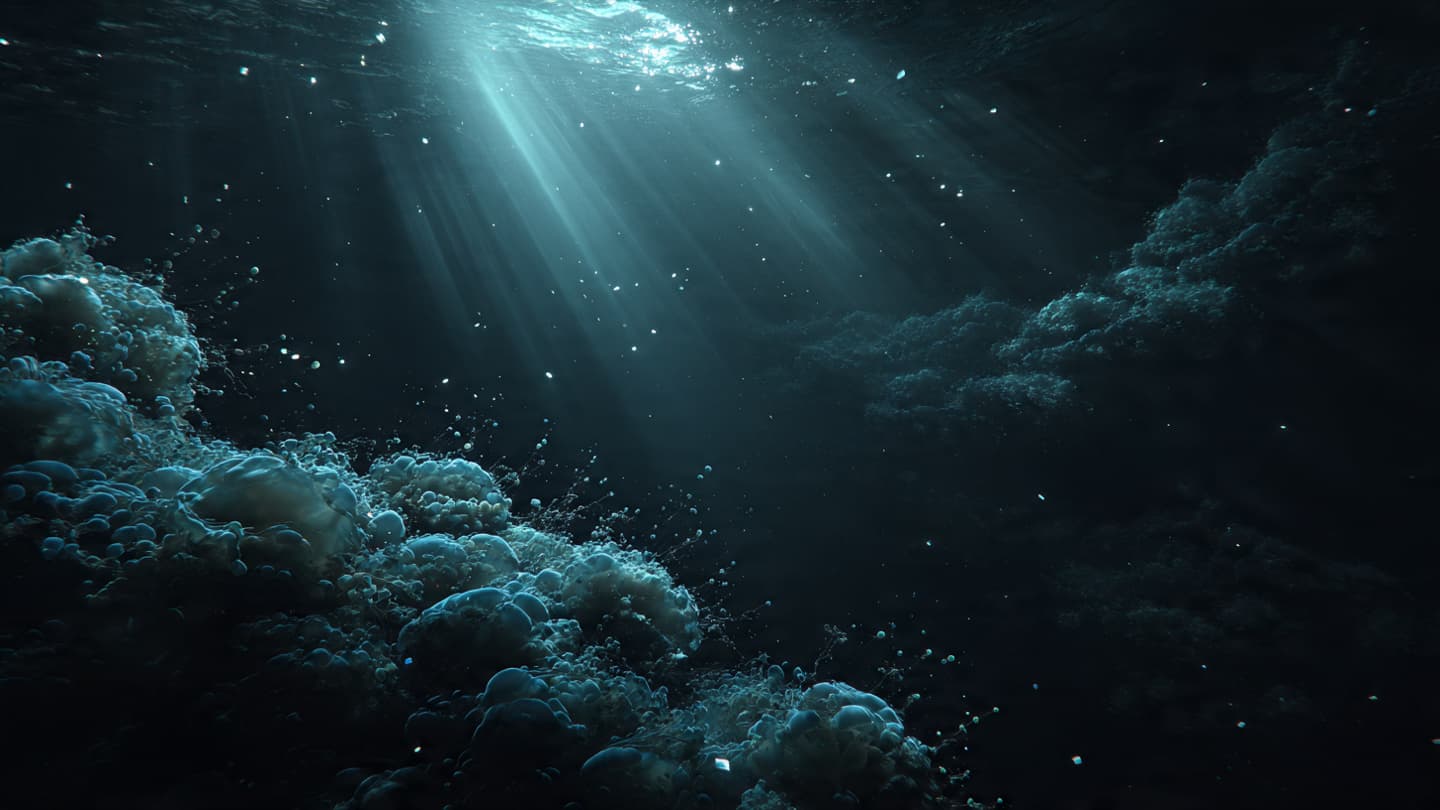
In the vast, dim corridors of the ocean, light fades long before imagination does. Below the surface where sunlight dissolves into blue uncertainty, life continues in forms that rarely encounter human attention. It is a world shaped not by visibility, but by pressure, patience, and adaptation — a slow unfolding of existence across depths that remain largely uncharted.
Recently, scientists have catalogued more than 1,100 previously undocumented or unusual marine species, expanding the known boundaries of ocean biodiversity. Among them are creatures with striking names that seem to belong as much to myth as to biology — “ghost sharks,” which glide through deep waters with pale, spectral bodies, and sponge-like organisms described in some findings as “death ball” formations, dense and unusual structures that challenge familiar classifications of marine life.
These discoveries are part of broader efforts to map the ocean’s biological diversity, a task that remains incomplete despite decades of exploration. Even as satellites circle the Earth and underwater vehicles traverse deep-sea trenches, much of the marine world remains beyond continuous human observation. Each expedition adds fragments to a larger, unfinished picture — a biological atlas still being written in real time.
The newly identified species span a range of environments, from shallow coastal ecosystems to extreme deep-sea habitats where pressure reshapes biology itself. In these environments, life adapts in ways that often defy surface-level intuition: transparency becomes camouflage, bioluminescence becomes communication, and skeletal structures may soften or vanish entirely in response to environmental extremes.
Among the more unusual findings are organisms whose forms blur the line between recognizable categories. Some species exhibit hybrid characteristics that complicate traditional taxonomic grouping, while others display behaviors or morphologies not previously documented in scientific literature. These discoveries highlight how much remains unknown about ecosystems that cover more than two-thirds of the planet.
Marine biodiversity research has long emphasized not only the richness of ocean life but also its fragility. Many of the newly documented species inhabit regions sensitive to temperature shifts, acidification, and human activity such as deep-sea fishing or seabed mining. In this sense, discovery often arrives alongside concern — as documentation becomes a race against environmental change.
The ocean’s depth has always functioned as both a physical and conceptual boundary. For centuries, it represented mystery more than map, a space where imagination filled the gaps left by limited exploration. Modern science has steadily reduced that unknown, yet it has not eliminated it. Instead, it has revealed that the unknown is deeper, more intricate, and more populated than previously understood.
Research teams emphasize that cataloguing species is not merely an exercise in naming, but a foundational step in understanding ecological relationships. Each organism plays a role within food webs, nutrient cycles, and habitat structures that sustain broader marine systems. Even the smallest or most obscure species contributes to the stability of environments that, in turn, influence global climate patterns.
The discovery of such a large number of species also underscores the pace at which scientific tools have evolved. Advanced imaging technologies, remotely operated vehicles, and genetic sequencing now allow researchers to identify organisms that would have been invisible or indistinguishable in earlier decades. What once required direct human presence in extreme conditions can now be observed from controlled environments on the surface.
Yet even with these tools, the ocean retains its resistance to full comprehension. Every mapped region seems to open into another layer of uncertainty, suggesting that knowledge expands not by closing gaps, but by revealing new ones. The recent findings reinforce this pattern: discovery as a continuous process rather than a completed archive.
As these species enter scientific records, they also enter a broader human awareness of the planet’s complexity. The ocean, long perceived as uniform and vast, emerges instead as a mosaic of specialized habitats, each hosting its own evolutionary narratives. In this sense, every new species is not only a biological entry but also a reminder of how much remains unseen.
The work continues quietly, often far from public attention, in research vessels, deep-sea laboratories, and coastal stations where samples are analyzed and classified. And with each expedition, the ocean yields more of its hidden forms — not in sudden revelation, but in gradual accumulation.
In the end, what emerges is not a completed picture, but a widening sense of scale: a reminder that beneath the surface of the familiar world lies another one, still unfolding, still unnamed in many of its parts.
AI Image Disclaimer These images were generated using AI tools and are intended as conceptual visualizations of deep-sea biodiversity discoveries.
Sources Nature National Geographic Science Magazine BBC News Smithsonian Ocean Institute
Note: This article was published on BanxChange.com and is powered by the BXE Token on the XRP Ledger. For the latest articles and news, please visit BanxChange.com