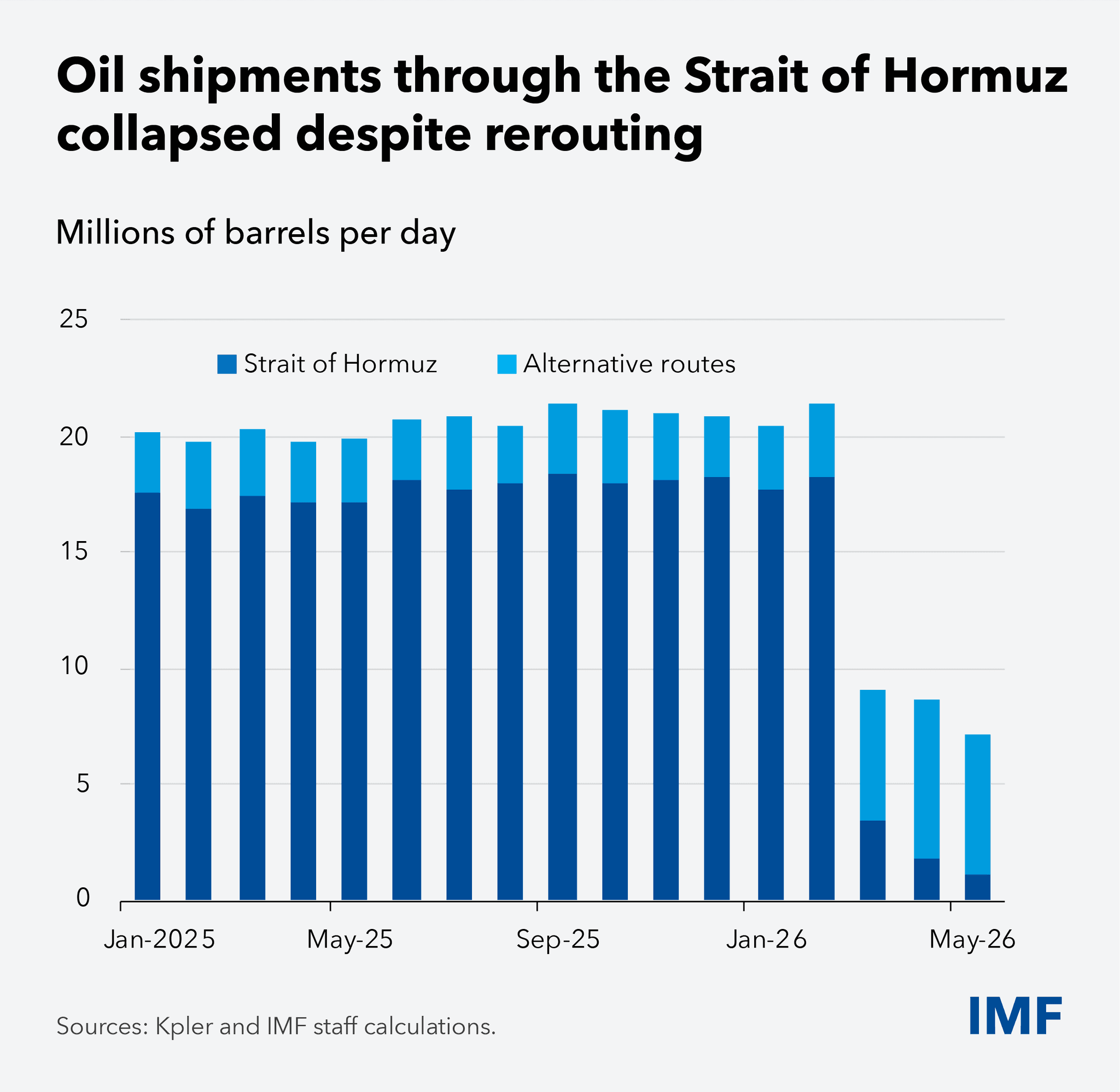
The International Monetary Fund (IMF) has warned that renewed tensions in the Middle East continue to pose a significant risk to the global economy, particularly through disruptions to oil shipments passing the Strait of Hormuz. The narrow waterway remains one of the world's most strategically important maritime corridors, serving as a major export route for crude oil and liquefied natural gas produced by Gulf nations. According to the IMF, recent conflict caused crude prices to rise sharply as markets reacted to fears that shipping through the region could be interrupted. Although increased production elsewhere, softer global demand and inventory drawdowns prevented an even larger price spike, the organization cautions that prolonged geopolitical instability could still trigger fresh supply shocks. The IMF's analysis shows oil shipments moving through the Strait of Hormuz declined significantly despite shipping companies rerouting vessels where possible. Alternative routes helped reduce some disruption but were unable to fully replace the capacity of the Strait, demonstrating how dependent global energy markets remain on this critical chokepoint. Higher oil prices affect nearly every sector of the global economy. Transportation costs rise, manufacturing becomes more expensive, electricity generation can be affected in some countries, and inflationary pressures often increase. Central banks may then face difficult decisions between supporting economic growth and controlling inflation through higher interest rates. Developing economies are particularly vulnerable because many rely heavily on imported energy. Sustained increases in fuel costs can weaken currencies, increase trade deficits and place additional pressure on government budgets already facing economic challenges. Financial markets also monitor geopolitical events closely because uncertainty often leads investors toward safe-haven assets while increasing volatility across equities, commodities and foreign exchange markets. Energy companies may benefit from higher prices, while industries dependent on fuel can experience declining profitability. The IMF argues that maintaining stable energy supplies will require both rapid restoration of disrupted production and continued international cooperation to keep shipping lanes open. Diversifying supply sources, expanding strategic petroleum reserves and investing in alternative energy infrastructure are also viewed as important long-term strategies for reducing future vulnerability. As geopolitical tensions persist, energy security remains one of the defining challenges facing policymakers, businesses and investors. The IMF's latest assessment serves as a reminder that regional conflicts can quickly produce global economic consequences far beyond the immediate area of hostilities.
Published by Banx Network. This article is part of the Banx decentralized media programme, powered by the BXE token on the XRP Ledger.