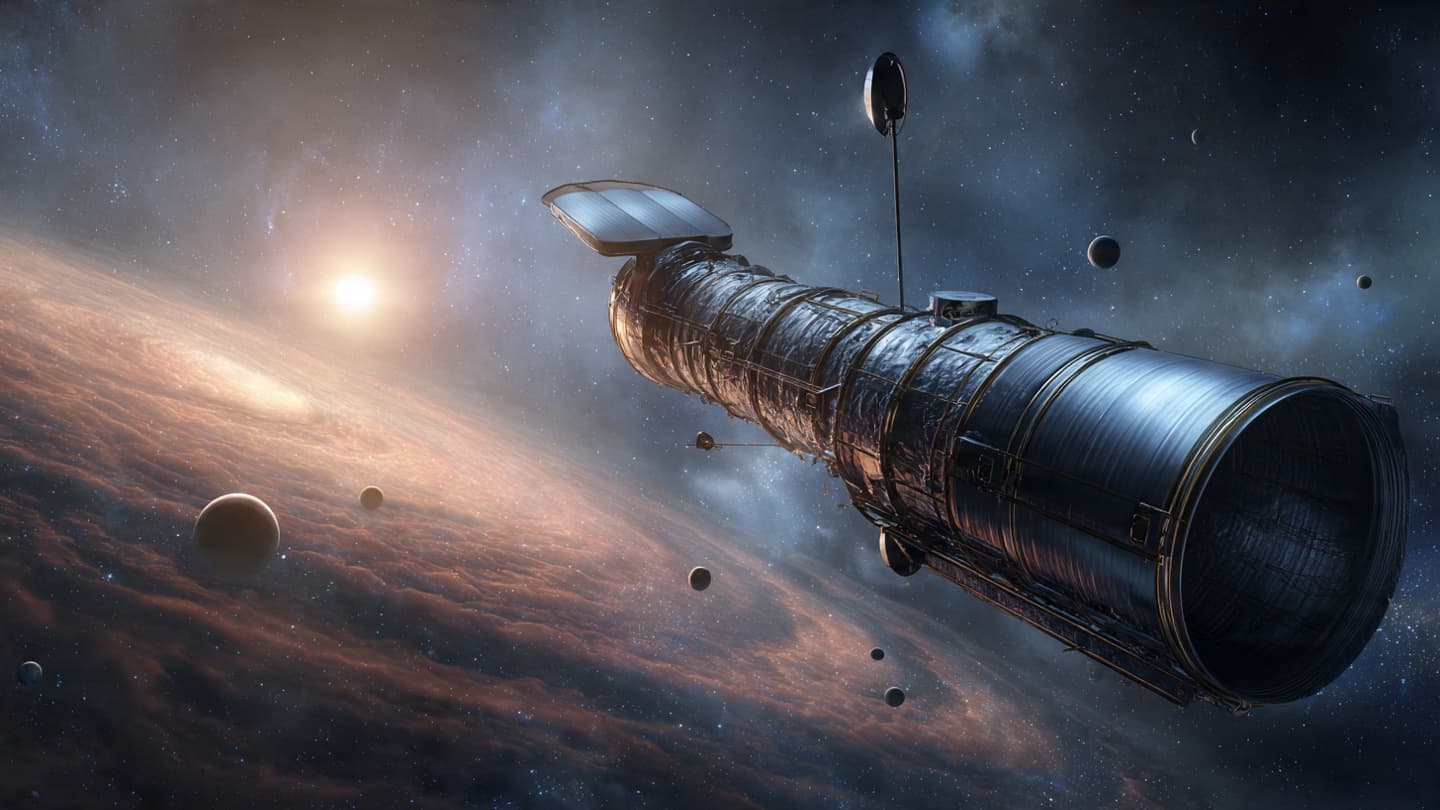
In an era increasingly defined by new technologies, it is often tempting to focus exclusively on the latest achievements. Yet some scientific instruments continue to provide remarkable value long after their original missions begin. The Hubble Space Telescope, launched in 1990, remains one of the most influential observatories in the history of astronomy. New research suggests it may still play an important role in understanding young exoplanets and the environments in which they form.
Exoplanets are planets located outside our solar system. Since the first confirmed discoveries in the 1990s, astronomers have identified thousands of these distant worlds. Many vary dramatically in size, composition, and environmental conditions, expanding humanity’s understanding of what planetary systems can look like.
Recent studies indicate that Hubble's capabilities remain particularly useful for observing young stars and the radiation environments surrounding them. Such observations can help researchers understand how planetary atmospheres develop during the early stages of a system's evolution.
Young stars often produce intense bursts of radiation and stellar activity. These energetic conditions can influence nearby planets by affecting atmospheric chemistry, temperature, and even long-term habitability. Observing these interactions is essential for building accurate models of planetary development.
While newer observatories such as the James Webb Space Telescope have expanded scientific capabilities, researchers note that Hubble offers complementary strengths. Together, the two instruments can provide a broader and more detailed picture of distant planetary systems than either could achieve alone.
One reason Hubble remains valuable is its extensive experience observing ultraviolet wavelengths. This region of the electromagnetic spectrum contains important information about stellar activity and atmospheric interactions that are difficult to study through other means.
Astronomers emphasize that understanding young planetary systems may help answer larger questions about the origins of planets, including Earth. By observing systems at different stages of development, scientists can compare evolutionary pathways and refine theories about planetary formation.
The continued relevance of Hubble also reflects the importance of maintaining scientific infrastructure over long periods. Instruments that generate decades of observations create datasets that become increasingly valuable as new discoveries emerge and technologies advance.
As researchers continue exploring distant worlds, Hubble remains an active participant in humanity's search for knowledge beyond the solar system. More than three decades after its launch, the telescope continues to contribute insights that help illuminate the origins and evolution of planetary systems throughout the galaxy.
AI Image Disclaimer: This article features an AI-generated illustration created to visually represent astronomical research concepts.
Source Verification Check: arXiv Research Papers, NASA, Space Telescope Science Institute, Astronomy Publications
Published by Banx Network. This article is part of the Banx decentralized media programme, powered by the BXE token on the XRP Ledger.