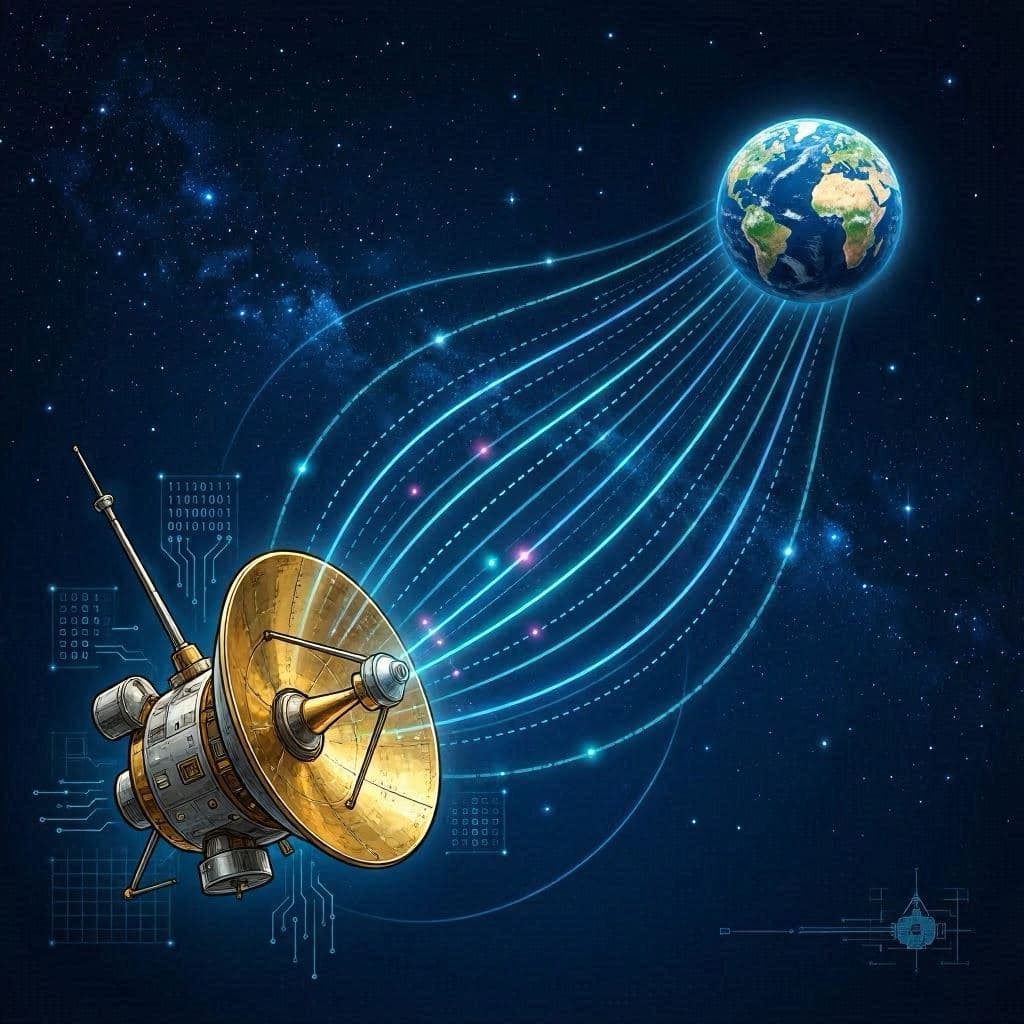
In the vast silence of interstellar space, a small messenger from Earth continues its lonely journey, carrying the greetings of humanity to the stars. Voyager 1, launched in 1977, has long since passed the boundaries of our solar system, venturing into regions where no human-made object has gone before. Yet, despite its age and distance, it remains a testament to human ingenuity and resilience. When the spacecraft began transmitting unintelligible data in late 2023, fears grew that its long mission might finally be coming to an end. However, a team of dedicated engineers at NASA devised a clever solution, proving that even at the edge of known space, human creativity can bridge the gap.
Body: The issue stemmed from a failure in one of Voyager 1’s memory chips, specifically a component responsible for storing critical flight data software. As the chip degraded, the spacecraft began sending back garbled telemetry, rendering it impossible to monitor its health or send commands. Given the immense distance—more than 24 billion kilometers from Earth—any signal takes over 22 hours to travel one way. This delay meant that troubleshooting had to be done with extreme caution and precision, as each attempt required days of waiting for a response.
Engineers realized that they could not repair the hardware physically, nor could they simply switch to a backup system, as the architecture of the 1970s did not allow for such redundancy in the same way modern systems do. Instead, they had to work with what was available. The solution involved breaking up the affected code into smaller chunks and relocating them to different areas of the remaining functional memory. This process required a deep understanding of the spacecraft’s original programming, written in assembly language decades ago.
The team spent months analyzing the old code, identifying which parts were essential and which could be moved. They then crafted a series of commands to instruct the spacecraft to rewrite its own memory structure. This was a risky maneuver, as any error could have permanently disabled the probe. However, the engineers’ meticulous planning paid off. In April 2024, Voyager 1 began sending back clear, readable data once again, confirming that the fix had worked.
This achievement highlights the remarkable durability of Voyager’s design. Built with technology that predates the personal computer, the spacecraft has survived for nearly five decades in one of the harshest environments imaginable. Its ability to respond to complex remote commands, even with limited processing power, is a tribute to the foresight of its original designers. They anticipated the need for flexibility, allowing for updates and adjustments long after launch.
The rescue of Voyager 1 also underscores the enduring human connection to our exploratory missions. For many, the spacecraft represents more than just a scientific instrument; it is a symbol of our curiosity and our desire to reach beyond our limits. The relief felt by the engineering team and the public alike upon receiving the first clear signal was palpable. It was a moment of shared triumph, reminding us that even in the face of seemingly insurmountable odds, perseverance and intellect can prevail.
Looking forward, this success provides valuable lessons for future deep-space missions. As we plan to send probes even farther into the cosmos, the ability to perform remote repairs and software updates will become increasingly critical. The techniques developed for Voyager 1 may well inform the design of next-generation spacecraft, ensuring that they too can withstand the test of time and distance.
Closing: Voyager 1 continues its journey, no longer silent but speaking clearly once more to its creators on Earth. Its rescue is a poignant reminder of the bond between humanity and its machines, a bond that stretches across billions of kilometers and decades of time. As it drifts further into the interstellar medium, it carries with it not just data, but the spirit of human resilience.
AI Image Disclaimer: Visuals included in this report are AI-generated illustrations created to support the narrative.
Sources: NASA Jet Propulsion Laboratory The New York Times Space.com IEEE Spectrum
Published by Banx Network. This article is part of the Banx decentralized media programme, powered by the BXE token on the XRP Ledger.