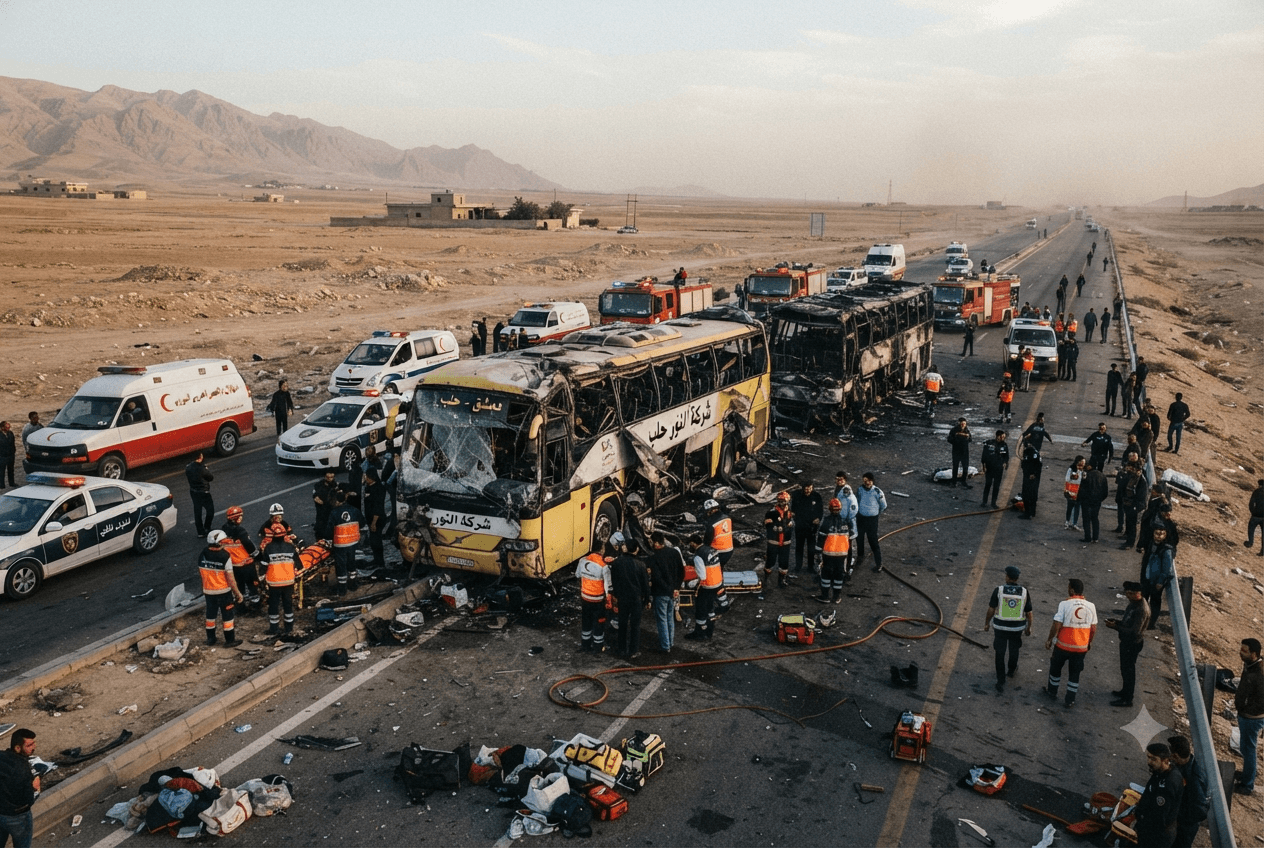
Damascus, Syria—Two passenger buses smashed head-on along the central desert highway during the early morning hours, scattering wreckage across both asphalt lanes. Emergency dispatchers received the first distress calls just after dawn as smoke billowed from the mangled diesel engines. The impact crumpled the front chassis of both vehicles beyond recognition, trapping dozens of passengers in twisted metal compartments. State rescue teams and military helicopters rushed to the remote stretch of asphalt to secure the perimeter and triage the wounded.
Health officials confirmed that thirty-five individuals died at the scene or succumbed to their injuries during transport to regional medical centers. Thirty survivors sustained varying degrees of trauma, ranging from severe bone fractures to extensive internal burns. Medical personnel at nearby military hospitals issued urgent blood donation appeals as emergency wards filled past capacity. Transport ministry inspectors established a temporary command post near the wreckage to map out the trajectory vectors of the crash.
The highway linking the capital to eastern provincial hubs remained completely sealed off to commercial traffic for more than six hours. Heavy cranes labored to hoist the burnt shells off the thoroughfare so forensic experts could inspect the skid marks. Investigators checked mechanical logs to determine if brake failure or excessive speed contributed to the catastrophic steering loss. Local drivers caught in the resulting gridlock turned off their engines and waited under the punishing desert heat.
Interior ministry representatives expressed profound sorrow through state media channels while directing local police units to expedite victim identification protocols. Relatives began gathering outside regional morgues clutching national identity cards and asking for official casualty manifests. Social welfare officers set up counseling desks outside emergency pavilions to assist families dealing with sudden trauma notifications. Transport safety advocates renewed criticisms regarding lax enforcement of speed limits on major transit arteries.
Civil defense crews used hydraulic spreaders to peel back the steel roofing of the civilian coach to reach trapped occupants. Military transport units deployed extra personnel to manage crowd control as frantic onlookers crowded the police tape. Forensic teams cataloged personal belongings strewn across the scorched roadside sand while documenting the layout of the impact zone. Officials noted that visibility had been clear prior to the crash, discounting heavy fog or sandstorms as immediate contributing factors.
Passing motorists described a chaotic scene of shattered glass and frantic screams before emergency sirens echoed across the arid landscape. Road maintenance crews spread sand over spilled fuel pools to minimize secondary fire hazards while investigators photographed the wreckage. Provincial governors arrived by motorcade to confer with operational commanders overseeing the clearance work. Heavy-duty flatbed trucks hauled the ruined chassis away toward an impound yard outside the city limits.
The wreckage was eventually cleared from the main thoroughfare, allowing single-lane traffic to crawl past the site under police escort. Engineers began assessing structural damage to the tarmac where intense post-crash fires melted portions of the surface layer. State investigators continued downloading telemetry data from surviving digital transit logs to reconstruct the final seconds before impact.
Repair crews worked under floodlights to patch the scorched roadway as traffic restrictions slowly eased for stranded commercial haulers. Transport authorities promised a comprehensive technical report once vehicle inspection data cleared laboratory analysis.
Note: This article was published on BanxChange.com and is powered by the BXE Token on the XRP Ledger. For the latest articles and news, please visit BanxChange.com