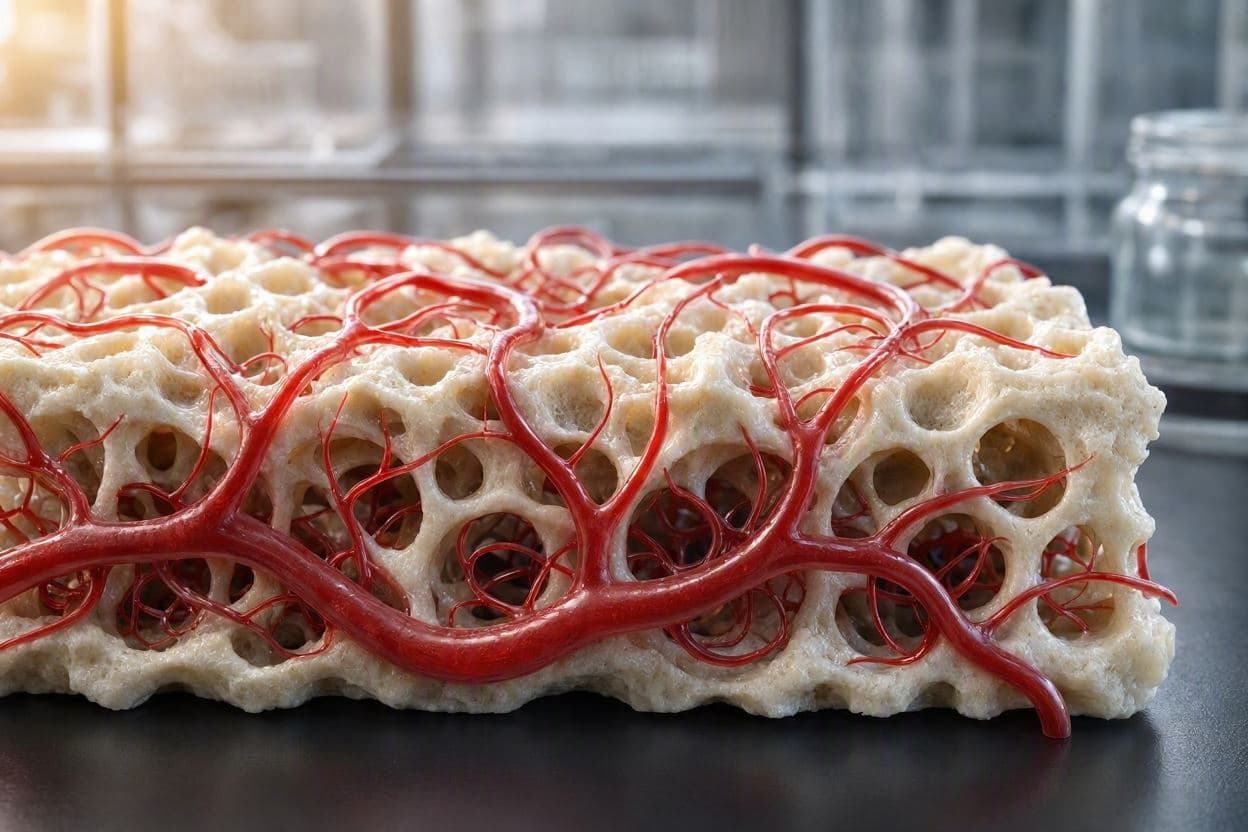
Bone is often perceived as a static scaffold, a rigid structure that holds the body upright. In reality, it is a living, breathing tissue, rich with blood vessels that deliver nutrients and facilitate healing. When bone is damaged or lost, replicating this complex vascular network has been a significant hurdle in regenerative medicine. Now, researchers have developed a novel approach using genetic switches to stimulate blood vessel growth within 3D-printed bone scaffolds, bringing us closer to truly functional bio-engineered tissues.
3D printing has revolutionized the creation of bone implants, allowing for custom shapes that fit perfectly into a patient’s defect. However, these synthetic structures often lack the internal biology needed to integrate seamlessly with the host tissue. Without a robust blood supply, the inner parts of large implants can die, leading to failure. The new technique addresses this by embedding genetic instructions into the scaffold material, effectively turning the implant into a biological signal tower that calls for vascularization.
The "genetic switches" refer to specific DNA sequences that activate the expression of pro-angiogenic factors, proteins that encourage the formation of new blood vessels. When the 3D-printed scaffold is implanted, these switches are triggered by the body’s natural healing response. This causes surrounding cells to produce the necessary signals, drawing blood vessels into the porous structure of the printed bone. It is a clever hijacking of the body’s own repair mechanisms.
In preclinical studies, this method has shown remarkable success. Implants treated with these genetic switches demonstrated faster and more extensive blood vessel ingrowth compared to standard scaffolds. The new vessels were functional, carrying oxygen and nutrients deep into the implant, which supported the survival and growth of new bone cells. This integration is crucial for the long-term stability and health of the regenerated tissue.
The implications for patients are profound. Those suffering from severe fractures, bone cancers, or congenital defects often face multiple surgeries and long recovery times. Bio-engineered bones that integrate quickly and naturally could reduce the need for repeated interventions and improve quality of life. It offers hope for more effective treatments for conditions that currently have limited options.
Safety is a primary focus of this research. Because the genetic switches are designed to be transient and localized, they minimize the risk of unintended effects elsewhere in the body. The materials used in the 3D printing process are biocompatible and degrade safely over time as new bone forms. Rigorous testing ensures that the technology meets strict medical standards before moving to human trials.
Beyond bone repair, this technology could have broader applications in tissue engineering. The principle of using genetic switches to guide vascularization could be applied to other complex organs, such as liver or kidney tissues, which also rely heavily on blood supply. It represents a shift from passive implants to active, biologically interactive devices that work in concert with the body.
As the field advances, the collaboration between engineers, geneticists, and clinicians will be key. The goal is to translate these laboratory successes into clinical realities, offering personalized solutions for bone regeneration. By teaching synthetic materials to speak the language of biology, we are unlocking new possibilities for healing and restoration.
AI Image Disclaimer: Visuals in this article are AI-generated illustrations of 3D-printed skeletal structures and cellular networks, designed to reflect the themes of regenerative medicine without depicting real patient data.
Sources: Science Translational Medicine, Nature Biotechnology, Medical Xpress, EurekAlert
Published by Banx Network. This article is part of the Banx decentralized media programme, powered by the BXE token on the XRP Ledger.