
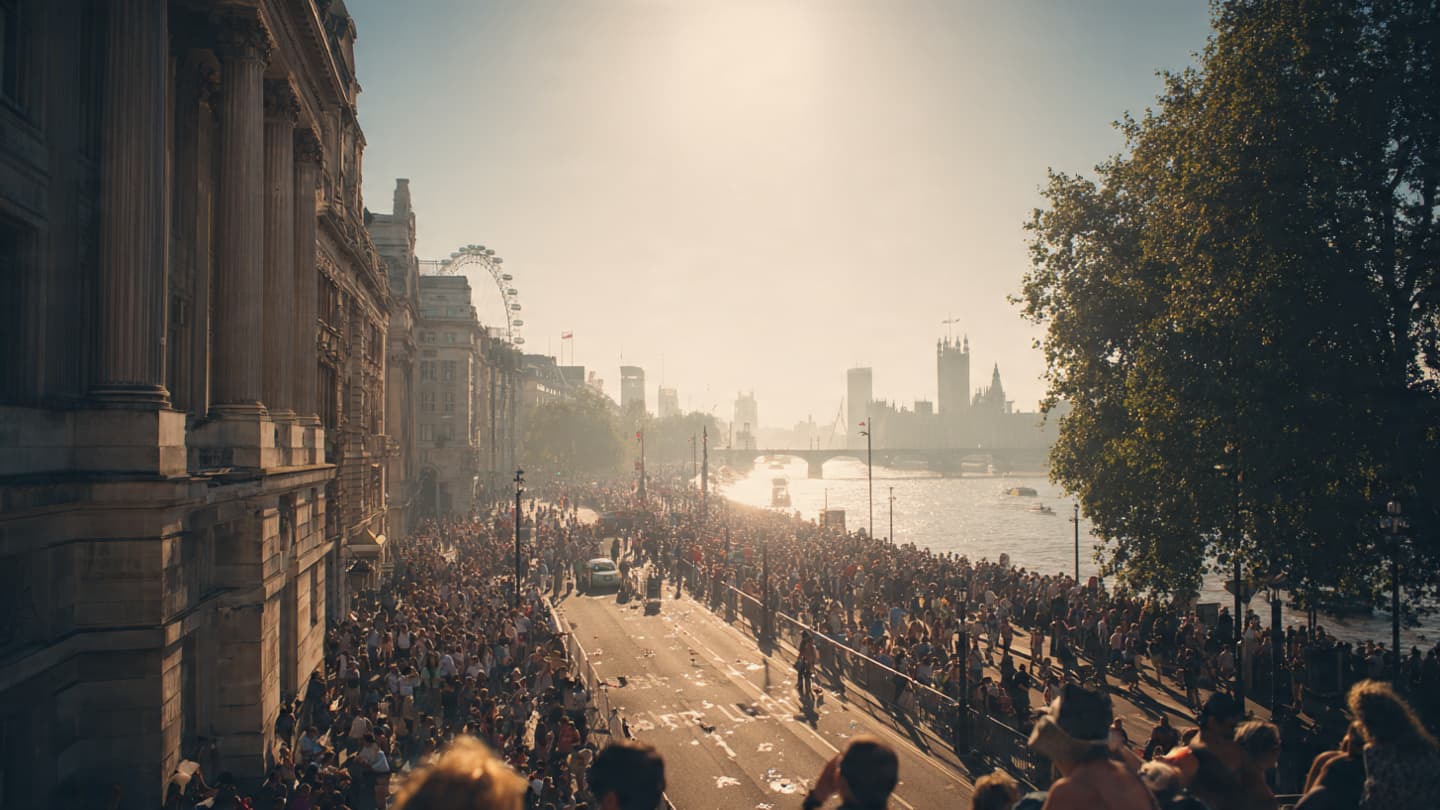
By late afternoon, the air above London had taken on the heavy stillness usually reserved for midsummer. Parks that only weeks ago carried the damp coolness of spring now shimmered beneath intense sunlight. Commuters loosened collars on crowded platforms, café terraces filled with people searching for shade instead of warmth, and the familiar gray rhythm of the city seemed briefly replaced by something Mediterranean and strangely unfamiliar.
This week, London recorded temperatures reaching 35 degrees Celsius, an extraordinary figure for May and one that placed the British capital at the center of a broader European heatwave sweeping across the continent. Meteorologists described the conditions as highly unusual for this early in the season, with temperature records broken in multiple countries as hot air spread northward across Europe.
The heat extended far beyond Britain. Across France, Spain, Italy, and parts of central Europe, cities experienced temperatures more typical of peak summer than late spring. Public health warnings were issued in several regions as officials urged residents to remain hydrated, avoid prolonged outdoor activity, and check on elderly or vulnerable neighbors.
For many Europeans, the unusual timing of the heatwave felt almost more unsettling than the temperatures themselves. May has traditionally belonged to transition — a month of lengthening evenings, mild sunlight, and cautious anticipation of summer. Yet across much of the continent this year, that gradual seasonal progression seemed to vanish. Summer arrived abruptly, carrying the intensity of August before June had even begun.
The atmosphere in London reflected that disorientation. Crowds gathered along the River Thames beneath cloudless skies, while transport systems strained under the heat. Older Underground lines, designed in another century for a cooler climate, trapped warm air in tunnels where temperatures climbed steadily throughout the day. Office buildings and apartment blocks built to preserve heat during long winters struggled to release it.
Across Europe, infrastructure has increasingly revealed its vulnerability to extreme temperatures. Rail systems slow under heat stress, power demand rises sharply as cooling systems work continuously, and wildfire concerns emerge earlier each year across dry southern landscapes. Scientists have repeatedly warned that climate change is making heatwaves more frequent, more intense, and increasingly likely to occur outside historically expected periods.
Yet beyond the scientific explanations lies a quieter emotional shift. Extreme heat changes how cities feel. Streets empty earlier. Public squares fall silent during the afternoon. Sleep becomes restless as warm air lingers through the night. Even familiar architecture appears altered beneath prolonged sunlight, stone buildings radiating heat long after sunset.
In Britain especially, where homes and public spaces are historically designed to retain warmth, periods of extreme heat can carry particular strain. Air conditioning remains far less common than in hotter regions of the world, leaving many residents reliant on open windows, electric fans, and improvised methods of cooling. Hospitals and emergency services often prepare carefully during such events, aware that heat can become a significant public health risk, particularly for older populations.
Meanwhile, climate researchers continue emphasizing that record-breaking heatwaves are no longer isolated anomalies. Europe has warmed faster than many other regions globally, with recent summers repeatedly producing historic temperature extremes, droughts, and wildfire seasons. Each new record arrives against a growing backdrop of scientific concern about how rapidly weather patterns are shifting.
Still, life across the continent continues adapting in small, visible ways. Children run through fountains in city plazas. Restaurants move tables deeper into shaded streets. Construction workers begin shifts before sunrise. Conversations increasingly revolve around temperatures once considered remarkable but now repeated with unsettling regularity.
As evening settled over London, the heat remained suspended above rooftops and riverbanks, refusing to fade with daylight. The city glowed beneath amber skies more reminiscent of southern Europe than the British Isles. And across the continent, from crowded Mediterranean coasts to northern capitals unused to such intensity, people moved through another day shaped by the growing unpredictability of climate and season.
The numbers themselves will likely enter meteorological records: 35C in May, broken averages, historic anomalies. But beneath those statistics lies something more difficult to measure — the quiet realization spreading across Europe that the atmosphere itself is beginning to feel different, and that seasons once trusted for their familiarity no longer arrive in quite the same way.
AI Image Disclaimer These visuals were generated using AI technology to represent the atmosphere and settings connected to the events described.
Sources
Reuters BBC News Associated Press Met Office Copernicus Climate Change Service
Note: This article was published on BanxChange.com and is powered by the BXE Token on the XRP Ledger. For the latest articles and news, please visit BanxChange.com