
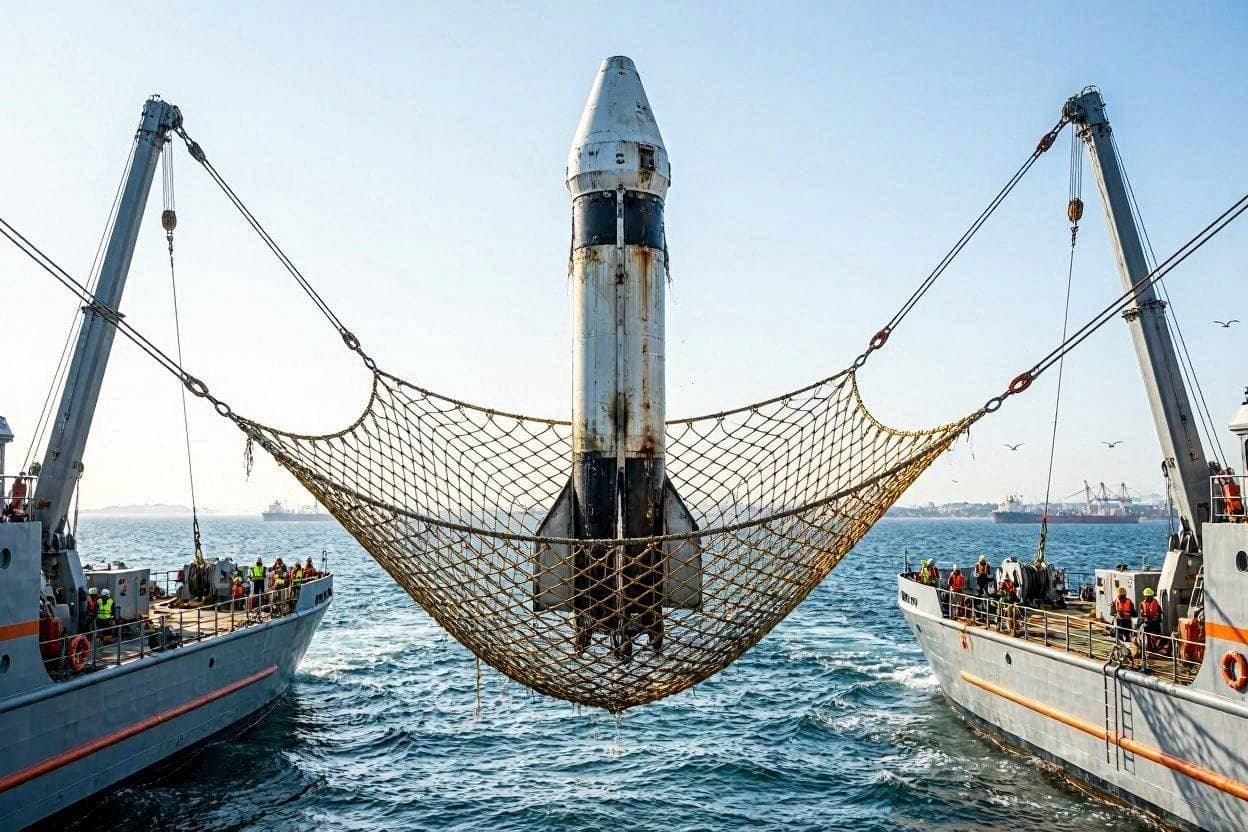
The ocean, vast and unyielding, has become the new frontier for aerospace innovation. In a significant milestone for reusable rocket technology, China has successfully tested a sea-based recovery system for rocket boosters, marking a step toward more sustainable and cost-effective space access. The gentle capture of the booster into a net suspended between ships signals a new era of precision and efficiency in launch operations.
The test, conducted off the coast of Hainan Province, involved a Long March 10B rocket booster that separated mid-flight and guided itself to a predetermined landing zone in the sea. Unlike traditional land-based recoveries, this method allows for greater flexibility in launch trajectories and reduces the risk to populated areas. The successful retrieval demonstrates advanced guidance, navigation, and control capabilities.
Reusability is key to lowering the cost of spaceflight, a principle pioneered by private companies but now being aggressively adopted by national space agencies. By recovering and refurbishing boosters, China aims to increase the frequency of launches while minimizing waste. This approach aligns with global trends toward sustainable space practices and economic efficiency.
The technical challenges of sea recovery are substantial, requiring precise coordination between the rocket, maritime vessels, and weather conditions. Saltwater corrosion and wave action pose additional hurdles for hardware integrity. Overcoming these obstacles requires robust engineering and rigorous testing, which this recent success helps to validate.
For the commercial space sector, this development opens new possibilities for collaboration and competition. As launch costs decrease, more entities can afford to send payloads into orbit, fostering innovation in satellite technology, communications, and Earth observation. The ripple effects of cheaper access to space are far-reaching.
International observers note the rapid progress in China’s space program, which has expanded from lunar exploration to manned missions and now reusable launch systems. This holistic approach strengthens the nation’s position as a major player in the global space arena. It also encourages other nations to accelerate their own technological advancements.
Environmental considerations are also part of the conversation, as reusable rockets reduce the debris and material consumption associated with expendable launch vehicles. While challenges remain, the move toward recovery systems represents a positive step for the ecological footprint of space activities.
Closing: As China refines its sea-based recovery techniques, the world watches with interest. The success of this test underscores the dynamic nature of space exploration, where innovation continues to push the boundaries of what is possible.
AI Image Disclaimer: The accompanying visuals are AI-generated representations intended to illustrate the context of the article and do not depict actual events or individuals.
Sources: Reuters Al Jazeera Space Daily TBS News
Note: This article was published on BanxChange.com and is powered by the BXE Token on the XRP Ledger. For the latest articles and news, please visit BanxChange.com