
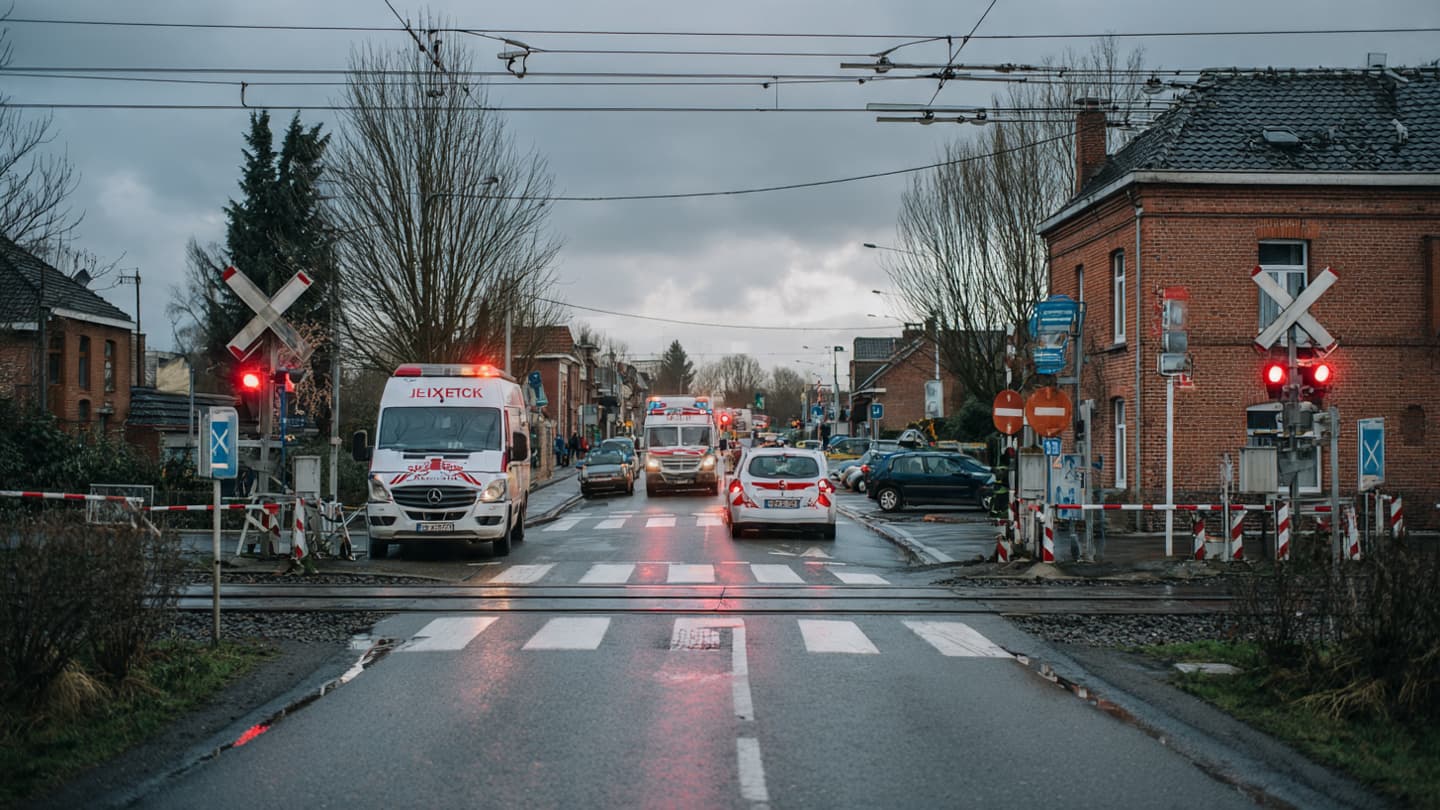
The morning had begun in the ordinary rhythm familiar to small towns across Belgium. Roads filled gradually with commuters, children gathered their bags for school, and trains moved along schedules repeated so often they seemed almost part of the landscape itself. In places like these, routine becomes a kind of quiet trust — a belief that the day will unfold as expected.
But at a railway crossing in Belgium, that rhythm was suddenly broken.
Authorities said at least four people were killed and five others injured after a collision between a train and a school bus. Emergency crews rushed to the scene as local communities awoke to flashing lights, blocked roads, and the disorienting realization that an ordinary school journey had ended in tragedy.
The crash unfolded during the morning hours, when roads and railways often intersect at their busiest and most vulnerable moments. Investigators began examining the circumstances surrounding the collision, while medical teams transported survivors to nearby hospitals. Officials worked carefully to identify victims and support families drawn suddenly into grief.
In the aftermath of accidents like these, time seems to move differently. Train schedules stop. Conversations lower into whispers. Familiar streets become marked by emergency tape, ambulances, and clusters of people standing silently together. The mechanics of transportation — rails, signals, crossings, timetables — briefly give way to something more human and fragile.
Rail travel remains one of Europe’s most relied-upon forms of transportation, threading cities and rural towns together with remarkable efficiency. Yet railway crossings have long represented points where different rhythms meet: the speed and certainty of trains intersecting with the unpredictability of road traffic. Even with modern signaling systems and safety barriers, moments of miscalculation or mechanical failure can carry devastating consequences.
In Belgium, where public transportation networks form part of everyday life, train stations and crossings are woven deeply into the social fabric. Children grow up hearing the distant approach of trains as part of the ordinary soundtrack of their communities. School buses, bicycles, pedestrians, and rail traffic coexist in close proximity, creating routines that depend heavily on trust in infrastructure and timing.
As news of the collision spread, messages of condolence emerged from local officials and national leaders. Schools prepared counseling support for students and families, while investigators continued gathering evidence to determine precisely what occurred in the moments before impact. Such investigations often move slowly and methodically, balancing technical analysis with the emotional weight carried by affected communities.
For those living nearby, however, the emotional reality arrives long before official conclusions. A crossing once passed without thought becomes difficult to look at in the same way again. The sound of trains passing later that evening may feel sharper, more noticeable. Ordinary geography absorbs memory quietly.
Across Europe, transportation safety systems have improved significantly over decades through technology, regulation, and infrastructure modernization. Yet accidents involving trains continue to resonate deeply because they interrupt spaces associated with reliability and public trust. Railways symbolize movement, connection, and precision — qualities that make moments of failure feel especially haunting.
The injured survivors now begin a different journey shaped by recovery, medical care, and emotional trauma. Families wait in hospitals beneath fluorescent lights and quiet corridors, while classmates and neighbors attempt to process events that resist easy explanation. In tragedies involving children and school transportation, communities often experience grief collectively, bound together by shared routines suddenly shattered.
By evening, the crossing itself may appear still once again. Emergency vehicles depart, tracks reopen gradually, and the physical signs of the accident begin to fade. But beneath that returning stillness remains a quieter permanence carried in memory — among first responders, witnesses, families, and the town itself.
The facts remain painfully clear: four lives lost, several others injured, and a morning journey interrupted forever. Yet beyond those numbers lies the deeper fragility exposed by such moments — the understanding that even the most familiar paths, traveled daily without fear, can change irrevocably in an instant.
And so, beneath the muted skies of another European afternoon, a community gathers itself slowly around grief, remembrance, and the difficult work of continuing forward after a day that began like any other.
AI Image Disclaimer The visuals accompanying this article were generated using AI and are intended as atmospheric representations of the reported events.
Sources
Associated Press Reuters BBC News Belga News Agency The Brussels Times
Note: This article was published on BanxChange.com and is powered by the BXE Token on the XRP Ledger. For the latest articles and news, please visit BanxChange.com