
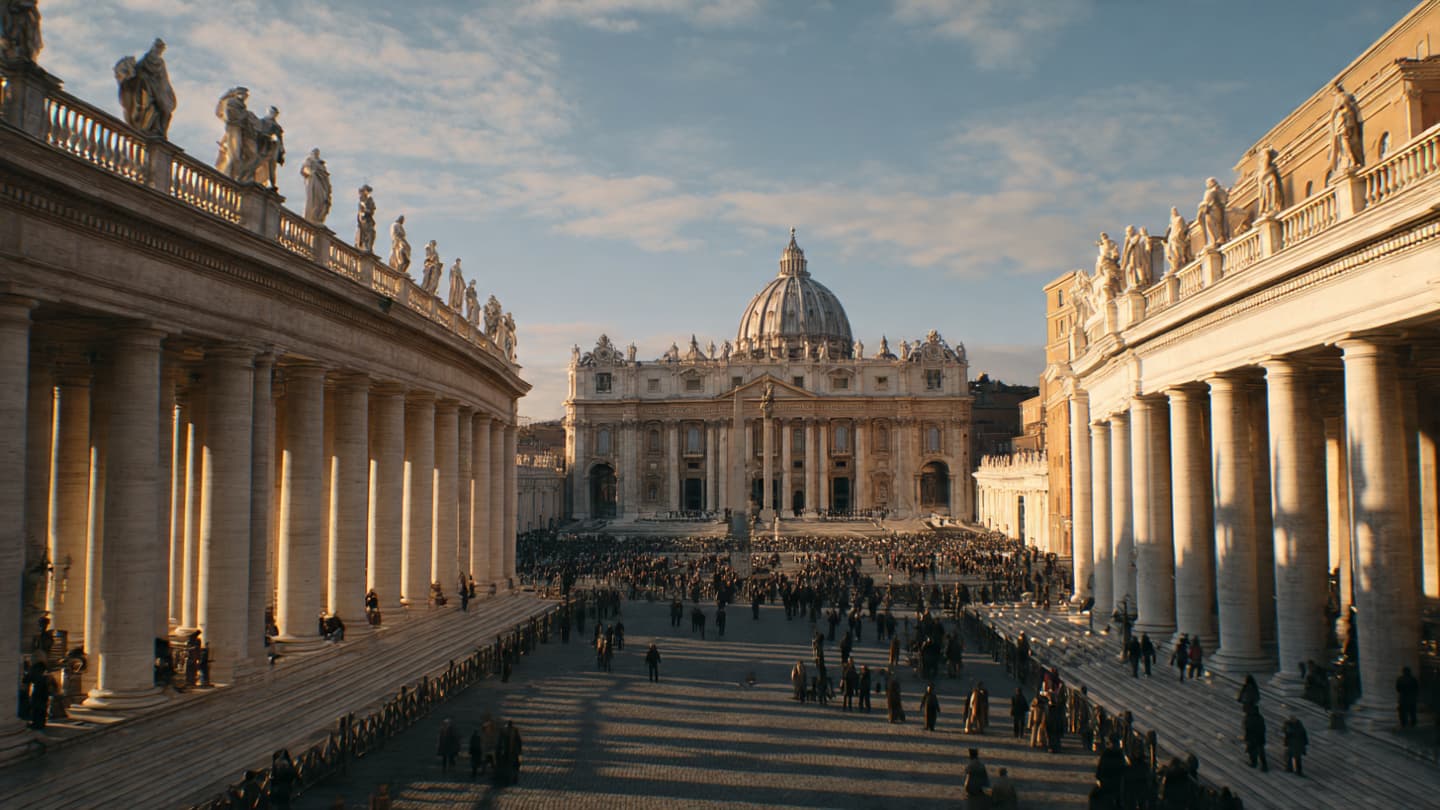
Morning light filtered softly across Saint Peter’s Square, touching the pale stone colonnades and the slow-moving crowds gathering beneath the Vatican sky. Pilgrims lifted phones toward the basilica dome while priests in white collars moved quietly through the square, their footsteps dissolving into the murmur of many languages. In Rome, faith often arrives not as spectacle, but as rhythm — bells marking the hour, candles flickering beside centuries-old walls, and voices carried upward through liturgy that has endured across generations.
During a recent audience at the Vatican, Pope Francis spoke about the relationship between liturgical tradition and renewal, describing both as essential forces in the Church’s mission of evangelization. His remarks reflected a theme that has followed much of his papacy: the effort to preserve continuity with the Church’s past while also engaging a rapidly changing modern world.
Addressing clergy, theologians, and participants involved in liturgical studies, the pope emphasized that tradition should not be understood as something static or frozen in history. Instead, he described it as living memory — something carried forward through prayer, ritual, language, and communal experience, yet still capable of speaking to contemporary realities.
Inside the Catholic Church, conversations surrounding liturgy often carry deeper meaning than ceremonial practice alone. They touch questions of identity, authority, spirituality, and the way faith is communicated across cultures and generations. For centuries, liturgical rituals have shaped not only worship itself, but also architecture, music, art, and the emotional life of Catholic communities around the world.
Pope Francis framed renewal not as rejection of tradition, but as its continuation through attentive engagement with present human experience. Evangelization, he suggested, emerges most meaningfully when ancient forms of worship remain spiritually alive rather than merely repeated out of habit.
The Vatican audience unfolded against broader debates within global Catholicism over liturgical reform and ecclesiastical direction. Some Catholics advocate for stronger preservation of older forms of worship, including the wider use of the traditional Latin Mass, while others support continued adaptation emphasizing accessibility, local languages, and pastoral outreach. These discussions have occasionally revealed tensions between differing visions of how the Church should navigate modernity without losing theological continuity.
Yet inside Saint Peter’s Square, such theological disputes often appear quieter than headlines suggest. Pilgrims still line up beneath Bernini’s columns. Choirs rehearse sacred music inside ancient chapels. Tourists step into candlelit silence after emerging from Rome’s crowded streets.
The Church itself moves slowly through time, shaped by centuries rather than election cycles.
Francis’s remarks also reflected his broader emphasis on encounter — the belief that faith must remain connected to ordinary human realities rather than isolated within institutional formality. Throughout his papacy, he has frequently spoken about reaching people living at social, economic, or spiritual margins, urging clergy to approach ministry with humility and openness.
Within that framework, liturgy becomes more than ritual performance. It becomes a meeting place between memory and present life, between inherited tradition and contemporary longing.
Across Catholic communities worldwide, those questions continue unfolding differently depending on geography and culture. In parts of Africa and Asia, Catholic populations are growing rapidly, often blending local traditions with universal liturgical structures. In Europe, where secularization continues reshaping public life, many churches confront aging congregations and declining attendance. In Latin America, long considered Catholicism’s demographic center, evangelical movements and political polarization increasingly influence religious identity.
Against that global backdrop, the Vatican’s reflections on renewal carry practical as well as symbolic importance. They speak to how the Church understands its future — not only doctrinally, but emotionally and culturally.
There is something deeply Roman about these conversations taking place beneath frescoed ceilings and Renaissance domes while tourists drift outside into afternoon sunlight. The city itself embodies continuity layered upon change: ancient ruins beside modern traffic, sacred ritual beside ordinary daily life.
As the audience concluded, bells echoed again across the square while visitors slowly dispersed through Vatican gates into the wider city. Some carried rosaries or prayer books. Others simply paused for photographs before disappearing into Rome’s winding streets.
The pope’s message remained less about conflict than about balance — the belief that tradition and renewal need not stand opposed to one another. Instead, they may move together, like old stone holding warmth long after sunset, carrying memory forward while still making room for new voices beneath the same enduring sky.
AI Image Disclaimer: Illustrations accompanying this article were generated using AI technology and are intended as visual interpretations of the described scenes.
Sources:
Vatican News Reuters Associated Press Catholic News Service BBC News
Note: This article was published on BanxChange.com and is powered by the BXE Token on the XRP Ledger. For the latest articles and news, please visit BanxChange.com