
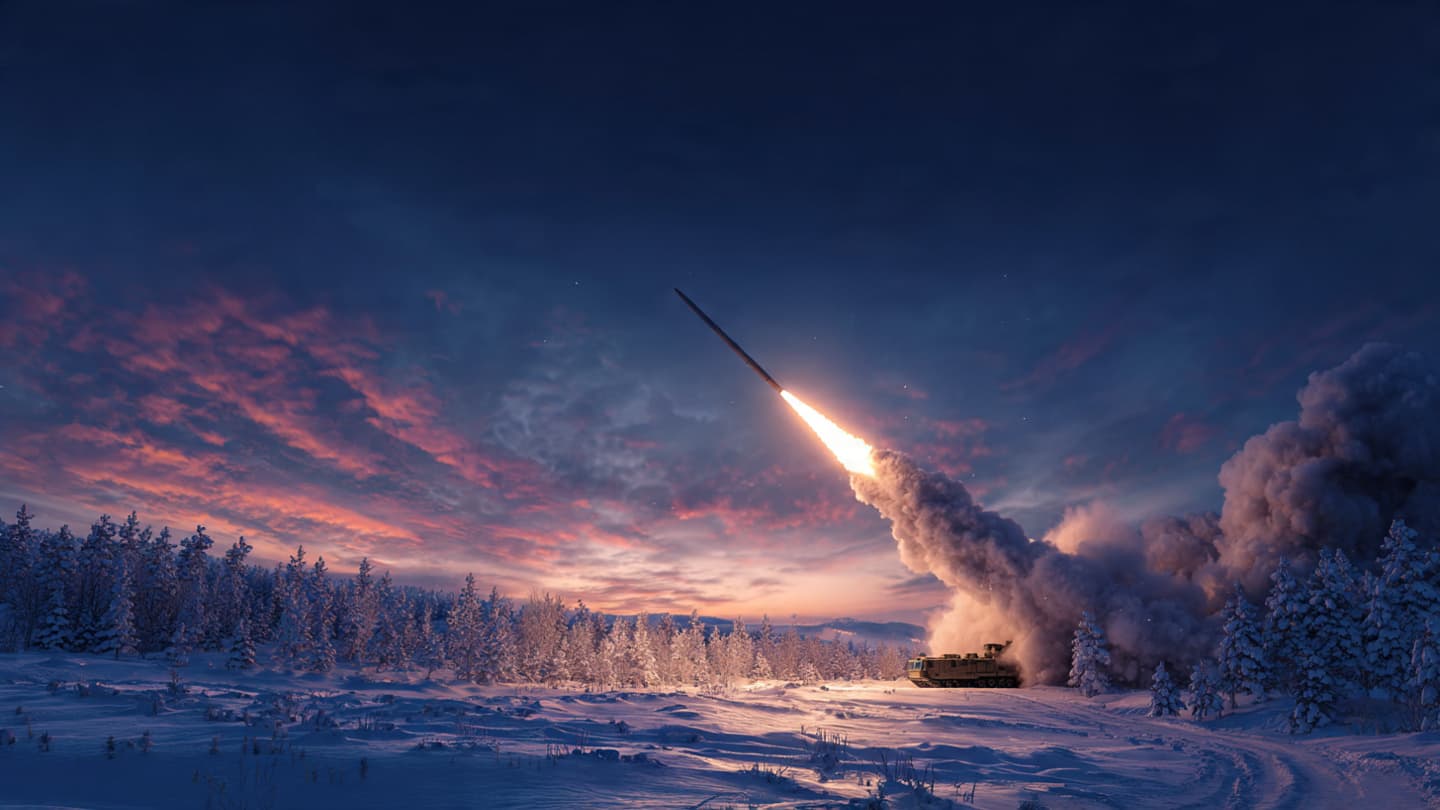
In the cold distances where military technology is often conceived, silence carries unusual importance. Vast launch fields, hidden facilities, and underground command rooms rarely appear in public view, yet they shape the atmosphere of global politics as surely as speeches or treaties. Across Russia’s winter landscapes — forests covered in frost, rail lines vanishing into gray horizons, isolated compounds lit against long northern nights — another chapter in the language of deterrence has begun drawing international attention.
The focus in recent weeks has centered on Russia’s Oreshnik missile and, more specifically, on the unusual type of payload associated with it: so-called “kinetic penetrators.” The phrase sounds almost abstract, technical enough to belong inside engineering manuals rather than headlines. Yet behind those words lies a reminder of how modern warfare increasingly merges advanced physics with geopolitical signaling.
Unlike conventional explosive warheads, kinetic penetrators rely primarily on speed, mass, and impact force rather than detonation alone. Moving at extremely high velocity, such payloads are designed to strike hardened targets with immense energy generated through motion itself. Military analysts often describe the principle in starkly simple terms: velocity becomes the weapon. The destructive force emerges not from fire or chemical explosion, but from the physics of impact concentrated into a narrow point.
In discussions surrounding the Oreshnik missile, analysts and defense officials have noted that these payloads could complicate existing assumptions about strategic weapons and missile defense systems. Much remains unclear publicly about the missile’s full capabilities, specifications, or operational deployment. Still, the appearance of such terminology in official Russian messaging has heightened concern across Europe and among NATO observers already monitoring a rapidly evolving security environment.
The name “Oreshnik,” meaning “hazel tree” in Russian, carries an almost pastoral softness that contrasts sharply with the technology associated with it. Modern military systems often adopt names disconnected from their purpose — storms hidden behind ordinary words. Yet this contrast also reflects the peculiar duality of strategic weapons themselves: engineered precision existing alongside symbolic theater.
Since the war in Ukraine intensified broader tensions between Russia and Western nations, military innovation has increasingly become part of political communication. Weapons are not only tools of combat but also instruments of signaling. Announcements, demonstrations, and carefully released footage shape perceptions far beyond the battlefield, influencing deterrence calculations, alliance debates, and public anxiety alike.
Across European capitals, conversations about missile defense, airspace security, and long-range strike capabilities have grown more urgent over the past two years. Governments are investing heavily in surveillance systems, interceptor technology, and defense coordination as fears rise over the pace of technological escalation. In this environment, even partially understood weapons systems can alter political atmospheres simply through uncertainty.
Kinetic penetrators themselves are not entirely new concepts. Variations of the technology have existed in anti-armor systems and certain specialized munitions for decades. What unsettles analysts is the possibility of integrating such payloads into advanced long-range missile platforms capable of traveling at extraordinary speeds and potentially evading traditional interception methods.
Military experts caution that much of the public discussion remains speculative, shaped partly by limited available information and partly by the strategic ambiguity that governments sometimes cultivate intentionally. In the realm of defense technology, uncertainty can serve its own purpose. A weapon does not need to be fully demonstrated to influence strategic calculations; the possibility alone may alter how adversaries plan, invest, and respond.
Yet outside defense ministries and military briefings, these developments settle into civilian life in quieter ways. In cities across Eastern Europe, discussions about air raid systems, civil preparedness, and regional security have become increasingly ordinary. Radar installations rise along coastlines. Emergency exercises occur in schools and transport hubs. A generation that once imagined large-scale European conflict as distant history now grows accustomed to its vocabulary returning.
The language itself often softens the emotional reality of modern weaponry. Terms like “kinetic penetrator” or “hypersonic delivery system” create distance through technical precision, translating violence into engineering concepts. But beneath the terminology lies a broader truth about the current moment: nations are once again preparing for futures shaped by deterrence, uncertainty, and accelerated technological rivalry.
Russia has continued presenting advanced missile systems as evidence of strategic resilience and military modernization amid prolonged confrontation with the West. NATO governments, meanwhile, have responded by expanding defense cooperation and reassessing vulnerabilities across the alliance’s eastern flank.
As winter light fades early across northern Europe, the conversations continue — in command centers, research facilities, diplomatic meetings, and quiet homes where headlines glow from phone screens late into the evening. Somewhere beyond public visibility, engineers refine guidance systems while analysts study trajectories across digital maps.
And above it all lingers the strange reality of modern deterrence: a world where the movement of steel through the upper atmosphere can reshape political calculations thousands of miles below, long before any object ever reaches the ground.
AI Image Disclaimer: Visuals in this article were generated using AI-based tools and are intended as illustrative interpretations.
Sources:
Reuters BBC News Defense News Associated Press Financial Times
Note: This article was published on BanxChange.com and is powered by the BXE Token on the XRP Ledger. For the latest articles and news, please visit BanxChange.com