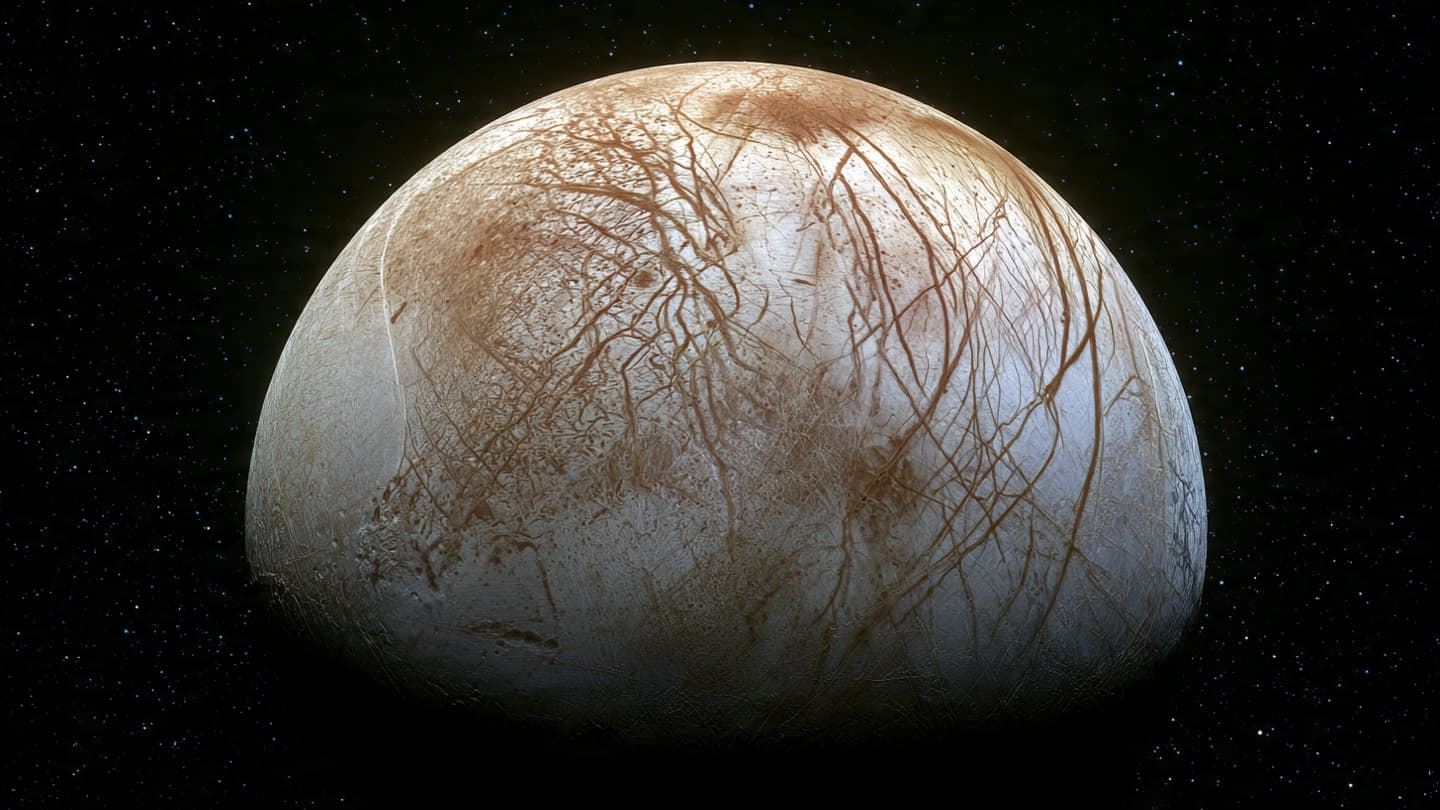
Europa’s surface is almost too clean. In a Solar System full of impactors, an icy moon should accumulate scars for billions of years — yet Europa has very few. The simplest explanation is also the strangest: the surface we see is young, constantly rewritten by forces rising from beneath the ice.
Across the Solar System, most ancient worlds wear their histories openly. Craters, ridges, and scars accumulate over immense stretches of time, preserving memories of countless collisions. Yet Jupiter's moon Europa appears curiously different, as though someone has repeatedly erased and rewritten its frozen surface.
Scientists have long recognized that Europa possesses surprisingly few impact craters. Compared with many other moons, its exterior looks remarkably youthful despite existing for billions of years within a busy and collision-filled region of space.
The most widely accepted explanation is that Europa's icy crust is continually being reshaped by internal geological activity. Beneath its frozen shell, researchers believe a vast global ocean of liquid water may exist, separated from the surface by layers of ice.
Heat generated by gravitational interactions between Europa, Jupiter, and neighboring moons likely drives this activity. The constant tidal flexing creates internal energy that may fracture, warm, and rearrange Europa's outer ice layers.
Images returned by NASA's Galileo spacecraft revealed extensive networks of cracks, ridges, and disrupted terrains known as chaos regions. These landscapes suggest that materials from beneath the surface may periodically rise upward, altering older terrain.
As new ice forms and existing structures shift, ancient impact scars can gradually disappear. This process effectively resets portions of Europa's surface, leaving scientists with evidence that many visible regions may be only tens of millions of years old.
The possibility of ongoing geological renewal has significant astrobiological implications. If exchanges occur between the subsurface ocean and the surface, materials from the hidden ocean could potentially become accessible to future exploration missions.
NASA's Europa Clipper mission, now en route to the Jovian system, is expected to provide unprecedented observations that may help determine how Europa's surface evolves and whether conditions beneath the ice could support life.
AI Image Disclaimer: Featured illustrations are AI-generated interpretations intended to visually support scientifically established concepts.
Sources: NASA, Nature Geoscience, Scientific American, Space.com
Published by Banx Network. This article is part of the Banx decentralized media programme, powered by the BXE token on the XRP Ledger.