Earth carries the memory of ancient events within its rocks. Like pages in a weathered archive, geological formations preserve traces of collisions, volcanic upheavals, and shifting continents. Occasionally, scientists revisit those records and discover that some chapters may need to be rewritten.
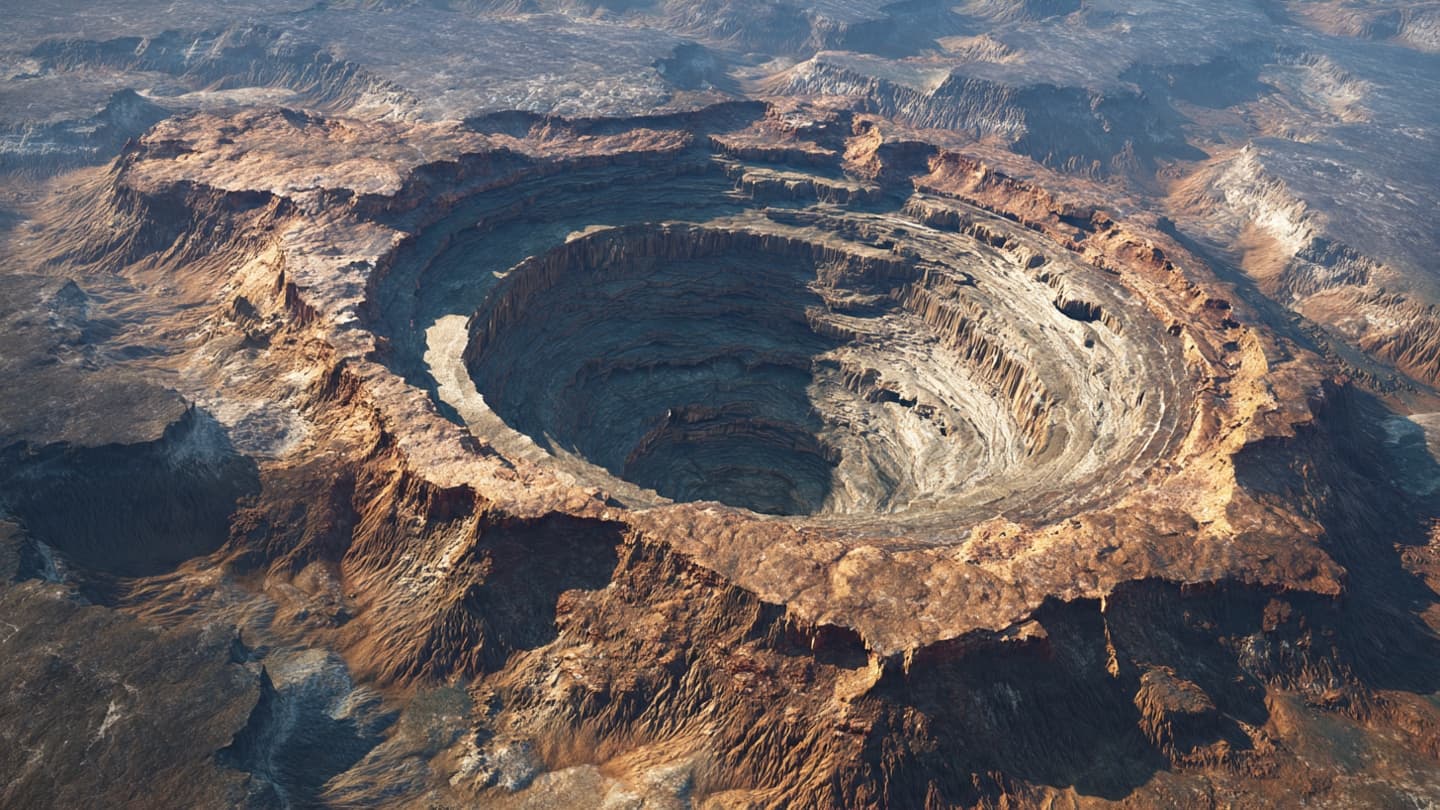
Researchers have revised estimates regarding the age of what has long been considered Earth's oldest meteorite impact crater. The updated findings suggest that the structure may be significantly younger than earlier studies had proposed.
The reassessment emerged from new geological analyses employing improved dating techniques. By examining mineral samples and isotopic signatures, scientists obtained more precise measurements of when the impact event likely occurred.
Impact craters offer valuable information about the history of the solar system and Earth's early development. During the planet's formative years, collisions with asteroids and other celestial bodies were far more common than they are today.
Determining the exact age of ancient craters is often difficult. Geological processes such as erosion, tectonic activity, and metamorphism can alter or erase evidence accumulated over billions of years, complicating efforts to reconstruct the past.
The revised age estimate does not diminish the scientific significance of the crater. Instead, researchers say it enhances understanding by providing a more accurate timeline for Earth's geological evolution.
Scientists also note that advances in analytical technology continue to transform planetary science. New methods are allowing researchers to revisit longstanding assumptions and refine interpretations of ancient geological records.
Understanding Earth's impact history has implications beyond geology. It also helps scientists compare Earth's development with that of other planets and evaluate how major impacts may have influenced the emergence and evolution of life.
As researchers continue investigating ancient rocks around the world, Earth's geological archive remains a source of both enduring knowledge and unexpected discoveries.
AI Image Disclaimer: Images associated with this report are AI-generated visual interpretations based on scientific concepts and geological research.
Sources (Source Verification Check): Live Science, Nature Geoscience, Reuters, Geological Society publications, Science News
Published by Banx Network. This article is part of the Banx decentralized media programme, powered by the BXE token on the XRP Ledger.