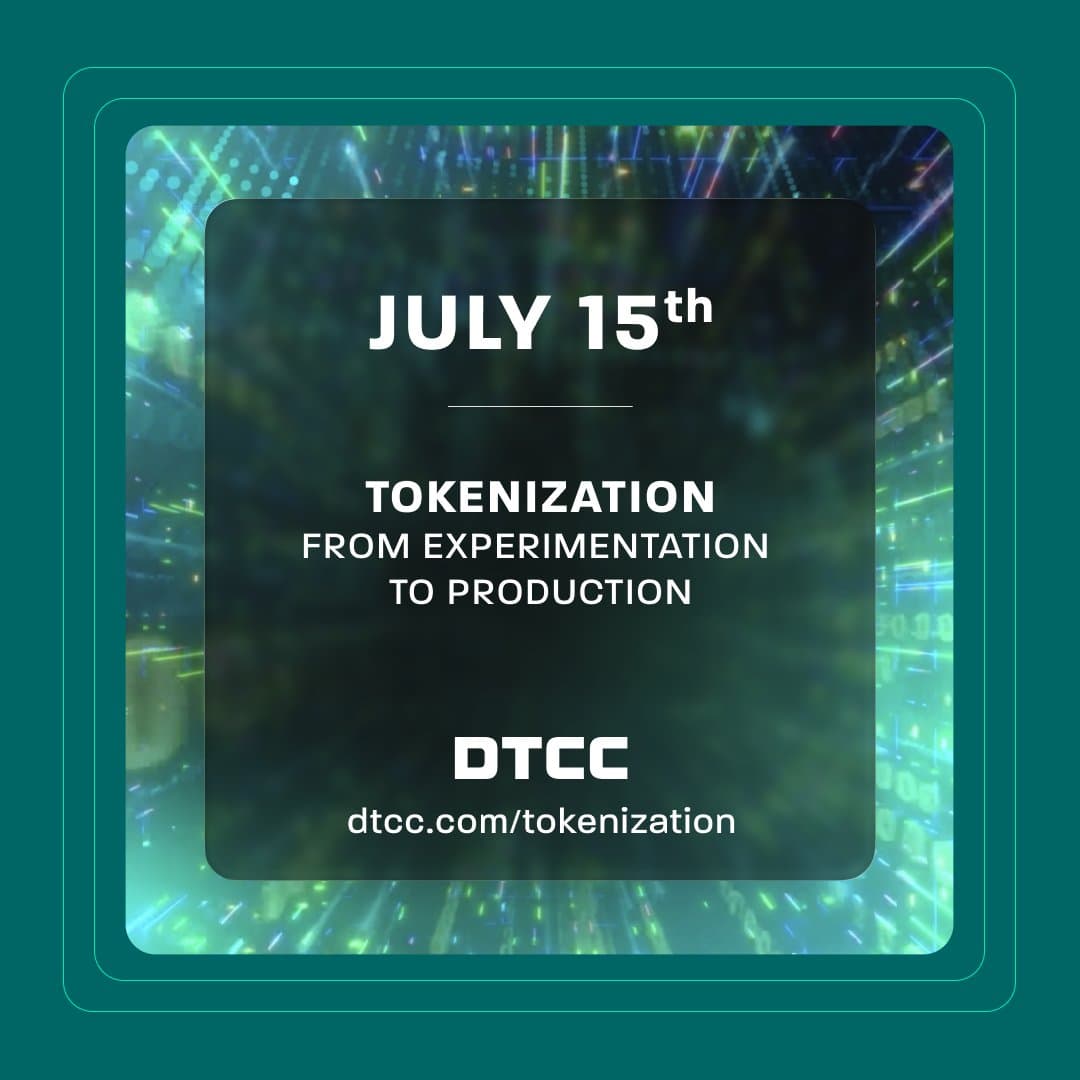
The Depository Trust & Clearing Corporation (DTCC) has announced a major tokenization-focused event scheduled for July 15 under the theme, "Tokenization: From Experimentation to Production." The message reflects one of the most important transitions currently taking place across global financial markets as institutions move beyond blockchain pilots toward large-scale commercial deployment. For years, financial organizations experimented with distributed ledger technology through limited proof-of-concept projects. These initiatives demonstrated that blockchain could improve settlement efficiency, transparency and asset management but often remained isolated from production systems. Today, that landscape is changing rapidly as banks, exchanges, clearing houses and asset managers begin integrating tokenization directly into core financial infrastructure. DTCC occupies a unique position within global capital markets. The organization processes quadrillions of dollars in securities transactions each year and serves as a critical component of post-trade market infrastructure. Because of its central role in clearing, settlement and custody, any movement by DTCC toward tokenized assets carries substantial significance for the broader financial industry. The July 15 event is expected to explore how tokenization is transitioning from experimental technology into operational financial systems capable of supporting institutional-scale trading and settlement. Industry leaders are likely to discuss regulatory developments, interoperability standards, operational readiness and the technological requirements needed for large-scale implementation. Tokenization refers to creating blockchain-based digital representations of real-world assets such as equities, bonds, real estate, commodities, investment funds and bank deposits. Once tokenized, these assets can be transferred more efficiently, settled almost instantly and managed using programmable smart contracts that automate administrative processes. Institutional interest has accelerated because tokenization offers measurable operational improvements. Near-instant settlement reduces counterparty risk, while programmable compliance can automate regulatory reporting and transaction verification. Fractional ownership expands investment accessibility, and unified digital infrastructure simplifies cross-border financial activity that traditionally involves multiple intermediaries. The industry's growing focus is no longer whether tokenization will become important but how quickly institutions can implement production-grade systems. Organizations like DTCC are working alongside commercial banks, central banks, technology providers and regulators to establish common standards that ensure interoperability between different digital asset platforms. The event also reflects increasing collaboration across financial ecosystems. Rather than building competing blockchain networks that cannot communicate, institutions are emphasizing standardized infrastructure capable of supporting multiple asset classes across jurisdictions. This approach is expected to accelerate adoption while maintaining the security, governance and reliability required by global financial markets. As regulatory clarity improves worldwide and institutional infrastructure matures, tokenization is increasingly viewed as the next evolution of capital markets instead of a niche blockchain application. Production deployments are expanding from pilot projects into real-world financial operations, supporting everything from tokenized deposits and securities to programmable payments and collateral management. DTCC's upcoming discussion underscores that the financial sector has entered a new phase where execution, interoperability and scalable implementation are replacing experimentation as the industry's primary priorities. The transition toward production could reshape how assets are issued, traded, settled and managed throughout the global financial system over the coming decade.
Published by Banx Network. This article is part of the Banx decentralized media programme, powered by the BXE token on the XRP Ledger.